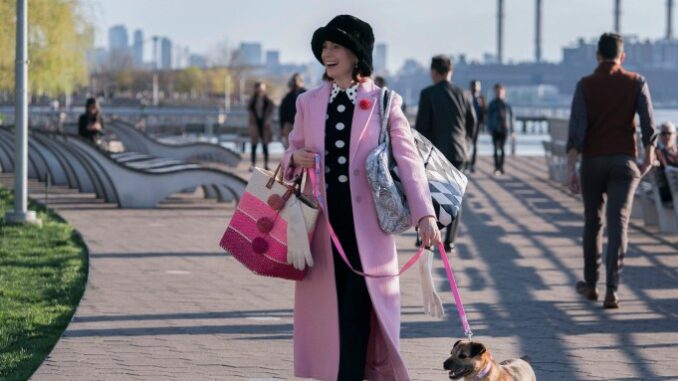
The camera, an insatiable eye, has long sought out the singular, the central, the star. Yet, for decades, it was often content to linger, with appreciative admiration, on the luminous periphery where Carrie Preston thrived. She was the architect of indelible supporting roles, the scene-stealer who could, with a tilt of her head or a perfectly timed stutter, reframe an entire narrative moment. From the quirky, brilliant legal eagle Elsbeth Tascioni, whose eccentricities masked a razor-sharp mind, to the vibrant, loyal Arlene Fowler, whose Southern charm belied a surprising steel, Preston built a career out of elevating the ensemble. She was the salt that brought out the flavour of the dish, the unexpected harmony that enriched the symphony. And now, after years of expertly navigating the currents of supporting artistry, Carrie Preston steps into the unforgiving glare of the lead role. And it comes at a price.
The first currency of this price is time, measured not just in hours on set, but in the accumulated years of waiting. For an actor of Preston’s calibre, whose talent has consistently outshone material and co-stars alike, the delayed ascent to lead status speaks to the subtle, often unseen, biases of an industry perpetually searching for the “next big thing” rather than celebrating the “already great.” Her years in the wings weren’t wasted; they were a masterclass in craft, a slow-burn accumulation of experience and nuance. But they were years nonetheless, spent witnessing others claim the spotlight she arguably deserved. The price is the quiet question that must have gnawed: When will it be my turn? And now that it is, every minute of every exhausting day is a payment for that patient endurance.
Then there is the physical and emotional toll of the lead. A supporting role allows for strategic appearances, intense bursts of energy, and then a retreat. The lead, however, is the anchor, the engine, the constant. The lines of dialogue are no longer a handful of memorable quips but reams of script, demanding relentless memorization. The character arc isn’t a subplot but the entire emotional landscape, requiring a deep, sustained dive into vulnerability and commitment, day in and day out. The 4 AM call times, the endless takes, the weight of carrying an entire production on one’s shoulders – these are not merely demands, but a relentless drain on the wellspring of an actor’s being. Preston, celebrated for her intelligence and precision, must now bring that exacting nature to every frame, every breath, every emotional beat, for hours upon end. The price is the sacrifice of personal energy, the surrender of private life to the insatiable appetite of the narrative.
Further, there’s the price of heightened vulnerability and expectation. As a supporting player, Preston was an unfailing delight, a safe bet. Her performances were consistently lauded, but the ultimate success or failure of the project rarely hinged on her alone. Now, the spotlight is singular, unforgiving. Every critical review, every viewership metric, every social media comment will, in some measure, fall upon her. The comfort of the ensemble, the shared burden, vanishes. This new price is the exposure of oneself, unshielded, to the judgment of millions. It’s the gnawing anxiety that comes with knowing that if the show falters, a significant portion of the blame will, however unfairly, land at her feet. After years of perfecting her art in the relative security of the background, she now steps onto the high wire, without a net, with the world watching.
Yet, perhaps the greatest price of all is the opportunity cost. For years, Preston could flit between projects, taking on diverse roles that enriched her range and kept her creatively stimulated. A lead role, especially in a series, demands unwavering allegiance. It consumes not just months, but potentially years of an actor’s life, precluding other opportunities, other characters, other stories. It is a commitment that, while exhilarating, can also feel like a gilded cage, limiting the very artistic freedom that made her so captivating in the first place. The price is the quiet goodbye to the myriad other roles she might have inhabited, the stories left untold because this one demanded her full, undivided devotion.
But within this calculus of cost, there lies a profound, undeniable reward. The price, in all its forms, is ultimately paid for the privilege of full creative expression. It is the artist’s hunger to paint the entire canvas, to conduct the whole orchestra, to finally tell their story from beginning to end. For Carrie Preston, a lead role is not just a job; it is a validation, a long-overdue coronation of her immense talent. It is the freedom to explore a character’s depths without interruption, to steer the narrative, to truly leave her indelible mark not just on a scene, but on an entire world.
Carrie Preston taking the lead role for the first time in years is a moment of triumph, hard-won and richly deserved. But it is a triumph steeped in sacrifice, paid for in time, energy, vulnerability, and the road not taken. The price is heavy, yet it is a price she undoubtedly pays with open eyes and a full heart, knowing that the greatest art often emerges from the deepest wells of commitment and cost. And for those of us who have long admired her brilliance from the sidelines, watching her finally command the center stage will be worth every penny.