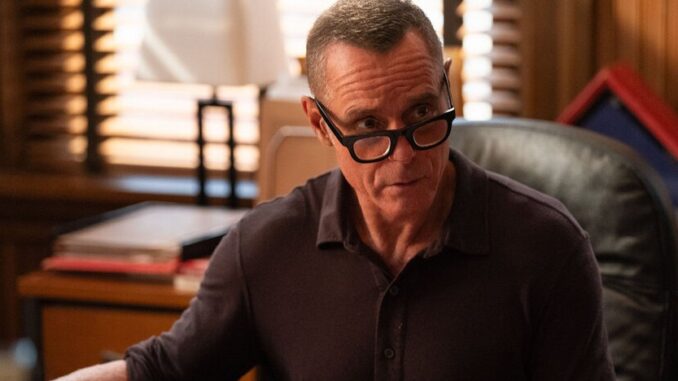
The Season 12 finale of Chicago P.D. suggested that Hank Voight (Jason Beghe) crossed one too many lines in orchestrating the cold-blood murder of corrupt Deputy Chief Reid (Shawn Hatosy), with Assistant State’s Attorney Nina Chapman (Sara Bues) all but confirming that he would be held accountable. Seven episodes into Season 13, Chapman hasn’t been heard from, and although the Intelligence Unit was disbanded for about a month, the Season 13 premiere saw Voight using blackmail to get the team reinstated.
Not only has Voight seemingly managed to evade consequences yet again, but he’s added to his long list of sins in order to achieve his goals. Again (it’s little wonder the Chicago justice system gets a bad rap). Voight exists in a vicious cycle of his own making, with his bad behaviors continually being rewarded, and, in doing so, justifying his use of them. Truthfully, he’s only ever really faced consequences once, over a troubling incident that happens in his very first appearance and the resulting escalation from it. The incident, and Voight’s first appearance in the One Chicago franchise, occurs in the Chicago Fire Season 1 episode “Professional Courtesy,” and one scene in particular from that episode proves that Voight is the undisputed villain of the franchise going forward.
‘Chicago Fire’s “Professional Courtesy” Introduces the Villainous Voight
“Professional Courtesy” sees the crew of 51 called to a car accident scene, where they find a van precariously hanging on the edge of a bridge, upside-down, with a young boy and his father inside. While they work to rescue the pair, Casey (Jesse Spencer) goes over to look at the other vehicle involved. It’s clear that the driver, who has alcohol on his breath and several open liquor containers in his car, is the one responsible, so he gives his assessment to the police officer on the scene, who agrees to book the driver. After the father and son are safely extricated and en route to the hospital, Casey returns to the other car. Only the driver and the open alcohol containers in the vehicle are gone, with the officer pointing to Detective Voight as the man who sent the driver, Voight’s son, away and picked up the cans.
Casey is faced with a dilemma: he learns that Voight is a dirty cop, and not someone to mess around with, but the boy, as a result of the accident, has been left paralyzed from the waist down. It’s only after learning from the boy’s father that the police report indicates that he is the one at fault, for having run a red light, that Casey decides to submit a proper, truthful account of the incident. He has the full support of Chief Boden (Eamonn Walker), who tells him that “leaders lead from the front.”
Voight’s True Colors Come Out in This Scene From ‘Chicago Fire’s “Professional Courtesy”
Voight, whose earlier attempt at bribery to keep Casey quiet fails, catches wind of Casey’s new report and suggests the pair get a drink and talk. They do, and the resultant scene is among the series’ best. At first, Voight appeals to Casey’s good graces: he’s a cop that’s given all he has to protect the city, making sacrifices along the way, including time with his son. “But I’m going to get him into a program,” Voight tells Casey, “You have my word.” Casey doesn’t bite, simply saying, “Good to hear.” Voight tries a different tactic, one that appeals to Casey’s mercy, saying “if” alcohol was involved, his son will serve time in the horrible conditions of Statesville. It’s the work of a master manipulator, trying to make an emotional connection with Casey that will see him recant his statement, while looking to place a seed of doubt about “if” there was ever alcohol in the first place.
Only, it doesn’t work, with Casey retorting that seeing a loved one in a spinal injury center, clinging to a fantasy that they might be able to walk again one day, is just as bad. Worse, in fact, given the whole family suffers as a result, with both parents taking time away from work to care for their child, taking on a second mortgage to try and live off of. Voight is unmoved, virtually seething at the prospect of not getting his way, and when Casey begins to openly challenge Voight’s request, Voight snaps. Making it crystal clear he’s not asking, but demanding Casey recant the statement. He threatens him, first by saying he’ll escalate the request to a higher level, then by making assertive, veiled threats, only to be stopped by the arrival of Boden.
From manipulator to monster in the blink of an eye, the scene props Voight up as the franchise’s perfect villain. He will lie, he will reason, he will threaten: the scene is a microcosm of that. There is no tool that Voight will not use to do whatever he sees as right, which in itself is chilling, a man that does these things in the pursuit of his own justice. It leaves his own people, and we, as viewers, to question if every move of his has an ulterior motive — because it so often does. Following that scene, Voight escalates the threats and even attempts to have Casey injured or killed, only to be caught and sent to prison as a result. He would serve only 6 months before being released and promoted to Sergeant of the Intelligence Unit, kicking off that crime/reward cycle that has been a part of the character ever since… and it’s not changing anytime soon.