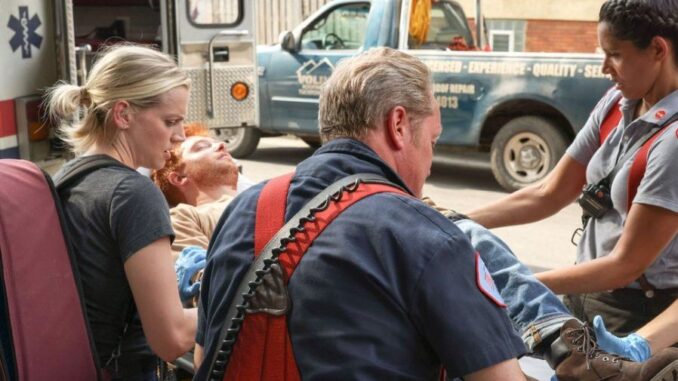
The siren’s wail, a familiar, almost comforting lament, had always been the prelude to chaos, a professional dance with destruction. When the call came in for a two-story residential on Elm Street, it seemed like just another Tuesday. Firehouse 51, a brotherhood forged in the crucible of shared danger, responded with their usual practiced efficiency. Flames licked at the windows, a hungry beast devouring timber and glass, but it was a beast they knew how to tame. Routine, or so they thought.
The first few hours were a blur of adrenaline and sweat. Hoses snaked through the acrid smoke, axes bit into charred wood, and the rhythmic pump of the engines was the steady heartbeat of their purpose. They pulled out a family of four, shaken but unharmed, a small victory in the face of the inferno. As the last embers glowed like malevolent eyes and the exhausted crew began the meticulous process of overhaul, a subtle unease began to creep in. It wasn’t just the smell of smoke; it was the metallic tang of something else, something unnatural, clinging to the air.
Arson investigators, their faces grim under the glare of portable lights, moved like ghosts through the skeletal remains of the house. They pointed to patterns on the floorboards that spoke not of random combustion, but of deliberate intent. The way the fire had traveled, too fast, too furious for an accidental blaze. Whispers of accelerants, of carefully placed ignition points, began to circulate, chilling the tired firefighters more effectively than the biting night air. What had seemed like a simple, tragic accident was mutating into something sinister.
Then came the confirmation, delivered by Captain Boden, his voice a low growl of controlled fury. The fire, meticulously analyzed, was no accident. The accelerant was uncommon, a signature, almost. And the homeowner, a man they had saved from another fire just months prior – a man whose careless actions had nearly cost lives – had been sending increasingly volatile threats to the station, to individual members of the crew, ever since his own negligence was exposed. His resentment had festered, turning a perceived injustice into a burning desire for retribution.
A collective gasp, then a cold, simmering rage, filled the bay. Firehouse 51. They were the target. Not a random building, not an anonymous victim, but the very place they called home, the sanctuary where they rested between battles, the symbol of their unwavering commitment to protect. The betrayal cut deeper than any flame could. This wasn’t just arson; it was an act of personal malice, a declaration of war against the very people who had once pulled him from the jaws of death.
The ghost of that simplicity, that naive belief in the random cruelty of fire, vanished in an instant. Every subsequent alarm suddenly carried a new, heavy weight. Every flickering shadow, every plume of smoke, was viewed through the lens of suspicion. Who else held a grudge? Who else might see their heroic efforts as an affront, their compassion as a weakness? The job, once a clear-cut fight against a tangible enemy, was now infused with the unnerving awareness of an invisible adversary, a hand reaching from the shadows.
Firehouse 51 had always stood as a beacon of safety, a fortress against chaos. But now, the walls felt thinner, the windows less secure. The fire on Elm Street hadn’t just consumed a house; it had consumed a piece of their innocence, leaving behind not just ashes, but the chilling realization that sometimes, the greatest danger comes not from the blaze itself, but from the human heart that ignites it, fueled by a terrifying, personal desire for revenge. Their fight was no longer just against fire; it was against a darker, more insidious force. And they knew, with a certainty that settled like lead in their guts, that the battle had only just begun.