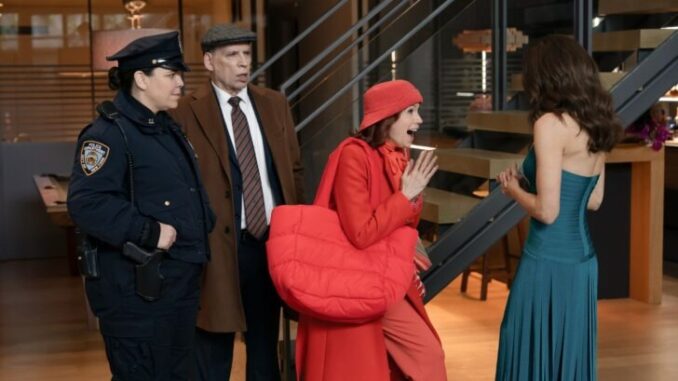
I’ve long hated the Elsbeth trope of the cops ignoring her theories even though she’s proven that she’s always right.
Elsbeth Season 3 Episode 9 could have been more of the same, considering that Elsbeth once again was the only one not jumping on the bandwagon of suspecting an innocent man was a murderer.
But this time, something clicked, and I finally understood the point of all of the cops’ denials.
The Cops On Elsbeth Season 3 Episode 9 Had Tunnel Vision
They were all so convinced that TJ was the killer that they literally could not see anything that contradicted their viewpoint.
Elsbeth again pointed out major holes in their logic, including that a killer who wanted to cover his tracks wouldn’t give them the world’s weakest alibi, but they weren’t having it, at least not at first.
Elsbeth’s argument didn’t align with what they already believed to be true, and the other models reinforced their confirmation bias, so it was easy to dismiss.
Instead of searching for the truth, the cops thought they already had it and were merely looking for the proof they needed to make an arrest.
This Type of Police Work Can Be Dangerous, And Elsbeth Shined a Humorous Light On It
In the past, I’ve been so caught up in how silly it is that Wagner and the other cops dismiss Elsbeth’s theories every week, even though they know she is usually right.
But maybe that’s the point. It certainly was this time.
TJ’s interrogation was as scary as it was annoying.
He and his lawyer tried to explain his weak alibi by telling the truth, only for it to be twisted into more proof that he was guilty.
When he explained that he had been huddled in his man-cave because he was trying to straighten out his tax situation, the cops turned that into a motive for murder: he could have used the life insurance money to cover his debt to the IRS.
In the world of television, the first person the cops question is rarely the killer, and this time, we knew it wasn’t because the murder was on-screen.
For this reason, it was extremely obvious that the cops were twisting facts to fit theories and not the other way around (where is Watson‘s Sherlock when you need him?)
It was entertaining to realize they were on the wrong track and that Elsbeth would have to prove it — that’s the point of this show.
But it was also disturbing, because in real life, people have been manipulated into false confessions or arrested on circumstantial evidence because of this kind of police work — and Elsbeth Season 3 Episode 9 made that point perfectly.
TJ’s Plight Helped Me Root For Elsbeth To Uncover The Truth…
…and so did how unlikeable the real villain was.
Elsbeth sometimes has sympathetic criminals that I almost feel bad for when they’re arrested, but not this time.
Tiff was the ultimate entitled woman.
She milked everything to try to garner sympathy and stop people from looking too hard at her.
Her earlier injury was only ever brought up in the context of the NYPD not having done anything about it, and she turned Elsbeth questioning her into some sort of anti-feminist nonsense.
Even her motive was superficial.
She and Maddie had been locked into an endless cycle of jealousy, sabotaging each other’s careers, and physical violence, and she decided to win that unwinnable game.
Some murders at least have a motive based on something other than selfishness (not that anyone should be killing anyone else).
This one featured an unlikable killer trying to frame the person the cops were insisting on investigating, who also played the victim card at every opportunity. Thank goodness Elsbeth finally found the evidence she needed to put this woman away!
What The Heck, Hackett?
While the case was fun, Hackett’s comedy routine definitely was not.
I’ve never enjoyed the type of comedy that seems mean-spirited, and her digs at her bosses were exactly that.
Plus, nothing she said was funny at all.
This part of the show seemed more like filler than anything else, though I guess Elsbeth’s feelings being hurt that she wasn’t roasted along with the others was amusing.
Beyond that, there didn’t seem to be much of a point to this subplot.
There were no repercussions for Hackett’s comments, and her set didn’t connect to anything else in the episode, so what did we need it for?
Elsbeth isn’t usually a show that needs filler, but that seemed to be what this was.