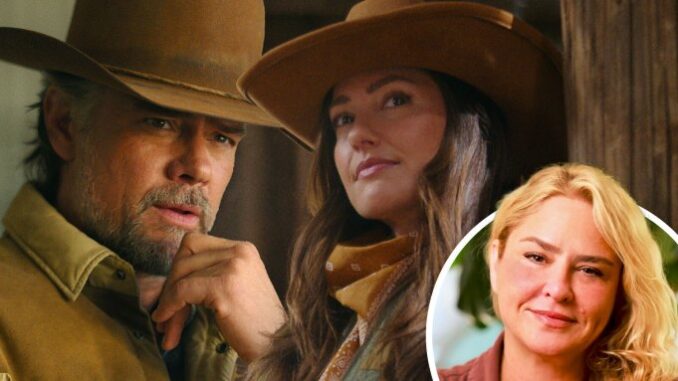
The cowboy. A figure etched into the American psyche, a silhouette against a relentless horizon, embodying a spirit of independence, grit, and an unbreakable bond with the land. For generations, he has ridden across silver screens, and now, the small screen. But as new contenders gallop onto the television landscape, the question arises: who wears the crown? In the showdown between the established titan, Yellowstone, and the promising newcomer, Ransom Canyon, we seek to determine the true king of television cowboys, not merely by the authenticity of their saddles, but by the archetypes they embody and the kingdoms they rule.
Yellowstone reigns supreme in the realm of the modern, brutalist cowboy king. John Dutton, portrayed with unyielding gravitas by Kevin Costner, is less a cowboy and more a feudal lord, his vast Montana ranch a kingdom constantly under siege. His kingship is forged in fire and blood, a relentless struggle to preserve a legacy at any cost. The cowboys of Yellowstone – Rip Wheeler, Lloyd Pierce, Ryan, Jimmy – are not merely ranch hands; they are loyal knights, bound by an unspoken code, willing to commit unspeakable acts to protect their sovereign and his dominion. Their authenticity isn’t just in their dusty boots and worn hats, but in the grime on their hands, the scars on their faces, and the raw, often violent, realism of their existence.
An illustrative scene: John Dutton, standing alone on his porch, surveying the thousands of acres that bear his name, the weight of generations in his gaze. He’s not breaking broncos; he’s breaking deals, breaking laws, breaking men. He’s a king who demands absolute fealty, an iron fist in a leather glove. The show illustrates the cowboy as a warrior, a strategist, a patriarch whose primary directive is survival and expansion, even if it means moral compromise. The king here is the one who holds the most power, wields the greatest influence, and whose very presence commands the landscape and its inhabitants. The show’s sweeping vistas, epic scores, and high-stakes drama paint a portrait of a kingship that is both aspirational in its scale and terrifying in its cost.
Enter Ransom Canyon, a new narrative promising a different kind of sovereignty, likely one rooted in the heart rather than the holster. While details are still emerging, the premise suggests a multi-generational ranching family in the titular Texas town, navigating romance, secrets, and the enduring spirit of the West. This show appears poised to champion the king of tradition, the benevolent patriarch or matriarch, whose crown is earned through unwavering integrity, community leadership, and a deep, abiding love for family and ancestral lands. The cowboys here are less likely to be involved in gunfights over land disputes and more likely to wrestle with matters of the heart, inheritance, and the changing tides of a small-town Texas community.
Imagine a scene from Ransom Canyon: a weathered cowboy, perhaps the elder statesman of the community, sitting on a porch swing, dispensing wisdom as the sun sets over the dusty fields. His strength isn’t in his ability to eliminate rivals, but in his capacity for forgiveness, his dedication to his kin, and his quiet resilience in the face of emotional storms. This king would rule not through fear, but through respect; his kingdom built on relationships, shared history, and the simple, enduring values of hard work and loyalty. The illustrative power of Ransom Canyon may lie in its portrayal of the cowboy as a romantic hero, a steadfast pillar of his community, and a guardian of a gentler, yet equally potent, way of life.
So, who is the true king? The answer, like the vastness of the Western landscape, is not singular. Yellowstone unquestionably delivers the king of power, the ruthless pragmatist who, in a modern world, fights tooth and nail for every inch of his legacy. His cowboys are extensions of his will, embodying a primal, almost mythic, loyalty. Their reign is visceral, bloody, and undeniably compelling, reflecting a darker, more complex side of the American dream.
Ransom Canyon, conversely, offers the promise of a different kind of royalty: the king of heart and heritage. If its narrative delivers on its implied promise, its cowboys will rule through virtue, community ties, and an unwavering commitment to the values that define their existence. Their reign would be quieter, perhaps more universally endearing, reminding us that true strength often lies not in what one can take, but in what one can preserve and nurture.
Ultimately, the crown remains split, depending on the kingdom one seeks. For those who crave the visceral thrill of an empire defended with an iron fist and a loaded rifle, John Dutton and the Dutton Ranch cowboys of Yellowstone are the undisputed monarchs. But for those who yearn for the comforting embrace of tradition, the enduring power of family, and the quiet dignity of a life lived with integrity under a wide Texas sky, Ransom Canyon stands ready to crown its own, equally legitimate, king of television cowboys. Both, in their own unique ways, remind us why the cowboy, in all his multifaceted glory, continues to be a sovereign force in the landscape of our imagination.