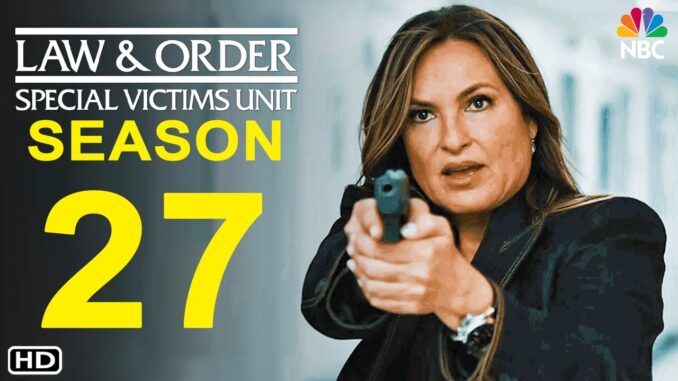
For more than two decades, Law & Order: Special Victims Unit has been one of television’s most powerful and enduring crime dramas. Known for tackling sensitive, often disturbing cases involving sexual assault and violent crimes, SVU built its reputation on gritty realism and emotional depth.
But as the series moves deeper into its later seasons, a growing number of fans are asking a difficult question:
Has SVU crossed the line between meaningful realism and emotional overload?
SVU’s Original Strength: Realism That Hit Hard
When SVU first premiered, its approach felt groundbreaking. The show didn’t just focus on crimes—it focused on victims, trauma, and the emotional aftermath often ignored by procedural TV.
At the center of this emotional core was Olivia Benson, portrayed by Mariska Hargitay. Benson wasn’t just a detective; she was an advocate, a listener, and often the emotional anchor for survivors.
Early SVU episodes balanced:
-
Investigative tension
-
Courtroom drama
-
Emotional restraint
The pain felt real—but it was controlled, purposeful, and impactful.
What Changed Over the Years?
As SVU evolved, so did its storytelling priorities. In recent seasons, the show has leaned more heavily into emotional intensity, often pushing characters—and viewers—to their limits.
Many longtime fans point to several noticeable shifts:
1. Trauma Is No Longer Occasional—It’s Constant
Nearly every episode now centers on extreme emotional distress, graphic subject matter, or deeply personal trauma involving main characters themselves.
Instead of processing pain over time, SVU often piles trauma on top of trauma.
2. Olivia Benson Carries the Emotional Weight of the Entire Show
Once part of an ensemble, Benson now absorbs:
-
Victims’ grief
-
Team conflicts
-
Institutional failures
-
Personal loss
While powerful, this constant emotional burden has led some viewers to feel emotionally exhausted rather than emotionally moved.
Emotional Overload vs. Emotional Impact
There’s a fine line between making viewers feel something and overwhelming them.
Earlier SVU episodes allowed space:
-
Silence
-
Reflection
-
Moral ambiguity
Newer episodes often escalate emotions rapidly, resolving them just as quickly, leaving little room for viewers to breathe or reflect.
For some fans, this results in:
-
Compassion fatigue
-
Reduced rewatch value
-
Emotional detachment rather than engagement
Is SVU Still Realistic—or Just Relentless?
SVU has always claimed realism as its foundation, but critics argue that modern episodes sometimes feel emotionally amplified beyond reality.
Real-life trauma is often:
-
Slow
-
Unresolved
-
Quiet
SVU’s recent storytelling, however, tends to favor:
-
High-stakes emotional confrontations
-
Repeated moral crises
-
Continuous personal suffering
This raises the question:
Does realism still work when everything feels like a breaking point?
The Cultural Shift Behind SVU’s Tone
It’s impossible to ignore how cultural changes have influenced SVU.
Under the guidance of Dick Wolf and airing on NBC, the show now actively reflects:
-
Modern conversations about trauma
-
Survivor advocacy
-
Systemic injustice
While this evolution is meaningful, it also means SVU has become emotionally heavier than ever, intentionally refusing comfort or detachment.
Fans Are Divided—and That’s the Point
Some viewers praise SVU for:
-
Refusing to sanitize trauma
-
Centering survivors’ pain
-
Making audiences uncomfortable on purpose
Others feel:
-
The emotional intensity has become repetitive
-
Subtlety has been replaced by emotional shock
-
The show no longer trusts viewers to process complexity without being pushed
Both sides raise valid points—and that tension may be exactly what SVU is designed to provoke.
So… Has SVU Crossed the Line?
The answer depends on the viewer.
If you believe television should:
-
Challenge emotional limits
-
Reflect uncomfortable truths
-
Leave viewers unsettled
Then SVU is doing exactly what it set out to do.
But if you miss:
-
Narrative balance
-
Emotional restraint
-
Procedural storytelling alongside character depth
Then it may feel like SVU has crossed from realism into emotional overload.
Final Thought
Law & Order: SVU hasn’t lost its purpose—but it has transformed its emotional language.
Whether that transformation feels powerful or exhausting depends on how much weight viewers are willing to carry alongside Olivia Benson.
💬 What do you think? Has SVU become too emotionally heavy—or is that exactly why it still matters?