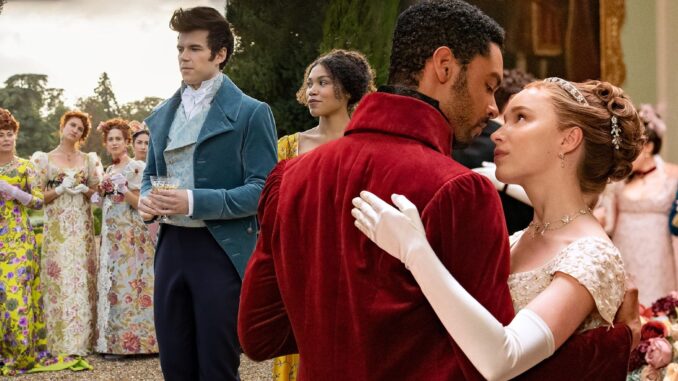
Revisiting Bridgerton Season 1 reveals Daphne’s happy ending may be performative compliance, shaped by toxic marriage and silence.
Netflix’s Bridgerton Season 1 captured audiences with its lavish costumes, witty dialogue, and steamy romance. Season 1 centers on Daphne Bridgerton (Phoebe Dynevor) and her relationship with Simon, the Duke of Hastings (Regé-Jean Page).
By the finale, it seems Daphne has everything. They have a son, their marriage seemed happy, and Simon appears to have overcome his emotional trauma. However, revisiting her story through a modern lens reveals that her happy ending may be more about performative compliance than genuine fulfillment.
The show presents her success as a romantic triumph while avoiding the deeper relational and emotional issues in her marriage.
Daphne, the Feminist Heroine Without Any Agency in Bridgerton
Daphne is presented as the diamond, the intelligent, confident girl. She was capable of navigating the complex social rules of London’s aristocracy. She can make decisions, speak boldly, and negotiate with her family and Simon. Daphne and Eloise are often celebrated as feminist heroines, although they have different desires.
In episode two, she convinces Simon to cooperate with their fake courtship, showing her assertiveness. She also challenges her brother, Anthony, when he tries to control her marriage prospects. She insists on her right to choose whom she will marry. However, it seems like much of Daphne’s agency in Season 1 is limited and performative.
Daphne’s independence is nuanced by her desire to conform to societal expectations. She wanted to marry and have children, not only for love but because society values a woman’s role, especially as the eldest daughter. Even as she exercises agency in her choices, the framework of her actions is heavily influenced by social norms.
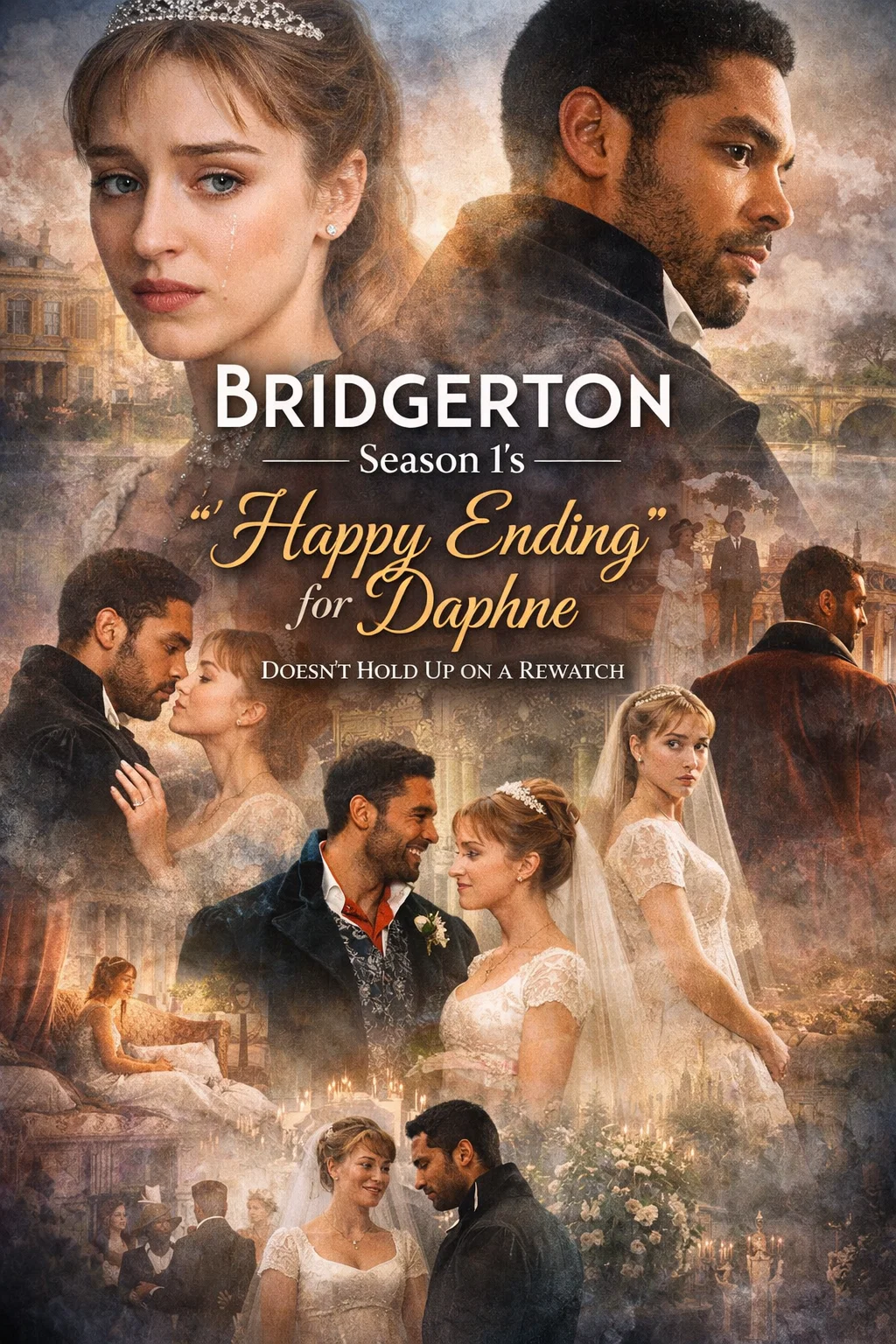
Her goals are intertwined with external approval, making her independence partial rather than complete. Scenes of her asserting independence are undermined because she relies on Simon or schemes rather than fully exercising autonomy. By the season’s end, her success is tied to the traditional markers of female achievement, a socially acceptable marriage and motherhood.
Daphne and Simon’s Marriage Has a Toxic Pattern Beneath the Surface
After marriage, Daphne’s relationship with Simon reveals deeper issues masked by the season’s romantic framing. Their relationship exposes a pattern of toxicity that the show avoids resolving. While you might agree with the term opposite attracts, their opposite outlook on life created unresolved conflicts. Simon repeatedly withholds critical information.
Simon lies to Daphne about his ability to have children, claiming he cannot, when in reality, he chooses not to. Daphne, on the other hand, constantly tried to change his mind. The most controversial moment comes in episode 6. Daphne takes the matter into her own hands, forces intimacy on Simon, and tries to get pregnant. While the show frames this as a turning point in their romantic connection, it is widely recognized as a non-consensual se*ual act.
The narrative does not explore the consequences of this act. Simon flees to the countryside, and the couple’s issues are superficially resolved by Daphne’s eventual pregnancy. In a healthy relationship, there should be healthy conversations, and the relationship should grow together. But Simon seems to step away from this, and Daphne should have pushed the other person.
While they may appear to have a happy ending, the show sidesteps significant concerns regarding boundaries, consent, and power dynamics in marriage. The show itself avoids putting Daphne on to appear and confront these dynamics in later seasons.
Daphne Bridgerton may have achieved marriage, motherhood, and social status, but her story is more complex than it seems. Her happy ending may be more about compliance than genuine empowerment.
Was Daphne’s ending truly a happy one, or is it a performance shaped by society and narrative convenience? What do you think? Let us know in the comments.
Bridgerton Seasons 1-3 are available to stream, and Season 4 Part 1 is premiering on January 29, 2026, on Netflix (US).