
In a show filled with towering personalities, explosive confrontations, and larger-than-life patriarchs, Monica Dutton has often been labeled the quiet one — the emotional center instead of the spectacle. But that assumption crumbles every time Kelsey Asbille steps into a reflective scene and turns stillness into storytelling.
One of the most striking portraits of Monica comes not from a moment of chaos, but from a moment of calm. Sitting on the wooden porch of the Dutton Ranch, wrapped in Montana’s silence and the legacy of the land beneath her, Monica isn’t just resting — she’s enduring, processing, and standing firm in a world that keeps asking too much of her. Her expression tells a story without raising a voice: the story of a woman shaped by loss, love, cultural identity, and the constant push-and-pull between survival and peace.
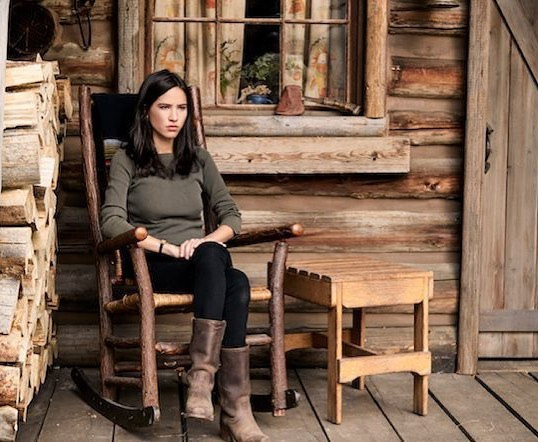
Vulnerability Isn’t Weakness on the Dutton Ranch — It’s Armor
Monica’s journey through Yellowstone has never been gentle. She has buried grief, wrestled with generational wounds, questioned her place within the Dutton empire, and carried the emotional labor of loving a man who lives half-in-shadow and half-in-violence — Kayce Dutton. Yet her vulnerability never breaks her. Instead, it hardens into resolve.
This is what makes Monica different from the rest of the ranch’s warriors. She doesn’t fight with fists, guns, or fire. She fights with presence, moral clarity, and the refusal to let pain become her identity. Fans see themselves in Monica because her strength doesn’t roar — it lingers, like the creak of a porch step or the steady rhythm of a rocking chair.
A Connection to Land That Feels Spiritual, Not Symbolic
While other characters defend the ranch as territory, Monica is one of the few who seems to feel it as heritage. Her Native American identity isn’t written into the show as a subplot — it’s interwoven into her perspective. When she sits outside that cabin, it feels less like staging and more like communion: a woman breathing with the land that both protects and burdens her.
The rustic textures around her — the woodgrain of the porch, the simplicity of the chair, the quiet openness of the sky — all echo the same thing: Monica is the human embodiment of Yellowstone’s core thesis: that legacy isn’t inherited, it’s carried.
Kelsey Asbille’s Performance Is a Slow Burn That Pays Off
Some performances demand attention immediately. Kelsey Asbille earns it over time. Every season, she has layered Monica with more emotional complexity:
-
The woman who grieves without collapsing
-
The mother who protects without needing violence
-
The wife who loves a Dutton without losing herself
-
The daughter-in-law who questions power without abandoning loyalty
And in moments of reflection like this one, Asbille delivers what the show depends on most — emotional truth.