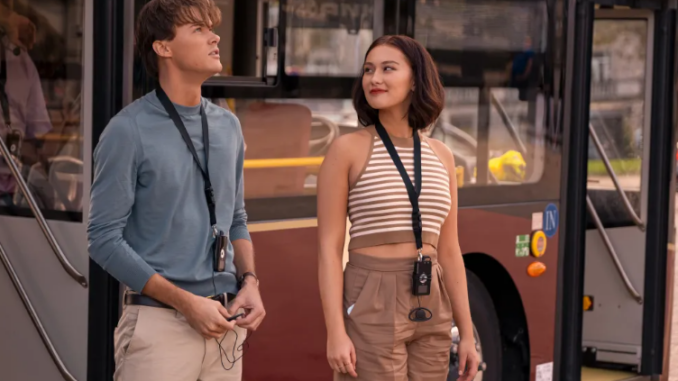
While movie theaters mostly experienced a drought of romance films in 2025, Amazon Prime Video arguably had one of the biggest blockbusters of the summer with the final season of “The Summer I Turned Pretty.” The coming-of-age series based on the novel trilogy written by Jenny Han ended as the streaming service’s top title in more than 140 countries. Whether protagonist Belly should end up with childhood crush Conrad, or his younger brother Jeremiah, even became a question asked on red carpets that had nothing to do with the project?
The achievement is an inflection point for author Han, who both created and co-ran the series based on her books. Season 3 even marked her directorial debut, with “Last Dance,” the long-awaited episode from Conrad’s perspective. Though the show has come to an end, the finale brought with it news of a cinematic conclusion to again be directed by Han, co-written with Sarah Kucserka, her “The Summer I Turned Pretty” co-showrunner for Season 2 and Season 3.
As for whether her recent ascendance to a multi-hyphenate mogul was always the plan, Han told IndieWire over Zoom, “I remember having conversations with friends about what would you do if you won the lottery and you won millions of dollars? And I said I would start my own production company and make TV and movies. But it wasn’t a goal. It was just a sort of pie in the sky wish.”
Though she had first been working on the TV series adaptation of “The Summer I Turned Pretty,” the first one of her books to be adapted into a streaming service project was the Netflix film “To All the Boys I’ve Loved Before” in 2018. While Han had enjoyed life as an author, saying “I’ve always loved storytelling and writing books and just being in the world of story,” being an executive producer on the film gave her a new perspective on how she would bring more of her books to the screen. “Being on set and filmmaking, I just really loved it, so I knew I wanted to do more,” she said.
“The important thing is really keeping what the essence of the story is,” said Han. Seeing how the “To All the Boys” film series would make changes from page to screen, the author turned showrunner would follow suit when it was her adapting her own work, creating “The Summer I Turned Pretty” TV series. “It was good for me also to be following my instincts and what I believe the audience likes about the story and trying to keep that essence.”

One of the big decisions was deciding it should be a TV show in the first place. “I don’t think that every book is meant to be a movie or TV show. Some things I think are better in their original form. So that was not on my mind as I was writing the stories,” said Han. “Many authors have that hope that one of their books would be adapted, but it’s really just to get more people to read your book. But now, because I’m screenwriting and producing and directing, the challenge is which medium is best for which story, because I have so many stories in my brain and it’s just about picking what’s what.”
With TV, “you have a lot of room to tell the story, and then you also have a lot more characters and it’s just a bigger world. It’s not so insular where you’re literally in Belly’s head exclusively in the books,” said Han. “I went into it trying to be as objective as possible in terms of what’s best for the story and how I would tell this story today, and also appreciating that it’s two different mediums.”
Though these details ultimately color the story she is telling, rather than become a core part of the story, a big change for “The Summer I Turned Pretty” was casting an Asian actress to play Belly. “I always think about story first and what I think is best going to serve the story. And when we were casting for Belly, we cast a pretty wide net. I knew she was going to be Asian, but then we were really looking at a lot of different potential Belly’s,” said the show creator. Upon seeing the audition tape from eventual series lead Lola Tung, Han said “she really just touched my heart.”
Though the author and showrunner is not so driven by stories led by a specific demographic, saying, “whatever I do, I’m thinking first about the story and what I think will serve it best,” including casting choices, it has been gratifying to see the ways in which the audience has expanded for her coming-of-age series with a diverse cast. “People of all different backgrounds tell me that they watch the show, and it really is quite a wide and diverse audience and that they feel connected to the story,” she said. “That is a great compliment to the show when people who you wouldn’t think at first blush are the target audience are watching the show.”
She adds, “It’s always important to connect with characters and stories and places that you wouldn’t necessarily think have anything to do with you, but that you could feel that kind of empathy and human connection, watching somebody and seeing we’re different, but we’re all very alike as well.”

Although, through the popularity of “The Summer I Turned Pretty,” the “To All the Boys” film franchise, and its TV series follow-up “XO, Kitty” (which she also created,) Han has become as success that transcends the young adult space, she still relies on her audience to determine what the secret sauce is for what makes her projects so well-received. “I just like to make things that I would enjoy as a reader or a viewer, so I think it’s really important as a storyteller to satisfy yourself and do things that are exciting to you, and then the audience finds you,” she said. “I like stories that feel sincere and real and from the heart. So that’s the kind of story I like to tell.”
Outside looking in, one of the contributing factors of her show’s success is the soundtrack for “The Summer I Turned Pretty,” complete with plenty of songs from music superstar Taylor Swift. Inspired by projects like Baz Luhrmann’s “Romeo + Juliet,” which she calls “one of the best ever soundtracks,” Han said, “from the get go, when I was pitching the show, I said that the music would be another character on the show and that I really the show itself to feel cross-generational and that the music would be a part of that. So it wouldn’t just be all current music, but it would be a real blend of what the parents were listening to and what the kids in the house listened to over the years, just so you could really feel that kind of layered, real existence in the house. And for that, I was well-supported by Prime Video.”
The decision to release the episodes week to week also became a contributing factor to the streaming series’ success. “You spend so much time making something you want people to really get to enjoy it and take their time with it,” said Han, complimenting the show’s weekly cadence. “It just makes it last a little longer in people’s memory as well. It just makes a more lasting impact if you live with it a bit longer.”

Finally, stemming off both the “To All the Boys” and “The Summer I Turned Pretty,” which were both published as trilogies, Han’s adapted work makes a strong case for stories that have a definitive conclusion. “I really like knowing what the end is going to be. To me, when I’m watching a movie or a TV show, I feel like I’m in really good hands with the storyteller when it feels like they know where they’re taking me,” she said. Going into her turn at the wheel, as a showrunner, Han said “I always want to be in the driver’s seat of when the story ends, because then you can’t really know where the rises and the falls and where you are in the story if you don’t know where you’re ending it. To me as a storyteller, it’s really important to have that destination in mind.”
In simpler words, “I like a beginning, middle, and end. And to me, the show has a beginning, middle, and end,” said Han. The upcoming “The Summer I Turned Pretty” film, her feature debut, is a turn of the page. “If you’ve watched the show first, then you will better enjoy the movie. But I just love romantic comedy, so I am really excited to offer something to the genre.”