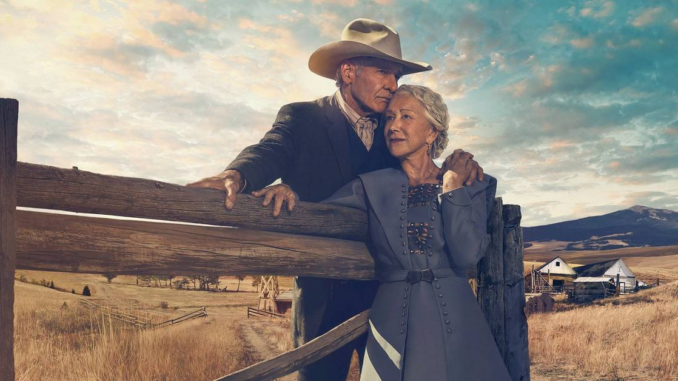
If 1883 showed how the Dutton family survived the American frontier, 1923 shows what survival eventually costs.
This Yellowstone spin-off doesn’t romanticize the West. It interrogates it.
By the time 1923 begins, the land has been claimed—but peace is nowhere to be found.
Where 1923 Fits in the Yellowstone Timeline
1923 is set several decades after 1883 and long before modern Yellowstone.
This era places the Duttons:
-
In ownership of their land
-
Under constant threat from institutions
-
At the mercy of a changing world
They are no longer pioneers. They are targets.
Why 1923 Feels So Different From 1883
While 1883 focuses on physical survival, 1923 focuses on systemic survival.
The dangers are no longer wolves or rivers—but:
-
Banks
-
Governments
-
Corporations
-
Bureaucracy
Violence still exists, but it’s calculated, not desperate.
The West Is No Longer Empty—and That Changes Everything
In 1923, the frontier has closed.
Land is now:
-
Registered
-
Taxed
-
Contested
Power shifts from the strongest gun to the strongest institution.
The Duttons must adapt—or disappear.
A Dutton Family Under Relentless Pressure
The family in 1923 isn’t expanding.
They’re defending.
Every decision feels reactive. Every move carries consequences.
This constant pressure gives the series its heavy, suffocating tone.
Why 1923 Is the Most Politically Charged Yellowstone Spin-Off
Unlike Yellowstone, which often personalizes conflict, 1923 zooms out.
It examines:
-
Colonialism
-
Capitalism
-
Cultural erasure
-
Legal manipulation
The villains aren’t just people—they’re systems.
Violence as a Tool, Not an Instinct
In 1923, violence is no longer emotional.
It’s strategic.
Characters don’t lash out—they calculate.
That shift makes the brutality colder and more disturbing.
Trauma Carries Forward in This Era
One of the most striking aspects of 1923 is how trauma lingers.
Characters don’t recover between episodes.
They don’t reset.
Pain accumulates—and shapes behavior.
This realism separates 1923 from traditional Westerns.
Why the Tone of 1923 Is So Heavy
There is very little hope in 1923.
Not because the characters are weak—
but because the world has become efficient at crushing resistance.
Optimism feels dangerous.
That darkness is intentional.
The Dutton Legacy Begins to Feel Like a Burden
For the first time, being a Dutton doesn’t feel empowering.
It feels isolating.
Legacy becomes:
-
A responsibility
-
A target
-
A trap
The land demands constant sacrifice.
Institutions as the New Antagonists
Unlike earlier eras, enemies in 1923 wear suits, not holsters.
Threats arrive as:
-
Legal notices
-
Financial pressure
-
Political leverage
This makes resistance feel almost impossible.
Why 1923 Is Slower—but More Intense
The pacing of 1923 is deliberate.
Long conversations.
Quiet dread.
Slow-building tension.
Instead of explosive action, the show relies on inevitability.
You feel the outcome approaching—even when you don’t know what it is.
Masculinity in a Changing World
1923 examines masculinity under pressure.
Old rules no longer work.
Strength alone isn’t enough.
Adaptation becomes survival.
This internal conflict drives many character decisions.
How 1923 Expands the Meaning of Yellowstone
After watching 1923, Yellowstone feels less like a power fantasy.
It feels like the final chapter of a long struggle.
Modern dominance is built on:
-
Generational trauma
-
Ethical compromise
-
Blood-stained endurance
Nothing comes free.
Is 1923 Harder to Watch Than Yellowstone?
For many viewers, yes.
Not because it’s violent—
but because it’s bleak.
There are fewer wins.
Less humor.
More consequences.
It demands patience and emotional engagement.
Why 1923 Matters in the Yellowstone Universe
This spin-off adds moral weight to the franchise.
It asks:
-
Was the land worth the cost?
-
Can legacy justify cruelty?
-
When does survival become exploitation?
These questions linger long after episodes end.
Is 1923 a Necessary Spin-Off?
Absolutely.
Without 1923, the Yellowstone story lacks context.
This series explains how power hardens—and why compassion fades.
Conclusion: 1923 Is About Endurance, Not Glory
1923 doesn’t celebrate the West.
It mourns what was lost to claim it.
By focusing on institutions, trauma, and moral erosion, the series transforms the Yellowstone universe from a family drama into a generational warning.
Survival may build empires—but it always leaves scars.
FAQs About Yellowstone Spin-Off 1923
1. Do I need to watch 1883 before 1923?
It helps emotionally, but it’s not required.
2. Is 1923 darker than Yellowstone?
Yes. Its tone is heavier and more serious.
3. What is the main theme of 1923?
The cost of progress and the violence of systems.
4. Is 1923 historically grounded?
While fictional, it reflects real social and political tensions of the era.
5. Does 1923 change how Yellowstone feels?
Yes. It reframes modern power as inherited trauma.