Get ready to return to 18th-century England with a look at the real-life world of Bridgerton
If you’re like me, you can’t get enough of the sumptuous historical settings, gorgeous clothes and steamy scenes in Netflix’s Regency-era romance Bridgerton. After busting the streaming service’s record for most-viewed show when it premiered, Bridgerton continued to smash the competition with each successive season—the third season had the biggest opening weekend in series history, with 45.1 million views.
So I’m certainly not alone in my excitement for Season 4. After a year-and-a-half hiatus (yes, it’s been that long!), the bingeable historical drama returns with a four-episode premiere on Jan. 29. The final four episodes hit Netflix on Feb. 26.
Based on a series of romance novels by Julia Quinn, the show follows the love matches of the eight siblings of the aristocratic Bridgerton family, with each season focusing on a different sibling. This time around, the Cinderella story of #Benophie (that’s Benedict and Sophie for the uninitiated) takes center stage. “Every season is different, but this season has just this beautiful quality of being an upstairs/downstairs … love story. The chemistry they have is amazing,” executive producer Shonda Rhimes said on The Jennifer Hudson Show. “This is the first season I’ve cried every time I’ve edited a certain episode. It’s emotional, and it’s romantic.”
And believe it or not, it’s based on real history. Mostly. Bridgerton‘s sets, clothes, society culture and even some characters are historically accurate. But nearly all elements are elevated to create a heightened reality: Colors are bolder, hairstyles more elaborate, balls more over-the-top. Of course, the show also takes some ideas based in reality and runs wild with them. “Part of it is storytelling as much as it’s representing history,” historian Lizzie Rogers told People.
So which parts of the show are pulled from the annals of history, and which are pure fiction? We searched the internet for the best behind-the-show true stories of Bridgerton‘s characters and the real-life history of Regency England. How well is that world reflected in the Netflix show? Let’s find out.
The Regency period is named after England’s prince regent
The Regency period in England began in 1811 with Parliament’s Regency Act, which allowed King George III’s eldest son to rule in his incapacitated father’s place. King George had suffered from mental health problems for years but finally seemed unable to rule anymore, so the Prince of Wales, then 49 years old, took over most official duties.
The prince regent became King George IV upon his father’s death in 1820, ruling until his own in 1830. Although the Regency period is often thought of as the nine brief years from 1811 to 1820, some historians count it as beginning earlier in George III’s reign (1795) and ending after the reigns of George IV and his younger brother, William IV. The death of King William IV and the accession of Queen Victoria in 1837 ushered in the Victorian period.
The “ton” is the high society of London
Although you’ll rarely come across mentions of it in the works of Jane Austen, whose stories from this era usually take place in the countryside, the ton really existed, and Bridgerton references it, well, a ton. The term—a shortening of the French le bon ton, which means good style, manners or breeding—describes the aristocrats, gentry and wealthy families, like the fictional Bridgerton siblings, who took part in the London “season.” This ran from about March to July, when Parliament was in session and many families resided in the city. The London season was when the society mamas (pronounced in the French way, with emphasis on the second syllable) tried to marry off their eligible daughters.
The rules of courting were essential to making a good match
In the Regency period, the rules of courting were very strict—and they weren’t just for show. As the good mamas of Bridgerton know, a scandal could ruin a young woman’s chaste reputation before she had a chance to marry. (Afterward, both men and women could take more liberties.) As in Bridgerton, courting couples would promenade in London’s Hyde Park and other outdoor spaces, chaperone in tow. The mamas’ role was to shepherd their daughters into society during the balls and events of the season. The goal was to make a “good match” so the women would be well cared for in a world where their options were limited. Compatibility was desirable, but it was more important that both the husband and the wife be part of the same social strata to keep money and power in the elite class.
Some characters are based on real people
The main historical figure in Bridgerton is the formidable Queen Charlotte, who really held balls and loved gossip. Her husband, King George III, was also a real person, as were her children—she had 15!—some of whom are depicted in the show. Also real: her nephew (Prince Frederich) and her brother (Adolphus).
The character of Will Mondrich was based on real boxer and gym owner Bill Richmond (notice the one-letter difference in the first name and the flipping of the surname’s syllables). Also, the real-life doctor John Monro appears in the spinoff Queen Charlotte: A Bridgerton Story. Finally, Mozart makes a memorable appearance in Queen Charlotte as well: As in the show, the real Charlotte was an early patron.

Queen Charlotte may have had African ancestors
Queen Charlotte may be connected to a branch of a Portuguese noble family descended from the Moors of North Africa, who were Black. She was also described by her physician as having a “true mulatto face.” However, most historians have long felt this is not evidence of her being Black, as any African ancestors she may have had would have been so many generations ago that it’s unlikely she would have African features.
But this is TV, so the creators of Bridgerton took the “what if” idea of a Black Queen Charlotte and ran with it, creating an alternate history in which Black people and other minorities are a major part of the upper classes.
Black people weren’t part of English society, with a few exceptions
Although Black people weren’t as integral to British society as they are in Bridgerton, there were a few illegitimate children of White slaveholders and enslaved women in the Caribbean who were brought to England and raised as members of the upper class. Most famously, Elizabeth Dido Belle was brought up alongside her white cousin, and the pair was painted together as (almost) equals, which was unusual for the time. Another illegitimate child taken to England: Nathaniel Wells, who was educated at Oxford and later owned land. Both Belle and Wells married White spouses. While fictional, Jane Austen’s unfinished novel Sanditon includes a Black heiress, so to the famous author, the idea of a Black upper-class woman wasn’t unheard of.
Of course, there were many Black people in England in the early 18th century, although most were in the working class and living in big cities, including the boxer Bill Richmond, the inspiration for Bridgerton‘s Will Mondrich.
The upper class of India sometimes mingled with the British elite
England had well-established colonial rule in India by the Regency period, and some higher-class South Asian women married British men, usually soldiers who were stationed there, and had children. One such notable woman was Catherine “Kitty” Kirkpatrick, who was born in India and sent to England as a child, then later entered English society. Another, Helene Bennett, traveled to England with her two children and their father, a French soldier. So in Season 2, when Kate Sharma moves from India to England with her mother and sister, enters society and has a hate-to-love romance with Anthony Bridgerton, there’s a historical basis for the storyline.
This season’s featured female, Sophie Baek (Yerin Ha), is a Korean woman who works for a Chinese family. Although there were some Chinese soldiers in England, there likely wouldn’t have been many Koreans. As for whether Season 4 might explain this, it’s anyone’s guess. Just remember: It’s light, frothy fiction!
Being gay was illegal
Season 4 will focus on the romance between Benedict Bridgerton (Luke Thompson) and a woman, but he’s been the most free-spirited of the siblings while enjoying a hedonistic art scene. And last season, we saw him involved with a man as well. But is that something that might have happened in Regency England? Yes, though it would’ve been a secretive affair.
Queer relationships have always existed, and they did so during the Regency period, but gay sex was illegal in England at the time. Men were more likely to be prosecuted than women, as two single women living together was acceptable. Bridgerton will explore another LGBTQ storyline this season as well: As was teased in the last episode of Season 3, Francesca Bridgerton (Hannah Dodd) develops a crush on a female character, whose name was changed from the books’ Michael to the show’s Michaela.
Some men really were rakes, although that’s become a literary trope
The word rake is used very frequently in modern-day romance novels like Bridgerton, and in the show. The word has its origins in the longer rakehell, which signified an upper-class man who was prone to pleasure-seeking behavior, including drinking and sex, yet had a charismatic and dangerous appeal. In today’s world, we might call him a “bad boy,” “womanizer,” “cad,” “scoundrel” or “playboy.”
In real life, these young men were allowed to have dalliances and indulge in bad behavior without fear of losing their reputation (unlike women of any station). This archetype began appearing in Restoration-era plays of the 17th century; today’s romance novels often use the trope of the “redeemed” rake, in which the heroine teaches a traumatized man (usually from a bad childhood or a broken heart) to learn to love again.
Queen Charlotte’s balls were elaborate social events
The first Queen Charlotte Ball was thrown in May 1780 by King George in honor of the queen’s birthday. It featured an enormous cake but also acted as a fundraiser for a hospital. What became a yearly ball marked an important time in a young woman’s life: the debutante’s coming out into society by being presented to the queen. After, she could attend the whirlwind of the season’s balls and parties—and hopefully secure a husband by her first or second season at the latest to avoid becoming a spinster (no pressure!).
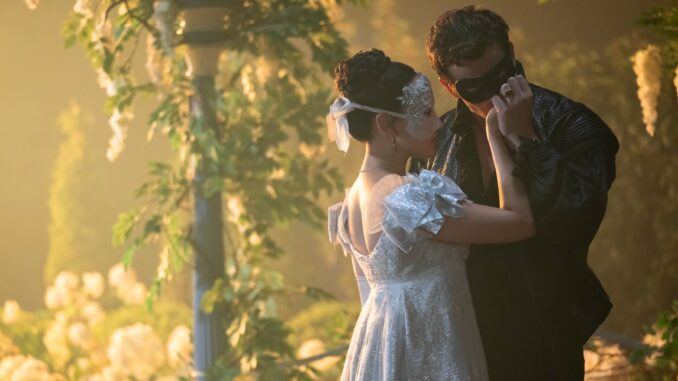
Balls in private homes were exclusive and sometimes quite elaborate, featuring luxe gowns, abundant flowers, mountains of food and entertainment that ranged from musicians to hot-air balloons, spectacular illumination, fireworks, pyrotechnics and sometimes even circus performers. So the over-the-top events we see in Bridgerton might not be far off from reality—and there were also masked balls, as we’ll see in Season 4.
Lady Whistledown is fictional, but scandal sheets are not
Even though the members of high society took unmarried women’s reputations very seriously, they still liked to be entertained with gossip and a good scandal, so the Society Papers penned by Lady Whistledown (voiced by the iconic Julie Andrews) are based on reality. The invention of steam printing in this era also meant that papers could be printed much faster and distributed to more people. Often, these OG gossip columns would include only the last initial of the person in question so as to avoid libel laws, but it didn’t take much to figure out who the blind items were really about.