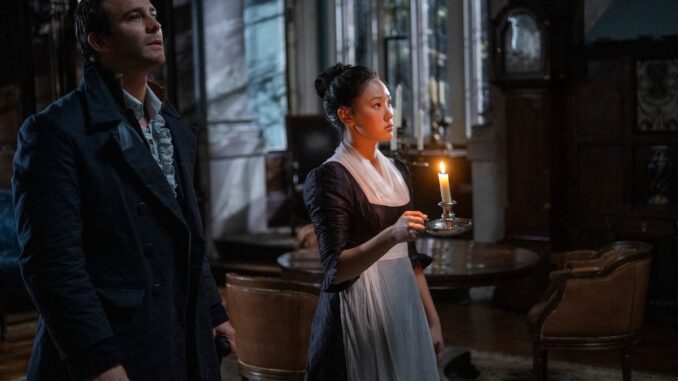
Part One of the highly anticipated fourth season premieres on Netflix this week
For Bridgerton’s Cinderella-inspired fourth season, only the most romantic location would do for the country home of second-born son Benedict. Alison Gartshore, the Emmy-nominated production designer for the Regency-era Netflix drama, found it in a private family estate in Surrey, England.
The house at Loseley Park dates back to the 1560s, when Sir William Moore had the Tudor manor built to accommodate visits from Queen Elizabeth I. As seen in the season’s third episode, an injured Benedict, played by Luke Thompson, and rescued maid Sophie (series newcomer Yerin Ha) take refuge there amongst a library that was one of the first of its time, a portrait-filled Great Hall, 2.5 acres of gardens in bloom, and a lake where Sophie can catch Mr. Bridgerton swimming naked. “It just had the most beautiful feel for Benedict. It reflected his less rigid personality, shall we say,” explains Gartshore. “It had his heart in there.”
Understandably, the More-Molyneux family, who’ve opened their doors to other shows, including The Crown and the 2024 series The Gentlemen, insisted on removing some of the manor’s most precious furnishings before it turned into Benedict’s beloved “My Cottage” for two weeks of filming. Gartshore never received an itemized list, but one would imagine the protected treasures included the rare portrait of Anne Boleyn from the drawing room—the show pays homage to it in Benedict’s bedroom—and King George IV’s coronation chair from the Great Hall.
The latter space’s famed musicians balcony, which features panels said to be painted for Henry VIII’s banquet tents and wood carvings by Grinling Gibbons, doesn’t receive screen time. Viewers, however, do see authentic family portraits on the walls of the Great Hall, including a massive 1739 painting of a couple with eight of their 11 children (a coincidental nod to Benedict and his seven siblings). As always, artwork that is too modern for Bridgerton’s early 19th-century setting has been replaced with prints selected from clearance-approved picture libraries or oil paintings commissioned with the composition and lighting of Georgian-era artists such as Sir Joshua Reynolds in mind.
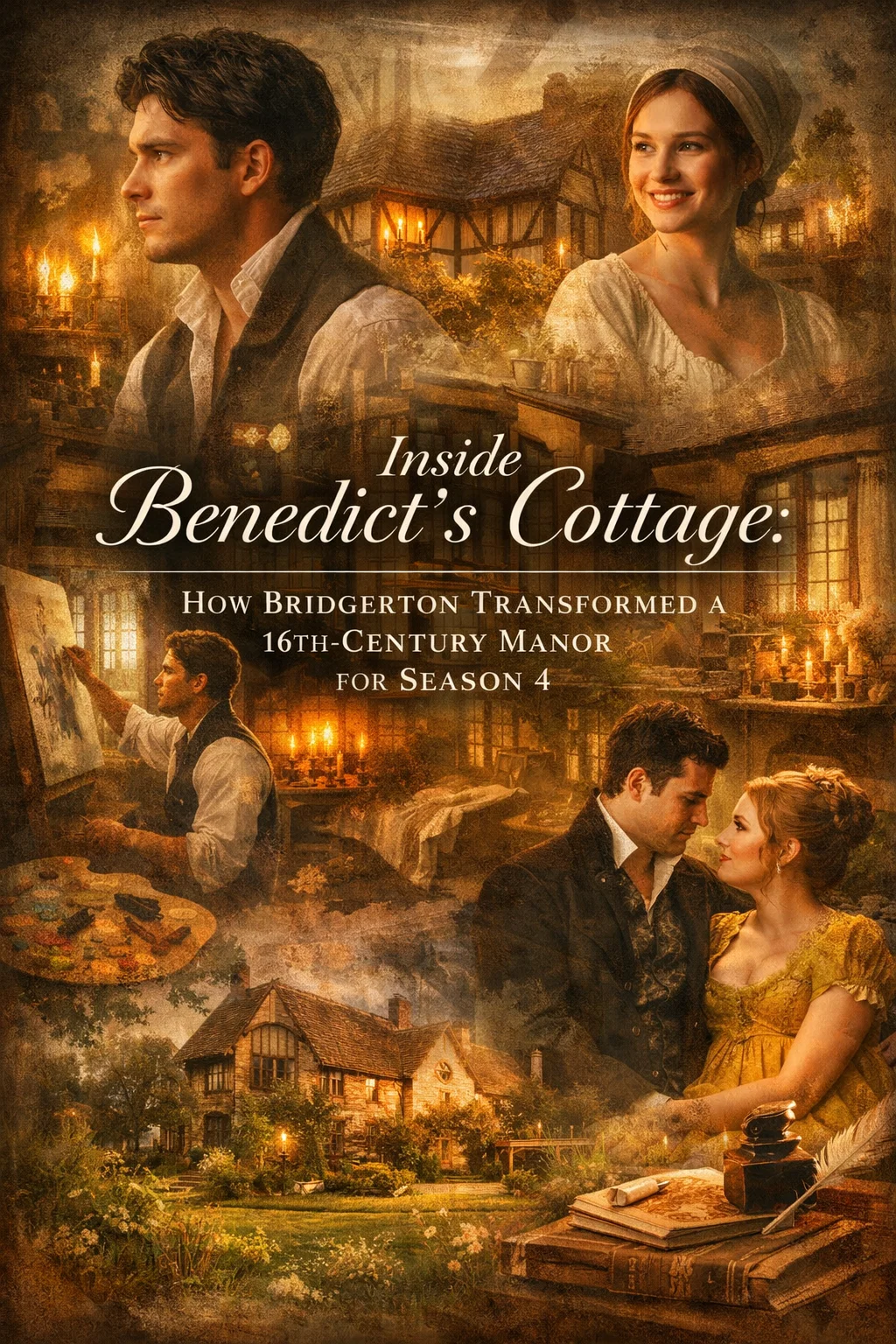
Artist Benedict stores much of his own work at “My Cottage” in the library. For one landscape Sophie describes as “unrestrained,” Gartshore and her team looked to the likes of J.M.W. Turner and Caspar David Friedrich in search of “something very atmospheric,” she says. “Free, loose, much more emotional is what we wanted.”
More precise, Gartshore notes, were the designs for lavish new royal sets built on the show’s two-acre backlot at Shepperton Studios in Middlesex, England. During previous seasons, the cast and crew would travel en masse to places like Blenheim Palace and Wilton House to film scenes involving Queen Charlotte, played by Golda Rosheuvel. “It kills the budget, it kills our time, it’s just very difficult,” says Gartshore. “So it was felt that it would be better to have a suite of rooms that was in our control on the stages, that we could turn into whatever we needed it to be.” Windsor Castle and Buckingham Palace were among the inspirations for the decadent décor as well.
In a telling sign that the set design was effective, the director of the fourth episode opted for an aerial shot of a long corridor so that an exquisite pink carpet could be properly appreciated. Like most rugs in the featured sets of Bridgerton, that one was designed by the show’s graphics department and hand-made to fit an expansive space. “There just really aren’t that scale of carpets to hire, and the colors are never particularly successful with our particular palettes, either,” says Gartshore. “So we tend to make our own.”