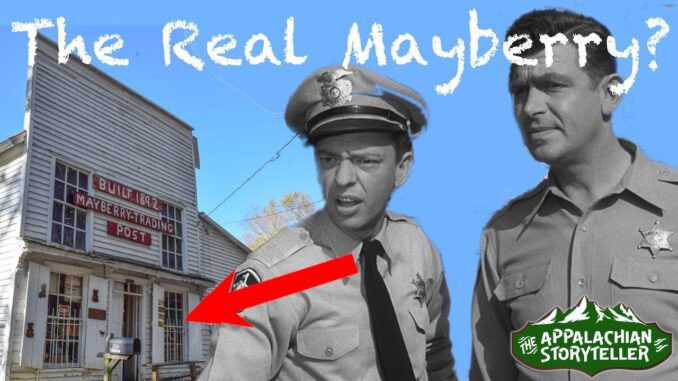
There are television towns we remember, and then there is Mayberry — a place so vivid that generations of viewers have spoken about it as if it sat somewhere off a quiet American highway. People don’t just recall episodes of The Andy Griffith Show; they remember the feeling of being there. The slow afternoons, the friendly waves, the front-porch conversations that seemed to stretch longer than time itself. Yet the truth is simple: Mayberry never existed. No map has ever marked it. No traveler has ever driven through it.
So why does it feel more real than many actual towns?
Part of the answer lies in how carefully the world was built. Unlike louder sitcoms driven by chaos and punchlines, The Andy Griffith Show moved at a gentler rhythm — one that mirrored the pace of small-town life people either knew firsthand or longed for. Nothing in Mayberry felt rushed. Problems were rarely catastrophic, conflicts rarely bitter. Instead, stories focused on everyday misunderstandings, neighborly disagreements, and the quiet lessons tucked inside ordinary days. That familiarity made the town believable. Viewers recognized the barbershop chatter, the local gossip, the sense that everyone knew everyone else’s name.
But authenticity isn’t just about scenery — it’s about emotional consistency. Mayberry operated on a clear moral atmosphere, one where patience mattered and kindness was never seen as weakness. Sheriff Andy Taylor didn’t rule with intimidation; he led with understanding. Discipline often arrived in the form of a conversation rather than a punishment. Watching Andy handle conflict felt less like observing television drama and more like remembering the guidance of a parent, a teacher, or a trusted neighbor. The town reflected an ideal many people wished their own communities could match.
There was also something quietly powerful about what Mayberry chose not to show. During a decade marked by enormous social tension and rapid cultural change, the series presented a calmer version of America — not necessarily because hardship didn’t exist, but because the show offered viewers a place to rest from it. For twenty-five minutes at a time, the world made sense. People listened to one another. Mistakes were forgiven. Life returned to balance before the credits rolled. That emotional safety created a bond stronger than realism ever could.
Memory plays a role too — even for those who never lived in a small town. Mayberry feels less like a physical location and more like a collective memory of how life should feel: connected, predictable, warm. It represents the comfort of routine and the reassurance that, no matter how complicated the outside world becomes, there can still be places guided by decency. In that way, Mayberry isn’t geography; it’s longing.
What makes this even more remarkable is the show’s restraint. It never tried too hard to convince viewers that the town was special. There were no sweeping speeches about community, no dramatic declarations about values. Instead, its charm emerged quietly through everyday behavior — a borrowed cup of sugar, an open door, a shared laugh after a misunderstanding. Over time, those small moments accumulated into something that felt undeniably real.
Perhaps that is the secret: reality on television isn’t always about accuracy. It’s about emotional truth. Viewers believed in Mayberry because they believed in the way it made them feel.
Decades later, long after the final episode aired, people still talk about the town with a surprising tenderness. Some even describe wishing they could visit it, if only for a day. That reaction says less about nostalgia for the past and more about a timeless human desire — the search for belonging.
Mayberry never needed to exist in order to matter.
Because the town was never just a setting. It was an idea — a reminder that somewhere, whether in the world or only in the heart, there can still be a place where life slows down, neighbors care, and everything is just a little bit simpler.
And maybe the reason Mayberry feels real is because, deep down, we’re all hoping a place like it could be.