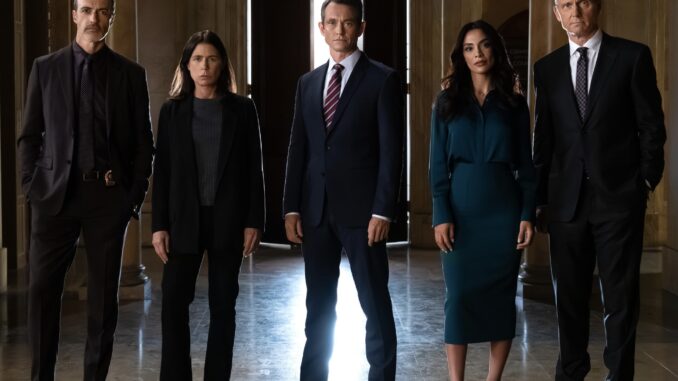
For more than two decades, Law & Order: Special Victims Unit has proven itself to be one of television’s most resilient franchises. Characters come and go, storylines evolve, and yet SVU remains emotionally grounded, culturally relevant, and fiercely loyal to its audience. So when news broke that Timothy Busfield would no longer be part of SVU, fans were left asking an unavoidable question: what will SVU look like without him?
Busfield’s involvement may not have spanned decades like Mariska Hargitay’s iconic Olivia Benson, but his presence mattered. In a series built on moral tension, power dynamics, and emotional realism, his character filled a space that wasn’t easily replaceable. His departure doesn’t just remove a familiar face—it subtly shifts the internal balance of the show.
Timothy Busfield’s Role: Quiet Authority in a Loud World
Timothy Busfield brought something rare to SVU: restraint. In a show known for emotional intensity—raw interrogations, devastating courtroom revelations, and personal trauma—Busfield’s character often served as a grounding force.
Rather than dominating scenes, he anchored them. His authority wasn’t loud or theatrical; it was measured, procedural, and deeply human. Whether delivering difficult truths, enforcing institutional limits, or acting as a counterweight to Benson’s emotional leadership, Busfield represented the system itself—flawed, cautious, and bound by rules.
That role is crucial in SVU. Without characters who embody institutional reality, the show risks drifting into pure emotional drama without friction. Busfield’s character reminded viewers that justice is never simple, and compassion often collides with bureaucracy.
Why His Absence Feels Bigger Than It Looks
On paper, Busfield’s exit might seem manageable. SVU has survived cast shake-ups before—Christopher Meloni’s exit once seemed impossible to recover from, yet the show endured. But Busfield’s departure is different.
He wasn’t the emotional heart of the series, nor the action-driven centerpiece. Instead, he operated in the margins, shaping tone rather than plot. And it’s often those characters whose absence is felt most strongly over time.
Without him, scenes that once carried quiet tension may feel sharper, faster, and more polarized. Conversations that previously unfolded with nuance may now lean toward extremes—either full emotional confrontation or rigid authority, with less space in between.
How This Changes Olivia Benson’s World
Olivia Benson has evolved tremendously over the years—from detective to captain, from survivor to symbol. Busfield’s character frequently functioned as a professional mirror to Benson’s leadership.
Where Benson leads with empathy, Busfield’s presence often reinforced caution. Where she pushes boundaries for victims, he represented the institutional lines she couldn’t always cross. Their dynamic created balance.
Without that counterpoint, Benson’s leadership may feel lonelier. The burden of decision-making becomes heavier when fewer voices challenge or temper her instincts. This could push the show to explore a more isolated, introspective Benson—one who carries even more responsibility, with fewer buffers.
For fans, that could be emotionally compelling—but also exhausting. SVU must be careful not to place all moral weight on Benson alone.
A Shift in Tone: From Institutional Drama to Personal Stakes
SVU has always walked a line between procedural realism and character-driven drama. Busfield’s character leaned the show toward the procedural side—meetings, decisions, consequences beyond the squad room.
With his exit, the series may tilt further into personal storytelling. That means more focus on emotional fallout, internal conflict, and long-term character arcs. This isn’t necessarily a bad thing—SVU excels at emotional depth—but it does change the show’s rhythm.
Episodes may feel more intense, more personal, and less restrained. The question is whether SVU can maintain credibility without voices that represent the system pushing back.
Can SVU Replace What He Represented?
Replacing Timothy Busfield isn’t about casting another actor—it’s about replacing a function.
SVU could introduce a new authority figure, but chemistry can’t be manufactured overnight. Alternatively, the show might redistribute that role among existing characters, allowing friction to arise internally rather than externally.
Another possibility is that SVU intentionally leaves that space empty. The absence itself becomes the story—highlighting how institutional support erodes, how leadership becomes isolated, and how decisions grow riskier without structural balance.
If handled carefully, this could lead to some of SVU’s most mature storytelling yet.
What Fans Are Really Worried About
Fan reactions to Busfield’s exit aren’t rooted in nostalgia alone. They reflect a deeper concern: change fatigue.
Long-running shows rely on emotional continuity. Every departure, no matter how small, chips away at the sense of familiarity. Fans worry that SVU could slowly lose the subtle textures that made it feel real—replacing them with louder drama and faster pacing.
Busfield symbolized stability. His absence raises fears that SVU may accelerate changes too quickly, sacrificing quiet complexity for shock and spectacle.
SVU Has Survived Worse—and Grown Stronger
It’s important to remember that Law & Order: SVU has faced existential crises before. Meloni’s departure, shifting network priorities, evolving social conversations—all threatened the show at different times.
And yet, SVU adapted.
In many ways, Busfield’s exit could be an opportunity. It challenges the writers to rethink power structures, refresh dynamics, and deepen character development. If SVU leans into that challenge rather than rushing to fill the void, the result could be powerful.
The Road Ahead: Risk, Reinvention, and Responsibility
Without Timothy Busfield, SVU enters a quieter but riskier era. One where authority is less evenly distributed, where emotional leadership dominates, and where institutional boundaries blur.
Whether that strengthens or weakens the show depends entirely on execution.
If SVU honors what Busfield’s character represented—restraint, accountability, and realism—while evolving its storytelling, the series can continue to thrive. But if it ignores that loss, the imbalance may show.
One thing is certain: SVU will not be the same. And for a show built on confronting uncomfortable truths, that change may be exactly the story it needs to tell.