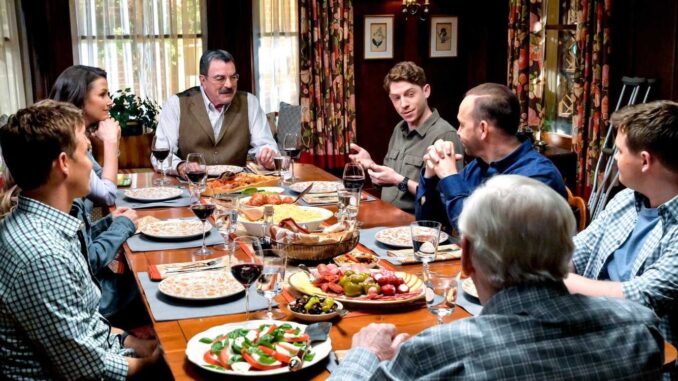
When Blue Bloods signed off after more than a decade on the air, it didn’t just close a chapter in CBS history—it ignited a firestorm of debate among its most loyal viewers. For a show built on tradition, family, and ritual, the final creative choices left many fans feeling unsettled, even betrayed. The overwhelming sentiment echoing across social media was blunt and emotional: the Reagan family deserved a better goodbye.
For 14 seasons, Blue Bloods wasn’t just another police procedural. It was a weekly ritual. Viewers tuned in not only for the cases of the week, but for the Sunday family dinners, the moral debates, and the quiet moments that defined the Reagans as more than uniforms and badges. That consistency created an unusually deep bond between the show and its audience—one that made the finale’s restraint feel, to some, like emotional withholding.
The most common criticism centers on what the finale didn’t do. There were no sweeping flashbacks, no extended farewells, no clear sense of finality for several beloved characters. For fans who had invested years watching Danny, Erin, Jamie, Frank, and the rest of the family evolve, the ending felt abrupt—almost procedural in itself. The cases wrapped up. Life went on. And suddenly, it was over.
That creative choice appears to have been intentional. Interviews and behind-the-scenes insights suggest the writers wanted to avoid melodrama, opting instead for realism. In real life, families don’t always get grand finales. Jobs continue. Conversations trail off. Sundays come and go. From a storytelling standpoint, that philosophy makes sense—but emotionally, it clashed with what many fans were hoping for after such a long journey.
Frank Reagan’s ending, in particular, became a focal point of debate. As the moral center of the series and the figurehead of the Reagan legacy, many viewers expected a moment that more clearly defined his future—retirement, reflection, or at least a symbolic passing of the torch. Instead, Frank remains largely where he’s always been: steady, principled, and unresolved. To some, that was fitting. To others, it felt like a missed opportunity to honor a character who carried the weight of the show for over a decade.
Danny Reagan’s arc also sparked mixed reactions. Fans who followed his emotional growth, his grief, and his gradual healing wanted acknowledgment—some sign that his journey had reached a meaningful point. The absence of a definitive emotional resolution left viewers feeling that Danny’s story simply paused rather than concluded.
Erin and Jamie fared no better in the court of public opinion. While their professional lives continued smoothly, fans were hoping for moments that emphasized how far they’d come—not just as a prosecutor and a cop, but as members of a family shaped by sacrifice and loss. Instead, the finale leaned heavily on normalcy, which many interpreted as underwhelming rather than comforting.
At the heart of the backlash is a simple truth: Blue Bloods trained its audience to care deeply. The show spent years reinforcing the importance of closure—at the dinner table, in the courtroom, and on the streets of New York. When the finale resisted offering that same sense of closure, it felt inconsistent with the values the series itself had championed.
That said, not all fans were disappointed. A vocal segment praised the finale for staying true to the show’s grounded tone. They argued that Blue Bloods was never about explosive endings or shocking twists. It was about duty, continuity, and the idea that the work—and the family—goes on. For these viewers, the quiet ending was not a failure, but a statement.
Still, the divide reveals something important about long-running television. When a series lasts this long, it stops belonging solely to its creators. It becomes a shared emotional space between the show and its audience. Endings, in that context, aren’t just narrative decisions—they’re emotional contracts. And for many fans, that contract felt only partially fulfilled.
The ongoing debate also explains why rumors of revivals, spinoffs, or spiritual continuations—like Boston Blue—continue to gain traction. Viewers aren’t just nostalgic; they’re seeking emotional completion. They want to believe the Reagan family’s story isn’t truly finished, just paused in a way that felt unsatisfying the first time around.
In the end, Blue Bloods leaves behind a complicated legacy. It succeeded in building one of television’s most enduring families, but stumbled—at least in the eyes of many—when it came time to say goodbye. Whether the finale was quietly brilliant or emotionally insufficient may never be universally agreed upon.
What is clear is this: the fierce reaction proves how deeply the Reagan family mattered. Fans don’t argue this passionately about shows they don’t love. And if Blue Bloods taught its audience anything over 14 seasons, it’s that family—on screen or off—deserves to be heard, even when the conversation is uncomfortable.
The era may be over, but the debate ensures one thing: the Reagans are far from forgotten.