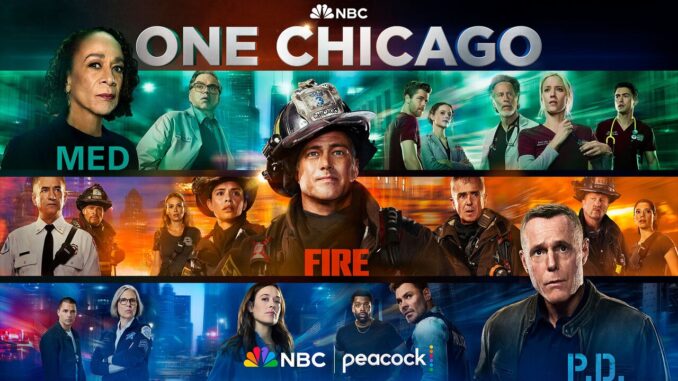
The One Chicago universe has delivered crossover events for years, but the rumored or developing 2026 crossover is being viewed very differently inside the TV industry. Rather than simply passing characters between Chicago Fire, Chicago P.D., and Chicago Med, this event is shaping up to feel more like a cinematic event—one designed to push the boundaries of what network television crossovers can actually be.
Traditionally, One Chicago crossovers have followed a “hand-off” structure. One emergency begins in one show, continues into another, and resolves in the final hour. It’s effective, familiar, and reliable. But 2026 appears to be experimenting with something bigger: a unified story that plays less like three separate episodes and more like a single, multi-hour movie broken across different series.
One reason this crossover is considered high-stakes is the shift in storytelling style. Instead of each show focusing mainly on its own characters with crossover appearances, the newer approach reportedly blends storylines more tightly. That means characters from Firehouse 51, Intelligence, and Gaffney Medical Center could share extended screen time in the same narrative threads, raising both production complexity and storytelling risk.
The cinematic comparison also comes from scale. Recent crossover planning appears to lean toward larger disaster scenarios, more location shooting, and longer action sequences. Network television budgets are usually tighter than streaming or film productions, so attempting a more cinematic look requires careful coordination between production teams, stunt crews, and post-production departments.
There’s also a scheduling gamble involved. Crossovers traditionally boost ratings, but a more serialized, movie-like crossover requires audiences to watch all parts to fully understand the story. In a fragmented viewing era—where many viewers stream selectively—this approach could either dramatically increase engagement or risk losing casual viewers who only follow one of the shows.
From a brand perspective, the experiment makes sense. Franchise universes are now competing with streaming giants that deliver large-scale, event-style storytelling. By turning crossovers into cinematic experiences, NBC keeps the One Chicago brand feeling modern and competitive without abandoning network TV structure.
Character stakes are also expected to be higher. Cinematic-style crossovers often involve long-term consequences—injuries, career changes, relationship shifts, or major leadership transitions. These types of outcomes create emotional investment that lasts beyond the crossover itself, which is key for long-running franchises.
Another major factor is fan expectation. After years of successful crossovers, audiences now expect bigger and more emotionally intense events. Simply repeating the same formula risks feeling predictable. By experimenting with structure and scale, the 2026 crossover could reset what fans expect from future franchise storytelling.
Technically, pulling off a cinematic crossover is incredibly challenging. Writers’ rooms across three shows must coordinate story beats. Production schedules must align across multiple casts. Editors must maintain visual and emotional continuity. Even small timeline errors can break immersion for longtime viewers who follow all three shows closely.
If successful, this crossover could influence how other TV universes approach shared storytelling. It could push network television closer to streaming-style event programming—longer arcs, higher stakes, and more unified narratives across multiple shows.
Ultimately, the 2026 One Chicago crossover represents more than just another shared episode event. It’s a test of whether network television can evolve its biggest franchise storytelling into something that feels closer to blockbuster event viewing—while still delivering the weekly character-driven drama fans love.