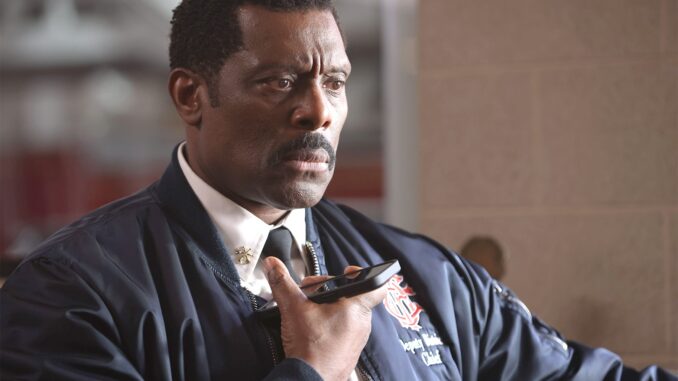
Few television actors leave a mark that feels both powerful and permanent. Eamonn Walker is one of them. Over the course of his career—most notably through his unforgettable portrayal of Chief Wallace Boden on Chicago Fire—Walker has built a legacy defined by quiet strength, emotional depth, and unwavering integrity.
Walker’s journey didn’t begin with instant stardom. Born in London, he trained rigorously in the craft of acting before steadily building a reputation through theater, British television, and eventually American drama. His early roles revealed a performer capable of intensity and subtlety in equal measure. He never relied on flash; he relied on presence.
That presence became unmistakable when he stepped into the role of Chief Boden in 2012. From the very first episode of Chicago Fire, Walker brought authority to the screen without resorting to theatrics. Boden was firm but fair, commanding yet compassionate. In a genre often dominated by explosive action and heightened drama, Walker anchored the series with emotional realism.
What made his performance extraordinary was its restraint. Walker understood that leadership is not about volume—it’s about conviction. In moments of crisis, Boden’s calm voice often carried more power than chaos. In moments of grief, a single look from Walker conveyed heartbreak more effectively than pages of dialogue.
Over the years, Chicago Fire evolved, introducing new characters and storylines. Yet Boden remained the steady center of Firehouse 51. Walker shaped the culture of that fictional firehouse through performance alone. His scenes mentoring younger firefighters, supporting Stella Kidd’s rise, or guiding Severide through professional crossroads highlighted not just the character’s wisdom, but Walker’s layered understanding of human dynamics.
Beyond the role itself, Walker’s impact carries broader significance. As a Black British actor leading a major American network drama, he expanded representation in positions of authority on screen. Chief Boden was not reduced to stereotype; he was multidimensional—strong, flawed, loving, principled. That complexity matters.
Walker’s career also reflects longevity built on craft rather than hype. From his earlier critically acclaimed role in Oz to guest appearances and stage work, he has consistently chosen projects that allow him to explore depth. He approaches characters as full human beings, not archetypes.
Perhaps most inspiring is the emotional intelligence he brings to every performance. Walker’s characters often wrestle with responsibility, morality, and the weight of leadership. He portrays courage not only as physical bravery, but as moral clarity—the ability to stand firm when values are tested.
Looking back at his journey, it becomes clear that Eamonn Walker’s brilliance lies not in spectacle, but in substance. He reminds audiences that true strength can be quiet, that authority can be compassionate, and that leadership is most powerful when it is rooted in integrity.
On the small screen, where characters come and go with changing seasons, Walker created something lasting. His work continues to resonate not just because of dramatic storylines, but because of the humanity he infused into every frame.
And that is what makes his journey truly inspiring.