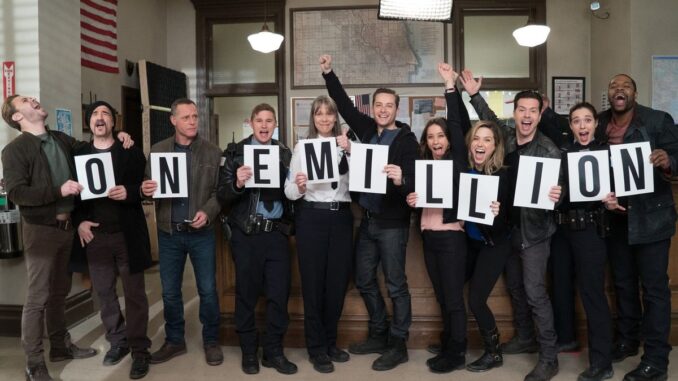
For over a decade, NBC’s One Chicago universe has been more than just a lineup of procedural dramas — it has been a weekly ritual for millions of viewers. Every episode of Chicago Fire, Chicago Med, and Chicago P.D. delivers emotional storytelling, intense emergencies, and interconnected character arcs that make fans feel like they’re part of something bigger than television.
So when all three shows suddenly disappeared from NBC’s schedule, fans noticed immediately. Social media lit up with confusion, concern, and — perhaps most of all — anticipation.
Because here’s the truth: when the One Chicago franchise steps away, it rarely comes back quietly.
And this time, all signs suggest their return could be one of the most explosive, emotional, and unforgettable moments in the franchise’s history.
Let’s break down what happened, why the shows were pulled, and why their comeback might be bigger than anything we’ve seen before.
The Night One Chicago Went Dark
NBC’s Wednesday night lineup has long been synonymous with One Chicago. For years, viewers have relied on the familiar rhythm:
-
Chicago Med opens the night
-
Chicago Fire turns up the heat
-
Chicago P.D. closes with intensity
It’s a structure that works — narratively and emotionally. Episodes often build on each other, crossovers feel seamless, and fans get a full evening of interconnected drama.
So when that lineup suddenly changed, it felt… wrong.
There was no slow transition. No major advance warning for casual viewers. One week, the shows were there. The next, they weren’t.
For longtime fans, it felt like someone had paused a heartbeat.
Why NBC Pulled the Shows From the Schedule
Despite the shock, the decision wasn’t random. Network television scheduling is a complex balancing act involving production timelines, ratings strategies, and event programming.
Several key factors likely played a role.
1. Production Delays and Episode Pacing
Large ensemble dramas like the One Chicago series are massive productions. Filming requires coordination across multiple locations, stunt sequences, hospital sets, and emergency simulations.
Even minor delays can ripple across an entire season. Networks sometimes pause broadcasts to prevent episodes from catching up too quickly to production — ensuring the season airs smoothly without long, disruptive gaps later.
2. Strategic Programming Moves
Networks don’t just schedule shows — they position them.
Pulling a hit franchise temporarily can create room for:
-
Special programming
-
Midseason premieres
-
Major television events
-
Audience reshuffling experiments
And when those flagship shows return, they often do so with maximum promotional impact.
3. Event-Level Storytelling Preparation
This is the reason fans care about most.
When multiple interconnected shows disappear at once, it often signals something big is coming — something that requires alignment across storylines, characters, and timelines.
In other words: a crossover, a major arc, or a franchise-level narrative shift.
Why This Hiatus Feels Different
Television breaks are normal. But this one feels… loaded.
Fans have noticed subtle signs that NBC may be building toward something major:
-
Intensifying character arcs before the hiatus
-
Storylines left at emotional tipping points
-
Rising tension across departments
-
Unresolved conflicts spanning multiple shows
This doesn’t feel like a pause.
It feels like a breath being held.
The Return Could Be the Biggest One Chicago Event Yet
If history has taught fans anything, it’s this: One Chicago thrives on spectacle when all three shows converge.
Past crossovers have delivered:
-
Multi-episode disaster responses
-
Citywide emergencies
-
High-stakes rescues affecting every department
-
Emotional character turning points
But the upcoming return could raise the stakes even higher.
Why the Comeback Could Be Epic
1. Narrative Momentum Is Already Built
Recent episodes across all three series have been escalating tension. Writers don’t build that kind of pressure unless something is about to release it.
2. Franchise Coordination Takes Time
Pulling three shows simultaneously suggests deep coordination behind the scenes — something only necessary for major storytelling events.
3. Fan Anticipation Is Now Sky-High
Scarcity creates excitement. The longer the wait, the bigger the impact when the shows return.
And NBC knows exactly how to use that energy.
What Kind of Story Could Bring Them Back?
NBC hasn’t revealed official details, but the One Chicago universe follows familiar patterns when building major returns.
Here are the most likely possibilities.
A Massive Multi-Agency Emergency
This is the franchise’s signature move.
Think:
-
Large-scale disasters
-
Infrastructure collapse
-
Citywide crisis response
-
Simultaneous emergencies overwhelming resources
These events naturally require Fire, Med, and P.D. to operate as one unified system — the heart of the One Chicago identity.
A Personal Story With Citywide Consequences
Sometimes the biggest crossovers begin with something intimate — a single incident that spirals outward.
An attack. A rescue gone wrong. A missing person case that expands into something much larger.
When emotional stakes drive procedural action, the franchise hits its strongest storytelling rhythm.
A Turning Point for the Entire Universe
Every long-running franchise eventually reaches moments that redefine its future.
Possible shifts could include:
-
Leadership changes across departments
-
Major character departures or arrivals
-
Structural changes in how agencies interact
-
Long-term narrative arcs that reshape the world
A synchronized hiatus is the perfect setup for a structural reset.
How Fans Are Reacting
If NBC wanted attention, they got it.
Online communities are buzzing with theories, speculation, and emotional reactions ranging from anxiety to excitement.
Some fans worry about character safety.
Some predict catastrophic disasters.
Some believe the franchise is preparing a historic crossover event.
But nearly everyone agrees on one thing:
The return can’t be ordinary.
The Power of the One Chicago Formula
The reason this hiatus matters so much is simple: no other franchise operates quite like One Chicago.
Each show stands on its own, but together they form something rare — a living, breathing television ecosystem.
Firefighters rescue victims.
Doctors fight to save them.
Detectives investigate what caused the crisis.
It’s a storytelling loop that mirrors real life — and when all three shows align, the emotional payoff is enormous.
That synergy is what makes their absence feel so noticeable… and their return so promising.
NBC’s Long-Term Strategy
From a network perspective, this move makes perfect sense.
Temporary absence can strengthen long-term engagement.
When major franchises return after a pause, they often deliver:
-
Higher ratings
-
Stronger social media engagement
-
Event-level viewership
-
Renewed fan investment
Television isn’t just about weekly episodes anymore — it’s about moments.
NBC appears to be preparing one.
What This Means for the Future of the Franchise
The One Chicago universe has already proven its longevity. But moments like this often signal evolution.
When the shows return, we may see:
-
New long-term story arcs
-
Rebalanced character dynamics
-
Expanded crossover storytelling
-
Emotional consequences that ripple through future seasons
This isn’t just about resuming episodes.
It’s about redefining momentum.
When Will Chicago Fire, Med, and P.D. Return?
NBC has confirmed they will return — and promotional hints suggest the network wants their comeback to feel like an event, not a routine continuation.
Expect:
-
Heavy marketing
-
Possible multi-episode launch
-
Interconnected premieres
-
Major narrative impact from the first moment back
When One Chicago comes back, it won’t ease in quietly.
It will arrive at full intensity.
The Wait Might Be the Point
In storytelling, tension is created not just by action — but by absence.
Right now, fans are in the narrative equivalent of silence before a storm.
And if One Chicago history is any guide, that storm is going to be unforgettable.
Final Thoughts
Yes, Chicago Fire, Chicago Med, and Chicago P.D. have been pulled from NBC’s schedule.
But this isn’t an ending.
It’s a buildup.
The pause feels deliberate. Strategic. Charged with narrative potential.
And when these shows return, they won’t just resume where they left off.
They’ll remind viewers exactly why the One Chicago universe remains one of television’s most powerful, emotionally immersive franchises.
The city may be quiet now.
But Chicago never stays quiet for long.