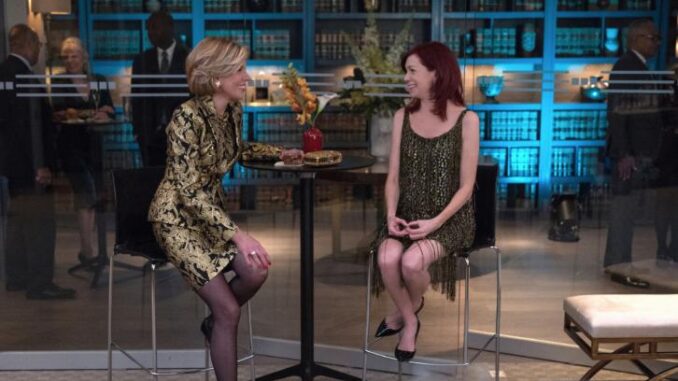
Television is no stranger to reinvention. Genres shift, tones evolve, and characters sometimes become entirely different versions of themselves in response to changing audience tastes. But every once in a while, a tonal pivot feels bold enough — or risky enough — to spark real debate. That’s exactly what’s happening with Elsbeth, a series that has increasingly leaned away from courtroom gravity and into full-blown comedic territory.
For some viewers, the shift feels natural — even inspired. For others, it raises a nagging question: is this creative evolution… or strategic repositioning? In simpler terms: is the show finding its voice, or chasing awards?
Let’s unpack what’s really happening — and why the answer might not be so simple.
From Legal Precision to Character-Driven Chaos
When Elsbeth premiered, expectations were clear. The character of Elsbeth Tascioni had already built a devoted following through her appearances in The Good Wife and The Good Fight. She was quirky, brilliant, unpredictable — but always operating within the structured seriousness of legal drama.
The spin-off initially seemed poised to maintain that DNA: smart investigations, procedural rhythm, and sharp courtroom tension. But something interesting happened along the way.
The tone loosened.
Dialogue got sharper, stranger, more playful. Situations leaned into absurdity. Emotional beats began to coexist with comedic timing rather than dramatic intensity. The show didn’t just allow humor — it began to build its identity around it.
And audiences noticed.
Comedy Was Always There — Just Not This Much
To understand whether this shift is radical or inevitable, we need to look at Elsbeth herself.
She has never been a traditional legal hero. Her brilliance has always been wrapped in eccentricity — mismatched scarves, unconventional logic, and a disarming conversational style that often throws suspects off balance before they even realize they’re being investigated.
In many ways, comedy has always been her investigative method.
What’s different now is scale.
Previously, humor functioned as contrast — a bright thread woven into serious storytelling. Now, humor often drives the storytelling. Cases are structured around personality clashes, awkward social dynamics, and comedic misdirection. The procedural elements remain, but they frequently serve as scaffolding for character-based comedy rather than dramatic stakes.
That’s not an accident. That’s design.
Why the Shift Actually Makes Creative Sense
Let’s start with the strongest argument in favor of the tonal evolution: character authenticity.
Elsbeth Tascioni has never fit comfortably inside rigid dramatic frameworks. Her brilliance works precisely because she destabilizes environments — legal, social, and emotional. A more comedic structure gives that energy room to breathe.
Instead of constantly forcing the character into traditional dramatic pacing, the show now allows her perspective to shape the world around her. That’s a major shift in storytelling philosophy:
-
Early appearances: Elsbeth adapts to the world.
-
Current series: the world adapts to Elsbeth.
That’s not dilution — that’s amplification.
Comedy, when done well, can reveal character more effectively than drama. Timing, awkwardness, miscommunication, and surprise all expose human behavior in ways that solemn dialogue sometimes can’t. By leaning into comedy, the show highlights Elsbeth’s observational genius in a more organic way.
Her insights often emerge not from intense confrontation, but from social absurdity. And that’s where comedy thrives.
The Television Landscape Is Changing — Fast
Creative intent is only part of the equation. Industry realities matter too.
Procedural dramas used to dominate network television because they were reliable. They provided comfort, familiarity, and easy entry points for casual viewers. But today’s audience environment is radically different:
-
Streaming competition fragments attention
-
Viewers crave distinctive tonal identity
-
Hybrid genres outperform traditional formats
-
Social media amplifies “shareable” moments
Comedy travels faster online than solemn courtroom dialogue. A strange one-liner, a bizarre interaction, or a perfectly timed reaction shot spreads far more easily than a carefully constructed legal argument.
In other words: humor is not just storytelling — it’s marketing.
A more comedic Elsbeth is more meme-able, more discussable, and more culturally visible. That matters in an era where relevance often depends on digital conversation as much as ratings.
The Awards Question: Coincidence or Strategy?
Now we arrive at the controversial part.
Some critics argue that the tonal pivot isn’t purely artistic — it’s strategic positioning. Awards categories, after all, are notoriously competitive. In certain years, drama fields can be packed with heavyweight prestige series, while comedy categories may offer different opportunities for recognition.
Performances that blend eccentricity, emotional intelligence, and precise comedic timing are particularly attractive to awards voters. A role that allows for both humor and subtle vulnerability can stand out more than one confined to traditional dramatic intensity.
And let’s be honest — television history is filled with shows that subtly recalibrated tone during awards campaigns.
But here’s the key question: does strategic awareness invalidate creative choice?
Not necessarily.
Television production is both art and industry. Smart positioning and authentic storytelling can coexist. A tonal shift can serve narrative growth while also making the show more competitive. These motivations are not mutually exclusive.
The Risk of Losing Dramatic Weight
Of course, not everyone is convinced the change is positive.
Some longtime viewers worry that increasing comedic emphasis reduces narrative stakes. Legal drama, at its core, often explores power, justice, morality, and consequence. When humor becomes dominant, those themes can feel softened.
There’s also the danger of tonal imbalance. If a story invites emotional investment but resolves tension through humor too quickly, audiences may feel that seriousness has been undercut.
Character credibility can also become fragile. Eccentricity works best when grounded by competence and genuine emotional awareness. If comedy overshadows those elements, the character risks becoming caricature rather than complexity.
Maintaining equilibrium is the show’s greatest ongoing challenge.
Audience Response: Surprisingly Strong
Despite skepticism from some critics, viewer reception suggests the shift is working.
Many audiences report that the lighter tone makes the show more rewatchable, more comforting, and more distinctive compared to standard procedural formats. Instead of blending into a crowded field of crime and legal dramas, Elsbeth now occupies a unique tonal space.
That differentiation matters. In a saturated content ecosystem, being recognizable is often more valuable than being conventional.
And Elsbeth herself thrives in unpredictability.
Genre Evolution Is Nothing New
Television has always experimented with tonal blending. Some of the most enduring series in history succeeded precisely because they refused strict genre boundaries.
Comedy and drama are not opposites — they are complementary storytelling tools. Human experience contains both simultaneously. The best shows recognize that emotional truth often emerges at their intersection.
What Elsbeth is doing isn’t unprecedented. It’s simply more visible because the shift happened quickly and within an already established character universe.
That makes the change feel dramatic — even if it’s part of a long tradition.
So… Genius Move or Awards Strategy?
The honest answer is: probably both — and that’s perfectly reasonable.
The tonal shift aligns with character logic. It enhances distinctiveness. It improves cultural visibility. It potentially strengthens awards positioning. And it reflects broader industry trends.
Rarely does one creative decision serve only one purpose.
Television evolves through overlapping motivations: artistic exploration, audience engagement, market strategy, and performance opportunity. When those forces converge, change becomes inevitable.
The Real Test Lies Ahead
The success of this transformation won’t ultimately be measured by ratings or nominations alone. The true test is sustainability.
Can the show maintain emotional depth while embracing comedic identity?
Can humor continue to reveal character rather than replace narrative stakes?
Can the series evolve without losing the intelligence that defined Elsbeth from the beginning?
If the answer to those questions is yes, the shift will be remembered not as strategic maneuvering — but as creative clarity.
Final Verdict
Calling the change a “desperate grab” may oversimplify what is, in reality, a sophisticated recalibration of tone, structure, and character focus.
If anything, the evolution suggests confidence rather than desperation — a willingness to lean into what makes the character truly distinctive instead of forcing her into traditional genre expectations.
Whether awards follow or not may ultimately be irrelevant.
Because if television history teaches us anything, it’s this:
Shows that fully embrace their identity rarely need to chase recognition — recognition tends to follow them.
And right now, Elsbeth seems more certain of its identity than ever.