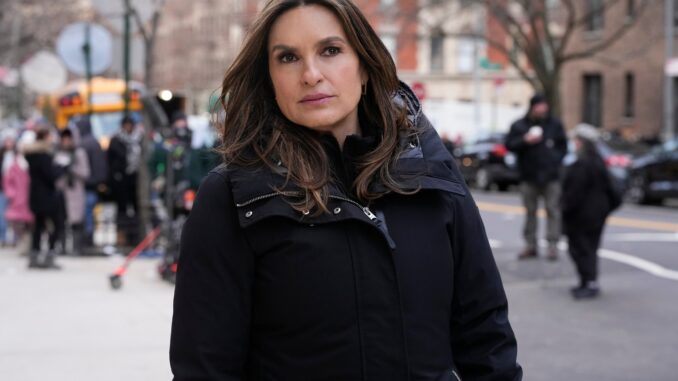
In an industry built on precision, reputation, and careful branding, even the smallest detail—like how a name is spelled—usually matters a great deal. Actors correct press outlets over typos. Agents obsess over credits. Studios triple-check billing order.
So when one of television’s most recognizable stars deliberately asks for her name to be spelled incorrectly on official production documents, it naturally raises eyebrows.
Yet that is exactly what Mariska Hargitay has reportedly requested for years on the set of Law & Order: Special Victims Unit. On call sheets—the daily production documents that list cast members, crew, schedules, and logistical details—her name appears misspelled by design.
It sounds strange. Maybe even absurd. But like many things connected to Hargitay, the story behind it reveals something far more meaningful than a quirky Hollywood superstition. It speaks to memory, identity, ritual, and the deeply human ways people cope with pressure in high-stakes environments.
Let’s unpack why one of television’s most respected actresses prefers imperfection on paper—and why that tiny “mistake” actually says a lot about her.
The High-Pressure World of Television Production
To understand why this tradition exists, you first need to understand what a call sheet represents.
A call sheet is essentially the nerve center of a television production day. It outlines everything:
-
who needs to be on set and when
-
shooting locations
-
weather forecasts
-
transportation arrangements
-
emergency contacts
-
scene breakdowns
In long-running series like Law & Order: Special Victims Unit, where filming schedules are tight and turnaround times are fast, call sheets are treated with near-sacred seriousness. A single mistake can create delays that cost thousands of dollars.
Which makes it even more interesting that one of the most important names on the document is intentionally spelled wrong.
In most professional contexts, that would be unacceptable. On this set, it’s tradition.
Not a Mistake — A Ritual
The intentional misspelling is not random. It’s deliberate, consistent, and known among the production team. It functions as a ritual—something repeated daily to create stability and continuity.
Film and television crews are famously superstitious. Many productions have traditions that outsiders might find odd:
-
Lucky wardrobe items
-
Specific pre-shoot routines
-
No whistling on set
-
Avoiding certain phrases like “good luck”
These practices help manage stress in an environment where schedules are demanding and creative stakes are high.
For Hargitay, the misspelled name operates in that same psychological space: a grounding ritual. Something small but steady in a constantly shifting work environment.
But for her, the meaning goes deeper than simple superstition.
The Power of Symbolic Imperfection
Hargitay has spent more than two decades portraying Olivia Benson, one of television’s most emotionally intense characters. The role involves confronting trauma, violence, and complex human suffering week after week.
That kind of sustained emotional performance requires resilience—and rituals can help create mental boundaries between actor and role.
The misspelling acts as a subtle symbolic reminder that perfection isn’t required to do meaningful work. The production may strive for excellence, but it begins each day by acknowledging imperfection.
In a profession where public image is carefully curated, that idea can be grounding. A tiny built-in flaw keeps the process human.
A Connection to Personal History
To truly understand why symbolism matters so much to Hargitay, it helps to consider her background.
She is the daughter of Hollywood icon Jayne Mansfield, whose life and tragic death shaped Hargitay in profound ways. Losing her mother at a young age created a lifelong awareness of vulnerability, survival, and emotional endurance—themes that mirror the work she later chose on screen.
Over the years, Hargitay has often spoken about healing, resilience, and transformation. She founded advocacy organizations, supported survivors, and turned her television role into real-world activism.
Within that framework, ritual takes on deeper meaning. Small symbolic acts can become ways of honoring continuity, memory, and presence.
The misspelled name may seem minor—but rituals tied to identity often are.
The Culture of SVU and Long-Running Bonds
When a show runs for decades, it stops being just a workplace. It becomes a shared ecosystem of habits, inside jokes, and traditions.
Law & Order: Special Victims Unit premiered in 1999 and has become one of the longest-running primetime dramas in television history. Its endurance is tied not only to storytelling but also to the stability of its core team.
Longtime collaborators—including creator Dick Wolf and co-star Christopher Meloni—helped build an environment where personal rituals could coexist with professional discipline.
Over time, the misspelled name simply became part of the show’s internal rhythm. Something that signals: we’re back again, another day, same team, same purpose.
Psychological Anchoring in High-Demand Work
From a psychological perspective, rituals serve important functions:
-
Reducing anxiety through predictability
-
Marking transitions between roles or emotional states
-
Creating a sense of control in uncertain environments
Actors often move rapidly between intense emotional experiences. Rituals provide a mental “anchor”—a signal that grounds them in reality before stepping into performance.
The call sheet misspelling may function as that anchor for Hargitay. A quiet cue that the day’s work is beginning, just as it always has.
Consistency builds safety.
Identity vs. Image in Hollywood
Hollywood is a place where identity is constantly shaped, packaged, and presented. Names are brands. Public personas are managed carefully.
Choosing to allow—or even request—an incorrect spelling subtly resists that perfectionism.
It suggests that identity is not fragile. It cannot be damaged by a typographical error. It exists independently of presentation.
That message aligns with Hargitay’s broader public philosophy: strength comes from authenticity, not control.
The Human Need for Meaningful Repetition
Anthropologists and psychologists have long noted that humans rely on ritual to create structure in daily life. From religious ceremonies to morning coffee routines, repeated actions help people feel oriented in time and space.
On a television set where schedules change, scripts evolve, and emotions run high, repetition becomes stabilizing.
The misspelled name is repetition made visible.
Why Fans Find the Story Fascinating
Stories like this capture public imagination because they reveal the hidden human layers behind polished celebrity images.
Fans see Hargitay as composed, authoritative, and emotionally powerful—qualities reflected in Olivia Benson. Learning that she maintains a small private ritual makes her feel more relatable.
It reminds audiences that even highly accomplished professionals rely on grounding habits.
A Tiny Detail That Reflects a Larger Philosophy
Ultimately, the misspelled call-sheet name is not about spelling at all.
It reflects:
-
acceptance of imperfection
-
respect for ritual
-
emotional grounding
-
continuity across decades of work
-
identity rooted in meaning rather than appearance
It is a quiet daily affirmation that excellence and humanity can coexist.
The Legacy of Consistency
Few television careers last as long or remain as influential as Hargitay’s. Her portrayal of Olivia Benson reshaped how television depicts survivors, law enforcement, and trauma.
When something endures that long, rituals become part of its architecture.
The misspelled name is a thread connecting thousands of filming days—each one building a legacy.
What It Says About Creative Longevity
Creative longevity is rarely sustained by talent alone. It depends on emotional sustainability—finding ways to keep showing up, fully present, year after year.
Rituals help maintain that continuity.
They are small acts that preserve energy, focus, and identity over time.
For Hargitay, the misspelling is not a mistake.
It is maintenance.
Final Thoughts
In a business that values polish, precision, and perfection, Mariska Hargitay’s choice to embrace an intentional error is quietly radical.
It transforms a routine administrative document into a symbol of grounding, memory, and humanity.
And perhaps that is why it endures—because behind every legendary performance is not just talent, but the small, meaningful rituals that make endurance possible.
Sometimes the things that look like mistakes are actually the structures that hold everything together.