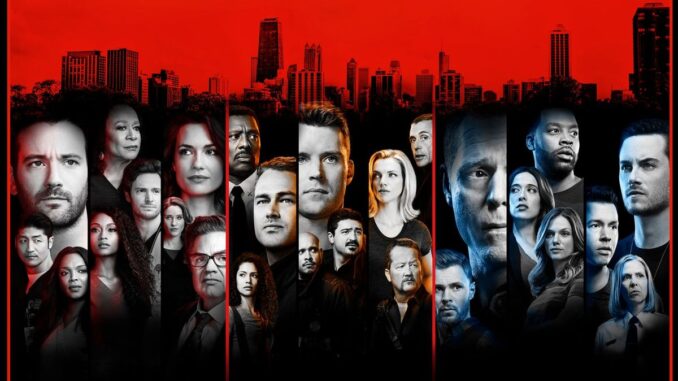
When NBC announced another crossover event within the One Chicago universe, fans expected high-stakes rescues, emotional courtroom drama, and at least one heart-stopping twist. What they didn’t expect — or maybe secretly hoped for — was the return of two of the franchise’s most beloved characters: Jay Halstead and Hailey Upton.
For longtime viewers of Chicago P.D., their reappearance wasn’t just another cameo. It was an emotional reckoning. A reminder of unfinished business. And perhaps, just maybe, the beginning of something new.
The One Chicago Universe: A Franchise Built for Crossovers
The One Chicago franchise — created by Dick Wolf — has always thrived on interconnected storytelling. With Chicago Fire, Chicago P.D., and Chicago Med operating within the same fictional universe, crossovers are more than ratings events. They are narrative earthquakes.
Characters move fluidly between firehouses, police precincts, and hospital corridors. A case that begins with a warehouse blaze on Fire might end in the interrogation room on P.D.. A gunshot victim rushed into Med could be the key witness that changes everything.
And occasionally, crossovers become vehicles for something deeper: closure, reconciliation, and resurrection.
That’s exactly what happened when Halstead and Upton stepped back into Chicago.
Why Halstead and Upton’s Return Matters
Halstead’s departure left a hole in the Intelligence Unit — professionally and emotionally. His exit was abrupt, controversial, and deeply polarizing among fans. Upton’s storyline following his departure carried visible weight: guilt, grief, and a lingering sense of abandonment.
So when news broke that both characters would appear in the crossover, speculation exploded across social media. Would this be a final goodbye? A rekindling? Or a confrontation long overdue?
The episode didn’t waste time. Halstead returned not as a nostalgic memory, but as a man changed by distance and experience. His presence in Chicago was tied to a multi-agency investigation that spiraled across Fire, Med, and P.D. — a coordinated response to a trafficking ring with tentacles throughout the city.
Professionally, Halstead slipped back into old rhythms with surprising ease. But personally? That was another story.
The Emotional Core: Halstead and Upton Face Each Other
The crossover’s most talked-about scene wasn’t an explosion or a shootout. It was a conversation.
In a quiet interrogation room, under harsh fluorescent lighting, Halstead and Upton finally confronted the silence between them. No dramatic score. No interruptions. Just two people grappling with the consequences of choices they made under pressure.
Halstead admitted he left because he felt he was losing himself. Upton admitted she felt left behind — forced to carry emotional burdens alone while maintaining her badge.
The writing struck a delicate balance. It didn’t romanticize their pain, nor did it villainize either character. Instead, it showed the messy reality of love complicated by trauma, duty, and identity.
For fans who invested seasons in their relationship, the scene felt earned.
What This Means for the Intelligence Unit
Halstead’s temporary return also rebalanced the team dynamic. His partnership with Ruzek reignited familiar banter. His tension with Voight carried unspoken history.
More importantly, his presence forced Upton to confront her own trajectory within the unit. Has she hardened too much? Has she inherited parts of Voight’s moral ambiguity? Or is she stronger now than she’s ever been?
Crossovers often focus on spectacle, but this one used the larger crisis to reflect internal change. The trafficking case became symbolic — a reminder that while Chicago’s dangers remain constant, the people fighting them evolve.
Fan Reaction: Nostalgia Meets Hope
The reaction online was immediate and intense. Longtime viewers praised the show for not treating the reunion as fan service. Instead, it felt purposeful — integrated into the larger narrative rather than tacked on for shock value.
Some fans interpreted the crossover as a soft launch for Halstead’s eventual permanent return. Others saw it as a graceful closing chapter. The ambiguity, perhaps, was intentional.
In a franchise built on resilience, few doors ever fully close.
The Power of Crossovers in Modern TV
In an era where streaming platforms dominate and shared universes are common, the One Chicago franchise remains uniquely network-driven. Crossovers serve as reminders of community — not just among characters, but among viewers who tune in week after week.
Halstead and Upton’s return exemplifies why these events still matter. They reward loyalty. They revisit emotional threads. They create momentum.
More than anything, they make the world feel alive.
Could This Be the Start of Something New?
The episode ended not with a kiss, nor a definitive breakup, but with possibility.
Halstead’s final scene showed him standing outside the district, watching the city skyline. Upton joined him. No promises. No ultimatums. Just acknowledgment.
Chicago has always been both their battleground and their home.
Whether this crossover marks a permanent reunion or simply a moment of reflection, one thing is clear: their story isn’t finished in the hearts of fans.
And in the unpredictable world of One Chicago, that may be enough.