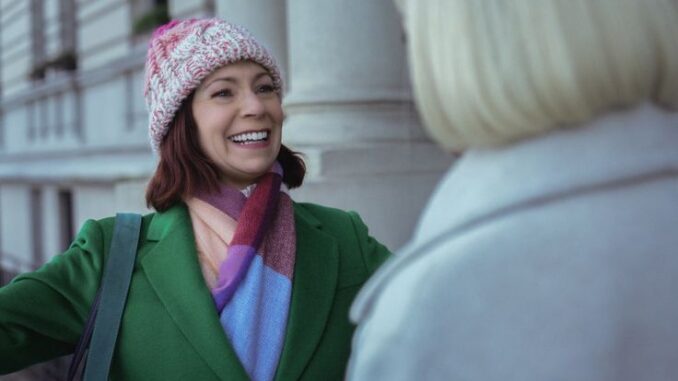
When Elsbeth premiered on CBS, few could have predicted just how quickly the quirky legal dramedy would capture the public imagination. A spinoff rooted in the universe of The Good Wife and The Good Fight, the series puts the spotlight squarely on one of television’s most delightfully eccentric legal minds: Elsbeth Tascioni.
But here’s the twist—what makes Elsbeth so addictive isn’t just her whimsical wardrobe, her scattered charm, or her razor-sharp legal brain. It’s something subtler. Something Carrie Preston herself describes as “not-so-innocent.”
In a recent press roundtable, Carrie Preston opened up about the character’s surprising complexity, revealing why audiences are connecting with Elsbeth on a deeper level than ever before.
The Evolution of an Unlikely Icon
Elsbeth Tascioni was never meant to be a conventional lead. Introduced years ago as a recurring character, she was originally the kind of scene-stealer who drifted in, dropped a few brilliant lines, and left viewers smiling in confusion and admiration.
“She was underestimated from the start,” Preston shared. “And that’s always been her secret weapon.”
In The Good Wife, Elsbeth’s seemingly distracted demeanor masked a strategic genius. She would wander into a courtroom appearing frazzled, only to dismantle an opponent’s case with surgical precision. That contradiction became her trademark.
But in Elsbeth, the writers push further. Instead of simply showcasing her brilliance, the show explores her moral gray areas, her instincts, and the calculated choices beneath the chaos.
“She’s not naïve,” Preston explained. “She lets people think she is. That’s different.”
The ‘Not-So-Innocent’ Factor
At first glance, Elsbeth appears harmless—almost childlike in her curiosity. She asks odd questions. She dresses in bright patterns. She rambles. But underneath the whimsy lies a strategic observer who notices everything.
That’s where the “not-so-innocent” dimension comes in.
According to Preston, Elsbeth understands power dynamics better than anyone in the room. She weaponizes underestimation. She leans into her perceived oddness because it gives her an advantage.
“It’s chess,” Preston joked. “She’s always five moves ahead.”
This dynamic has resonated with audiences in an era where subtle intelligence often triumphs over loud dominance. Viewers see a character who doesn’t fit traditional molds of authority, yet consistently outsmarts those who underestimate her.
A Female Lead Who Defies Archetypes
Television has no shortage of brilliant lawyers. But Elsbeth isn’t cold, ruthless, or emotionally detached. She is warm. Curious. Empathetic. Yet she is also calculating when necessary.
That blend is rare.
Rather than portraying strength through stoicism, Elsbeth celebrates emotional intelligence. She listens. She disarms. She befriends. And then—if needed—she strikes with devastating logic.
Preston emphasized that the show’s creators intentionally leaned into that complexity.
“Women on TV are often put in boxes,” she said. “Elsbeth refuses the box entirely.”
This refusal has become a cultural talking point online. Fans frequently describe her as “chaotic good with a legal degree” or “weaponized kindness.” Memes circulate weekly, highlighting her ability to appear scattered while orchestrating airtight arguments.
The Comfort of Competence
Part of Elsbeth’s popularity lies in a psychological phenomenon: viewers crave competence. In a world filled with uncertainty, watching someone who knows exactly what they’re doing—even if they pretend not to—is reassuring.
Each episode follows a semi-procedural structure, allowing audiences to experience the satisfaction of problem-solving alongside Elsbeth. The payoff is consistent: she sees what others miss.
But unlike darker crime dramas, the tone remains buoyant. The show balances intrigue with warmth, humor with moral questioning.
That tonal balance has expanded its demographic reach. Younger viewers appreciate the irony and meme-ability. Older audiences enjoy the classic procedural rhythm. Legal drama fans relish the strategic sparring.
Carrie Preston’s Creative Ownership
Preston’s long history with the character gives her a rare advantage. Having played Elsbeth for over a decade across two previous series, she brings continuity and evolution simultaneously.
In interviews, she’s hinted that stepping into the lead role allowed her to explore quieter, more introspective sides of Elsbeth—moments of doubt, calculation, even vulnerability.
“She’s always been underestimated,” Preston said. “But now we get to see how intentional that is.”
That intentionality is key. What once felt like eccentric improvisation now reads as layered performance—both from the character and the actress portraying her.
A Post-Prestige TV Appeal
We’re living in an age of antiheroes. From morally ambiguous masterminds to tortured detectives, audiences have been conditioned to expect darkness.
Elsbeth offers something different.
She is morally grounded, but not simplistic. Strategic, but not cruel. Funny, but not frivolous. That tonal middle ground feels refreshing.
The show also embraces episodic storytelling without sacrificing character development. Each case adds dimension to Elsbeth’s worldview, slowly revealing her internal compass.
And perhaps most importantly, the show trusts its audience. It doesn’t over-explain her genius. It lets viewers connect the dots.
Why the Internet Fell in Love
Social media has played a significant role in amplifying Elsbeth’s popularity. Clips of her courtroom cross-examinations regularly go viral, especially moments where she traps a suspect using seemingly unrelated small talk.
Fans often comment on how satisfying it is to watch arrogance crumble under soft-spoken persistence.
There’s also a fashion element. Elsbeth’s bold prints and layered textures have sparked think pieces and style breakdowns online. Her wardrobe reinforces her unpredictability.
But beyond aesthetics, there’s emotional resonance.
Many viewers see themselves in her outsider energy. She doesn’t conform—and she doesn’t apologize for it.
The Future of Elsbeth
As the series continues, Preston has teased deeper explorations into Elsbeth’s past and motivations. While the procedural framework remains intact, the writers appear increasingly interested in the character’s inner life.
“There’s more going on behind the smile,” Preston hinted.
That promise of depth keeps audiences invested. Elsbeth isn’t a gimmick. She’s a long-form character study wrapped in a crime procedural.
Final Verdict: Why It Works
So why is Elsbeth so popular?
Because she represents a new kind of television hero.
She proves that intelligence doesn’t have to shout. That kindness can coexist with strategy. That eccentricity can be power.
Carrie Preston’s performance anchors the show with authenticity and precision. The “not-so-innocent” layer transforms Elsbeth from comic relief into cultural symbol—a reminder that sometimes, the most underestimated person in the room is the one orchestrating the entire game.
And viewers can’t look away.