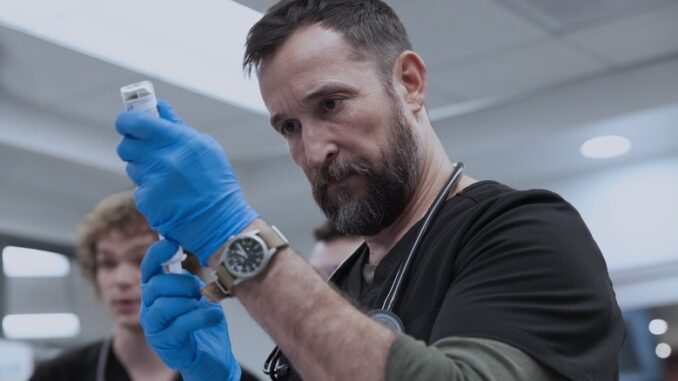
Elsbeth popped back onto our screens with one of its more out-there premises: a biohacker obsessed with longevity killing his assistant to get his hands on his assistant’s liver.
The premise relied on a couple of annoying tropes that I have had more than enough of, but that didn’t mean the episode flopped.
Despite the ridiculous premise, there were some genuinely hilarious moments, even if Elsbeth’s methods this time were on the obvious side.
Ugh, Not The Transplant = Possession Trope Again!
I don’t know why television is so obsessed with the idea of people who receive transplants turning into the person whose organ they received.
This idea is never done well, whether it’s on a serious show like Chicago Med or an unrealistic one like Days of Our Lives.
So, when Elsbeth Season 3 Episode 11 introduced some guy who broke into an organ donor bank because he believed in cellular memory, and then a group of people who all got transplants from the same donor began having the same nightmares, I physically recoiled.
This trope is bad news in the best of circumstances, and a show as silly as Elsbeth usually is didn’t stand a chance of writing it compellingly.
Reversing the Victim and the Killer Was a Nice Twist, Though
The organ donation leading to possession stuff was ridiculous, but once we entered the story, it became more interesting.
I especially liked that Tyler turned out to be the victim rather than the killer — the opening sequence made it appear like the opposite would be true.
The visual of Archer in the bed, appearing to have died, was striking — and it became the clue that broke the whole case open at the end.
Well done! Elsbeth rarely surprises me, but this twist was an exception.
Could Elsbeth Have Been Any More Obvious, Though?
After two and a half seasons, I’m used to the unrealistic way Elsbeth inserts herself into criminals’ lives to uncover the truth, but this episode was especially hard to take seriously.
In many cases, the killer implies that they are onto Elsbeth or makes a concerted effort to block her investigation. But not this time.
Elsbeth was incredibly obvious about how she signed up for the same longevity program and kept showing up at Archer’s house.
For a supposedly brilliant villain, he certainly was oblivious! Or, at the very least, not nearly as clever as he thought he was.

I’m Also Not a Huge Fan of Biohacking Plots…
TV often whips out the type of biohacker who is desperate to live forever, and for some reason, those plots rub me the wrong way.
I think what irks me is that it’s always exaggerated — people either have bizarre surgeries (like on Watson) or they are so obsessed with wellness that they don’t allow themselves to have any quality of life.
I’m sure people like that exist, but it always feels like the writers are mocking anyone who is interested in pursuing a healthy lifestyle for greater longevity.
Elsbeth was no exception to this problem.
Archer planned his life down to the minute for greater longevity, lived on wellness shakes, and killed Tyler because he wanted a perfect liver, not one that had been affected by actual living.
Nobody could stand him for long, and everyone who worked for him eventually quit.
In short, he was a walking stereotype of the obsessed and egocentric biohacker.
Elsbeth’s attempts to emulate him for her research were hilarious, though.
I couldn’t stop laughing when she was jogging in place in Captain Wagner’s office in order to get her steps in. It’s a credit to her co-workers that they’re used to her eccentricity and weren’t distracted by her exercise routine.
About Those Subplots…
I’m not happy with the suggestion that Marissa has become corrupt.
She was always my favorite character on The Good Wife, and I was excited about her visiting Elsbeth.
Maybe I’m remembering wrong, since there were a lot of corrupt politicians and lawyers on The Good Wife, but it seems out of character for Marissa to manipulate situations to cover up a politician’s lies.
I haven’t been all that interested in the Alec Bloom subplot, anyhow, though Teddy being thrown off the story about Bloom and Elsbeth having to choose between him and her new boyfriends is potentially interesting.
The Wagner/Julia subplot has potential, though.
I’ve been interested since Julia’s introduction in why things are tense between her and her dad, and whether they’ll ever repair their relationship.
I could do without Rivers or Wagner threatening him if he hurts his daughter, but if we take that out of the equation, Wagner’s struggles to establish a healthy relationship with his daughter are compelling.