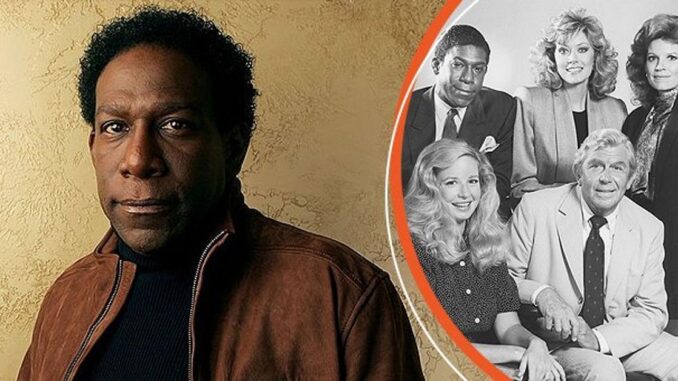
For a generation of television viewers, Kene Holliday was more than just a supporting actor on a hit legal drama — he was the heart of the office. As Tyler Hudson on Matlock, Holliday brought warmth, humor, and humanity to a series often driven by courtroom theatrics and Southern charm.
Then, seemingly overnight, he was gone.
So… whatever happened to Matlock’s Kene Holliday?
Let’s take a closer look at the rise, disappearance, and quiet reinvention of one of 1980s television’s most memorable co-stars.
The Breakout Role That Changed Everything
When Matlock premiered in 1986, it quickly became one of network television’s most reliable hits. Anchored by Andy Griffith as the folksy but razor-sharp defense attorney Ben Matlock, the show thrived on its comforting formula: wrongful accusation, clever cross-examination, last-minute revelation.
But what made the show feel alive was the chemistry inside Matlock’s office.
Enter Kene Holliday as Tyler Hudson — Matlock’s first private investigator. Tyler wasn’t just there to chase down suspects. He was charismatic, stylish, quick-witted, and refreshingly modern compared to Matlock’s old-school demeanor. Their dynamic added texture and humor that elevated the series beyond a standard procedural.
For many viewers, Tyler Hudson was essential.
Which made his sudden absence all the more noticeable.
The Sudden Exit: Rumors and Reality
Holliday left Matlock during its third season. At the time, the official explanation was vague. Industry chatter suggested “creative differences.” Some insiders whispered about scheduling conflicts. Others speculated that producers wanted to “refresh” the supporting cast.
Years later, Holliday spoke candidly in interviews about battling substance abuse during that period of his life — something he has since openly discussed as part of his recovery journey. It was not a scandal in the tabloid sense, nor was it accompanied by public drama. But behind the scenes, the pressure of a hit show combined with personal struggles created a turning point.
Unlike many Hollywood departures, there was no explosive headline. No public feud. No lawsuit.
Just a quiet exit.
Life After Prime Time
After leaving Matlock, Holliday didn’t vanish — he pivoted.
He made guest appearances on several television series throughout the late 1980s and early 1990s, including roles in In the Heat of the Night and Diagnosis: Murder. While these appearances were well-received, they didn’t recapture the long-term visibility of Matlock.
Instead of chasing fame, Holliday made a decision that surprised many in Hollywood circles: he stepped back.
Friends and colleagues have described this era as one of recalibration rather than retreat. Holliday reportedly focused on faith, family, and recovery. He became involved in ministry work and community outreach programs, often speaking about resilience and second chances.
For someone once at the center of a major CBS hit, it was a dramatically different spotlight — quieter, more personal, but arguably more meaningful.
The Actor Beneath the Role
It’s easy to forget that before Matlock, Holliday was already a respected stage performer. Trained in classical theater, he had appeared in numerous productions prior to landing his breakout television role.
Unlike some television stars who struggle to separate themselves from a single character, Holliday seemed comfortable allowing Tyler Hudson to be a chapter rather than the entire story.
In interviews over the years, he has spoken about gratitude — not bitterness — toward the show that made him famous. He has also expressed appreciation for Andy Griffith, often describing him as a generous and supportive co-star.
That mutual respect remains one of the quieter but more enduring legacies of Matlock.
Why Fans Never Forgot
Even decades later, fan forums and retro-TV communities still ask about Tyler Hudson. Streaming has introduced Matlock to younger viewers, and many are surprised when Tyler disappears from later seasons.
There’s a reason for that reaction.
Tyler represented something rare in 1980s network television: a confident, intelligent Black professional character who wasn’t defined by stereotypes. His presence added dimension to the show’s world, and for many viewers, that mattered.
Holliday’s performance felt effortless — which, as actors will tell you, is usually the hardest thing to achieve.
A Brief Return and Lasting Legacy
In later years, Holliday made selective appearances in independent films and stage productions. While he never returned full-time to network television, he remained active in creative and spiritual circles.
There were occasional rumors about a Matlock reunion. Though none materialized in a major way, Holliday has consistently expressed openness to revisiting the character if the opportunity ever arose.
With renewed interest in legacy reboots — particularly following discussions around modern reinterpretations of classic legal dramas — fans have wondered whether Tyler Hudson could someday reappear in a new form.
Hollywood loves a comeback story.
And Holliday’s would be a powerful one.
The Bigger Conversation
Kene Holliday’s journey reflects a broader truth about television fame: not every departure signals failure. Sometimes, stepping away is survival.
The 1980s were not known for open conversations about mental health or addiction in Hollywood. Actors often suffered in silence. In retrospect, Holliday’s decision to prioritize recovery may have been one of the bravest moves of his career.
Today, the industry speaks more openly about wellness. Back then, it was a different world.
That context matters.
So, Whatever Happened?
Kene Holliday didn’t disappear.
He evolved.
From breakout TV co-star to community advocate, from courtroom sidekick to voice of personal transformation, his story isn’t one of scandal — it’s one of reinvention.
While he may no longer dominate prime-time ratings, his impact remains preserved in reruns, streaming platforms, and the memories of viewers who still smile when Tyler Hudson flashes that confident grin.
And maybe that’s the most fitting legacy of all.
Because sometimes, the real story isn’t about what happened to someone after fame.
It’s about what they chose to do with their life once the spotlight dimmed.