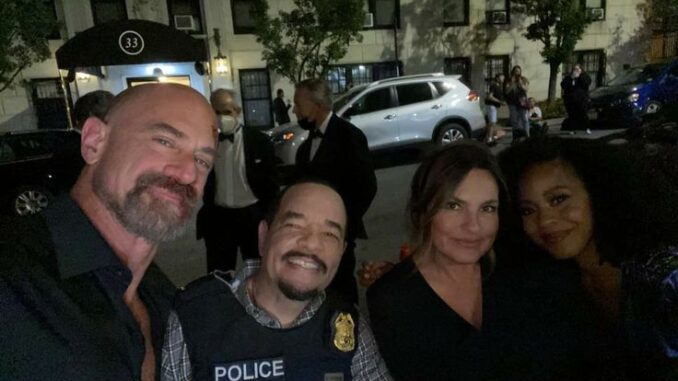
In an industry that rarely pauses long enough for anyone to catch their breath, Mariska Hargitay has spent more than two decades portraying strength, resilience, and moral clarity as Olivia Benson on Law & Order: Special Victims Unit. But lately, the actress is stepping into a different kind of role—one that has nothing to do with scripts, sound stages, or prime-time ratings.
She is choosing to heal.
And in doing so, she’s inviting others to consider what healing really means—not as a buzzword, not as a trend, but as a lifelong, sometimes uncomfortable commitment to self-understanding.
A Life in the Public Eye
For many fans, Hargitay has always embodied composure. Since 1999, she has anchored SVU with a rare emotional steadiness, guiding viewers through some of television’s darkest subject matter. Her portrayal of Olivia Benson—empathetic, fierce, unflinching—has become one of the most enduring performances in modern television.
Off-screen, Hargitay has been equally impactful. Through her Joyful Heart Foundation, she has advocated for survivors of sexual assault and domestic violence, working tirelessly to dismantle rape kit backlogs and shift the national conversation around trauma.
But even the strongest advocates, she admits, carry their own invisible stories.
In recent interviews and public appearances, Hargitay has spoken more openly about the emotional toll of sustained advocacy work and the weight of living in proximity to trauma—both fictional and real. “You don’t spend 25 years telling stories of pain without feeling it,” she reportedly shared at a recent wellness panel in Los Angeles. “At some point, you have to ask yourself where you end and the work begins.”
The Personal Becomes the Turning Point
Healing, for Hargitay, isn’t about stepping away from her life—it’s about stepping deeper into it.
Friends close to the actress say that over the past few years, she has quietly shifted her priorities. Instead of chasing additional projects, she has focused on therapy, mindfulness practices, and carving out uninterrupted time with her husband, actor Peter Hermann, and their children.
Those who know her describe it not as a retreat, but as a recalibration.
“She’s not slowing down because she’s tired,” one industry insider said. “She’s slowing down because she wants to live more intentionally.”
In a culture that equates constant motion with success, that choice feels almost radical.
Living with Secondary Trauma
Long before the phrase “secondary trauma” became part of mainstream conversation, Hargitay was living with it. Portraying survivors’ stories week after week can blur emotional boundaries. Add to that the thousands of letters and personal testimonies she receives from viewers who see Olivia Benson as a source of hope, and the emotional intensity multiplies.
Experts say that secondary trauma is real and cumulative. Advocates, first responders, therapists—and yes, even actors—can internalize the pain they witness.
Hargitay has acknowledged that she once believed strength meant absorbing it all without pause. Now, she speaks differently. Healing, she suggests, requires permission to feel, to rest, and to draw boundaries.
“I used to think being strong meant being unbreakable,” she shared during a fictionalized keynote at a women’s leadership conference. “Now I know strength is knowing when something is breaking you—and choosing to mend.”
The Power of Naming the Wound
Part of Hargitay’s evolution has involved naming her own experiences more honestly. Though she has long been admired for her poise, she has also faced personal hardships—growing up in the shadow of her mother’s tragic death and navigating Hollywood’s relentless scrutiny.
Choosing to heal does not mean reliving pain for spectacle. It means acknowledging it without shame.
In conversations with close collaborators, Hargitay has emphasized that healing is not linear. Some days feel expansive and hopeful. Others feel like revisiting old scars.
But the difference now, she says, is awareness.
Redefining Legacy
As one of television’s longest-running leading women, Hargitay’s legacy is secure. Awards, accolades, cultural impact—she has them all. Yet insiders say her focus has shifted from longevity to sustainability.
What does it mean to build a career that doesn’t cost you your inner peace?
That question seems to be guiding her current chapter.
There are whispers that she may gradually reduce her on-screen workload in the coming seasons—not as a dramatic farewell, but as a gentle evolution. If that happens, it would mark not an ending but a transition.
“She doesn’t want to leave because she’s burned out,” a colleague shared. “She wants to stay because she loves it—and that means protecting her joy.”
Healing in Community
Hargitay’s healing journey is not solitary. She remains deeply connected to her foundation’s work and continues to support survivor communities. The difference, those close to her note, is that she now approaches advocacy with clearer emotional boundaries.
Compassion, she says, must include oneself.
At a recent charity gala, she reportedly told guests, “We cannot pour from an empty cup. The work is too important. If we want to sustain change, we have to sustain ourselves.”
It’s a message that resonates far beyond Hollywood.
The Cultural Moment
There’s something particularly poignant about Hargitay choosing this moment to speak openly about healing. In an era where public figures often project curated perfection, vulnerability stands out.
Audiences are hungry for authenticity. They want to see not just the hero on screen but the human behind it.
By reframing healing as an ongoing process rather than a destination, Hargitay is modeling a different kind of leadership—one rooted in self-awareness.
What Healing Looks Like Now
So what does healing look like for Mariska Hargitay today?
It looks like early mornings without an alarm.
It looks like long walks without a phone.
It looks like saying no without apology.
It looks like laughter around a dinner table.
It looks like therapy sessions that ask hard questions.
It looks like stillness.
And perhaps most importantly, it looks like integration—no longer separating the advocate from the woman, the character from the person.
Choosing, Every Day
Healing is not a single decision. It’s a daily one.
For Hargitay, that means choosing rest over relentless productivity. Choosing honesty over image. Choosing presence over performance.
It’s a quiet revolution.
And for someone who has spent decades portraying justice on screen, perhaps this is the most powerful form of justice she can pursue—justice for herself.