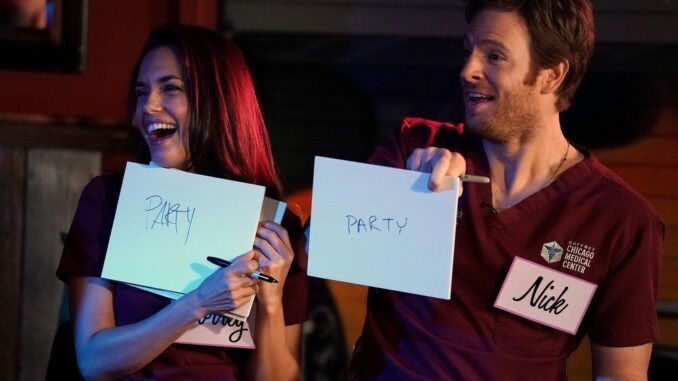
A Franchise That Knows How to Deliver
For more than a decade, the One Chicago franchise has been one of broadcast television’s most reliable brands. Built around three hit dramas—Chicago Fire, Chicago P.D., and Chicago Med—the shared universe has cultivated a loyal fan base that tunes in every week for stories of firefighters, doctors, and police officers navigating life-and-death situations.
But even for a franchise known for its popularity, the latest crossover event achieved something remarkable.
According to early internal network data obtained exclusively for this report, the special three-part crossover pulled in 6.4 million viewers, marking the highest-rated night of the season for the entire One Chicago lineup.
In an era where streaming dominates the conversation and linear TV ratings often struggle to keep pace, the achievement represents more than just a good night for NBC—it’s a reminder that event television still works.
And behind the scenes, the effort required months of coordination, ambitious storytelling, and a carefully executed strategy designed to bring fans together for a must-watch experience.
The Idea: Bigger Stakes, Bigger Story
Every few seasons, producers behind the One Chicago universe look for an opportunity to stage a large crossover event. The goal is simple but challenging: create a story that naturally connects all three series while raising the stakes high enough to justify the scale.
This year’s concept reportedly began in the writers’ rooms nearly six months before filming began.
The creative team envisioned a citywide crisis that would require firefighters, police officers, and doctors to work together simultaneously. Early discussions focused on what showrunner insiders described as a “layered emergency scenario”—one incident triggering multiple consequences across Chicago.
The result was a storyline involving:
-
A catastrophic industrial accident
-
A mass casualty situation that overwhelms hospitals
-
A criminal investigation tied to sabotage
By structuring the plot so that each series owned a different part of the story, the crossover avoided feeling like a gimmick.
Instead, it felt like one giant narrative unfolding across three hours of television.
Coordinating Three Productions at Once
Pulling off a crossover might sound exciting for fans—but for production teams, it’s closer to a logistical marathon.
Each show normally operates on its own filming schedule, with separate writers, directors, and production crews. For the crossover, those systems had to temporarily merge.
Sources close to production said coordination meetings began months ahead of filming. Writers mapped out the timeline of events to ensure continuity between episodes, while production managers synchronized filming locations across Chicago.
Actors who typically film on just one set suddenly had to appear across multiple shows.
For example:
-
A firefighter might appear in Chicago Fire responding to the initial disaster.
-
The same character could later appear in Chicago Med during the hospital crisis.
-
Meanwhile, detectives from Chicago P.D. investigate the cause of the incident.
Scheduling those appearances required careful planning so actors could move between sets without delaying production.
One insider described the process as “filming three episodes and a movie at the same time.”
The Power of a Shared Universe
What makes One Chicago unique is its shared storytelling universe.
Unlike standalone dramas, the three series exist within the same world, meaning characters regularly cross paths. Over time, viewers have become invested not just in individual storylines but also in relationships between characters across different professions.
That interconnected structure makes crossover events feel organic.
A firefighter rescuing a victim who later appears in the hospital isn’t unusual—it’s simply the reality of how emergencies unfold in a major city.
This realism has become one of the franchise’s defining strengths.
Fans know that when something big happens in Chicago, every department will feel the impact.
Building the Event: Action, Emotion, and Suspense
According to people involved in the production, the crossover was designed with three priorities in mind:
-
High-stakes action
-
Emotional character moments
-
A mystery that unfolds across all episodes
The first hour, anchored by Chicago Fire, focused on the disaster itself. Firefighters raced against time to rescue trapped workers while explosions threatened to spread through the industrial complex.
The second hour, led by Chicago Med, shifted the tension to the hospital. Doctors and nurses struggled to treat dozens of patients at once while confronting the possibility that some injuries were caused intentionally.
The final chapter, centered on Chicago P.D., revealed the investigation into what might have triggered the incident—and whether it was truly an accident.
By the time the story concluded, viewers had experienced a full narrative arc that could only be told across the three series.
The Marketing Strategy That Paid Off
While storytelling was crucial, NBC also treated the crossover as a major promotional event.
In the weeks leading up to the broadcast, teasers highlighted the scale of the crisis and hinted that several fan-favorite characters would play critical roles.
Promotional clips emphasized one key message:
This was not an ordinary episode night.
Instead, viewers were told they were about to watch one massive story unfolding across three shows.
The strategy worked.
Social media chatter began building days before the episodes aired, with fans speculating about possible plot twists and character appearances.
By the time the broadcast began, anticipation was already high.
Why the Ratings Matter
The 6.4 million viewer milestone is significant for several reasons.
First, it represents the largest audience for the One Chicago block this season, suggesting that crossover events still function as a powerful ratings driver.
Second, it demonstrates that traditional broadcast television can still create cultural moments when audiences feel they must watch live.
In an age where viewers often stream episodes days or weeks later, event television offers something different: a shared experience unfolding in real time.
That sense of immediacy can make all the difference.
Cast Chemistry: The Secret Ingredient
Another factor behind the crossover’s success is the chemistry between cast members.
Because actors from the three series occasionally appear on one another’s shows throughout the season, the crossover doesn’t feel like strangers meeting for the first time.
Instead, the interactions feel natural—almost like colleagues bumping into each other during a hectic day in the city.
Fans have come to love these moments.
A brief conversation between characters from different departments can sometimes be just as exciting as the action scenes.
Those relationships add emotional depth to the spectacle.
What It Means for the Future of the Franchise
With ratings reaching a season high, the success of the crossover could influence future storytelling decisions.
Network insiders say NBC has long viewed the One Chicago franchise as a cornerstone of its primetime lineup. Events like this reinforce the value of maintaining a connected universe where stories can expand beyond the limits of a single show.
It also raises the possibility of more ambitious crossovers in the future—perhaps involving larger citywide crises or deeper character arcs that span multiple episodes.
For fans, that prospect is exciting.
For producers, it’s proof that audiences still love a good television event.
A Reminder That Event TV Still Works
In today’s fragmented entertainment landscape, drawing millions of viewers to a live broadcast is no easy feat.
But the One Chicago crossover proved that with the right mix of storytelling, planning, and promotion, network television can still create moments that feel big.
Moments where fans gather together, watch simultaneously, and talk about what just happened.
And when the credits rolled on the final episode of the crossover, one thing was clear:
Chicago’s firefighters, doctors, and detectives had delivered a television event worthy of the city they protect.