Emergency rooms tend to feel more tense than television studios. However, there were times when it seemed difficult to distinguish between a fictional drama and something more visceral while watching the Chicago Crossover 2026 play out. The eerie silence of an impending catastrophe was conveyed by the opening scene alone, which featured a silent passenger jet heading toward a Chicago runway.
It seemed fitting that Chicago Fire opened the evening. When trouble arises, firefighters are typically the first to arrive. The city’s emergency network starts humming as soon as Firehouse 51 gets the call about a plane that has lost communication in midair. Radios emit a crackling sound. The station is roaring with engines. Fans of the show will recognize the tone, but there’s a feeling that something more serious is about to happen.
As it happens, the aircraft is carrying a much more deadly issue than a mechanical malfunction.
The cause of the mayhem is an exposure to a toxic chemical inside the aircraft, which has already claimed the lives of the 188 people inside. It is a sobering discovery. The air grows eerily silent as firefighters carefully enter the aircraft, their boots resonating against the metal floor. The scene, which includes rows of motionless seats, dispersed luggage, and the recognition that the situation goes far beyond a normal rescue, feels uneasy even in a television drama. The narrative swiftly crosses over into Chicago Med.
Doctors at Gaffney Medical Center initially notice symptoms like seizures, breathing issues, and abrupt neurological collapse that don’t quite make sense. In an effort to identify the toxin before more victims show up, the medical team scrambles through labs and emergency consultations. Under fluorescent hospital lights, the show’s writers may have purposefully leaned into the chaos to create a sort of medical mystery.
It’s difficult to ignore the little details when watching those scenes: doctors speaking in short, urgent sentences, nurses racing down cramped hallways, and monitors flashing erratic heart rhythms. Tension is probably increased by the almost cramped atmosphere of the hospital.
The investigation eventually lands at the Chicago Police Department’s intelligence unit, which is where these stories frequently end up.
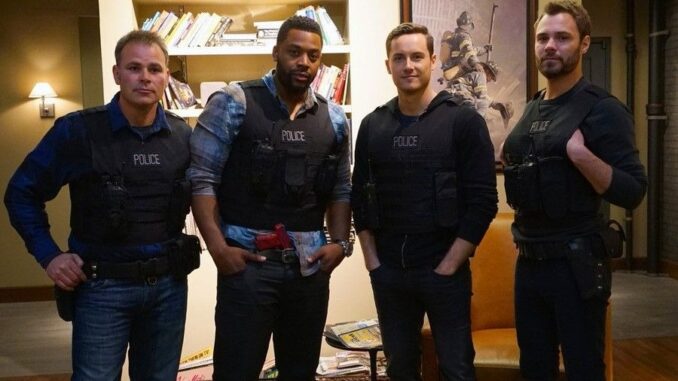
A familiar mixture of distrust and impatience greets Hank Voight and his crew as they enter the third hour of the crossover. As time goes on, the crisis starts to appear less accidental and more intentional. A criminal thread emerges, gradually linking the plane disaster to a more extensive operation involving hazardous chemicals.
One of the crossover’s biggest surprises is revealed at that point.

Jay Halstead and Hailey Upton, portrayed by Jesse Lee Soffer and Tracy Spiridakos, are two former characters who reappear in the narrative. There is an odd emotional charge to their reunion. The characters’ reappearance raises long-standing concerns about loyalty, unresolved relationships, and the decisions people make when they leave the show, especially for seasoned viewers.
Late in the evening, the two have a private discussion while sipping drinks. Chicago glows in the background as the city noise hums outside the bar windows. It’s not explosive or dramatic. Just two characters circling past emotions that never completely went away.
It’s still unclear if the authors want that reunion to result in anything long-term.
Tragedy is another aspect of the crossover.
Macy, a graduate of Stella Kidd’s “Girls on Fire” program, is one of the victims. Her untimely death lends the incident a weight that disaster episodes don’t always have. Not just the character herself is lost. As a reminder to viewers that the stakes in these made-up emergencies are supposed to feel real, it focuses a lot on Stella and the firefighters who trained her.
After being exposed to the nerve agent, other characters, including Joe Cruz and Lizzy Novak, also flirt with danger. The tension feels more personal than cinematic as you watch their symptoms develop. These days, the drama isn’t about villains or explosions. The goal is to survive.
The Chicago Crossover 2026’s familiarity is one intriguing feature.
The franchise has previously staged crossovers involving biological threats, citywide emergencies, and serial bombers. This new plotline adheres to a familiar pattern in certain respects. The authors maintain the emotional core rooted in the characters while increasing the spectacle, seemingly cognizant of that familiarity.
Depending on the viewer, that formula may still be effective.
The crossover—three hours when the whole One Chicago universe unifies into a single story—remains an annual tradition for many fans. Seeing detectives, doctors, and firefighters working together on the same crisis and exchanging information between scenes like a well-practiced emergency response is satisfying.
As you watch it play out, you get the impression that the franchise knows exactly what it is.