I love it when a TV show can prove me wrong, and Chicago Fire just did that.
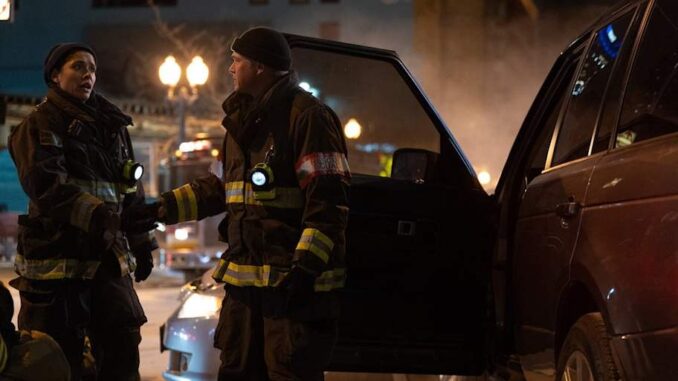
Just ahead of the crossover event, Chicago Fire introduced us to Chief Cranston, who died off-screen from a heart attack.
Naturally, that death was disappointing, especially as it didn’t affect the storyline at the time, but then the crossover event came into play, changing my perspective.
Cranston’s Death Started the Crossover Without Us Knowing
When Cranston’s death first happened, I looked too closely at the storyline taking place.
Cranston had evidence that Pascal wasn’t at fault for Tony’s injury, but his death seemed to be timed in a way that would cause problems for Pascal.
I felt it would’ve been more dramatic and important had Cranston died before he could pass on information about the low-quality bolts to someone else.
Instead, Pascal was cleared, and the focus turned to the loss of Cranston and his grieving family and colleagues.
The series finally introduced a new character who could shed some light on Pascal’s backstory, only to rip him from us. It just didn’t make sense.
But what I didn’t anticipate was how Cranston’s death would lead us into the crossover arc.
The One Chicago crossover delivered a mysterious plan full of dead people and a chemical weapon potent enough to affect people hours later.
Throughout the event, we learned that the attack may have been connected to the Heart of Chicago fire. And based on the flashbacks, we learned of Voight, Pascale, and even Sharon’s involvement with that.
Of course, we learned of Cranston’s involvement in that fire, too.
While he wasn’t in the flashback, the event revealed that Cranston agreed to hold off on a fire inspection so Voight could shut down the drug gang in one of the apartments.
Suddenly, with this revelation, things started to fall into place. If this perpetrator was after those he blamed for the fire, then surely Cranston would have been among the victims.
Because Cranston was already dead, many of us likely didn’t suspect anything at first. It was the perfect twist.
In fact, I found myself thinking it was a shame Cranston wasn’t around. I was curious about what his thoughts would’ve been on the attack.
The moment the Chicago PD hour exposed the truth behind the Heart of Chicago fire, I stopped feeling like Fire cheated us out of a strong character.
A mention of a drug that could mimic a heart attack made it clear that Cranston’s death wasn’t an accident or some freak medical situation.
It was a targeted strike, and killing him off-screen was the only way to keep that a surprise.
This was the way it had to be done, so we learned about the situation at the same time as Voight.
We got to put the puzzle together as Voight did, still not quite getting all the answers, but getting enough to fuel the final takedown.
So, I take it all back. Chicago Fire didn’t waste a character with great potential.
Instead, I got to the Chicago PD crossover hour and had to rewind, taking in everything being said about the poison.
A show that makes me stop and rewind is one that has my full investment. It means the series is building up a story well, and I have to soak in all the facts to follow that storyline through.
It was a strong move, but there were some ways they could’ve executed it differently.
One Chicago Should’ve Written Cranston in Sooner
Pascal is a character with a lot of weight and backstory, but we’ve barely gotten to know him.
He moved to Miami, and it took him a long time to return. However, Chicago Fire left us in the dark regarding the initial reason he left Chicago.
Cranston’s introduction during Chicago Fire Season 14 Episode 12 offered a chance to get the story. There was even a hint of Pascal somewhat blaming Cranston for some decisions.
Now, reading between the lines, it seems that Cranston and Pascal were hinting at the Heart of Chicago fire.
This is something that has sat with a few characters — albeit, without us knowing until now.
Voight has a whole file on the 22 people — now 23 — who died because of that fire, because he blames himself. He asked Cranston and Pascal not to do the fire check.
Pascal and Cranston clearly felt guilty about this as well. Although it seems Pascal blamed himself more than Cranston ever did.
If Chicago Fire had introduced Cranston an episode or two earlier, I think there could have been a better lead into the One Chicago crossover.
We would’ve better understood how the Heart of Chicago fire impacted everyone, especially Cranston. Instead, it feels like they missed an opportunity to showcase Cranston’s guilt.
That also would’ve helped viewers genuinely mourn Cranston because we cared about him. And we would feel more sympathetic toward Pascal after Cranston’s off-screen death.
Instead, we spent Cranston’s introductory episode wondering if he’d be the one behind benching Pascal.
This method undermined the importance of Cranston’s death to people like Pascal and minimized the impact of that loss.
All it would’ve taken was another episode, maybe two, to better flesh out his character, allowing a stronger connection to form between him and Pascal.
In fact, there could have even been a mention of Voight, further connecting to the One Chicago crossover without us realizing.
There is power in foreshadowing, especially if we don’t realize it’s happening.
It gives us time to take in conversations and figure out the meanings behind the words. We become more invested as viewers, looking to see what the seeds of conversation will grow into.
Sudden deaths are no longer immediately disappointing; instead, we know they’ll connect to something else down the line.
Part of the issue with Chicago Fire is that it kills off characters without consequences.
The series writes out characters without ever giving them depth, exploration, or meaning in their exits.
It’s easy to assume that the series used death when they didn’t know what else to do with a character. It’s been a pattern.
Yet, Chicago Fire — and the rest of the One Chicago team behind the crossover — surprised me with Cranston deaath connection.
I still wish we had more time with Cranston before it happened, though.