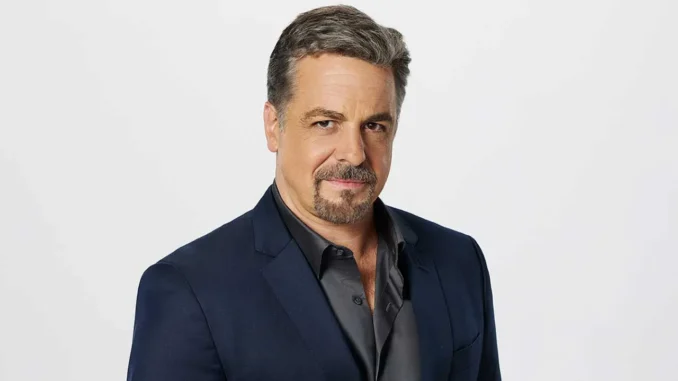
In the world of daytime drama, we are used to seeing characters battle through amnesia, hidden twins, and life-altering secrets. But for General Hospital star Chris McKenna, the most significant plot twist of his life wasn’t written by a team of television screenwriters—it was a diagnosis he had been waiting for since he was a teenager. For the first time ever, the man behind the enigmatic Jack Brennan is stepping out from behind the script to share a deeply personal and harrowing reality: he has bipolar disorder.
The revelation came during a soul-baring appearance on Maurice Benard’s State of Mind podcast, where McKenna joined his co-star in a candid conversation about the mental health struggles that nearly cost him everything. For years, fans have admired McKenna’s polished performances, unaware that beneath the surface, he was navigating a turbulent sea of undiagnosed emotional extremes.
The turning point, as it was for many across the globe, was the COVID-19 pandemic. The forced isolation and the heavy monotony of the lockdowns acted as a pressure cooker for McKenna’s mental state. He described the period as a time where the lack of movement in his life began to do a “number” on his psyche. What started as “heavy cyclothemia”—a mood disorder characterized by extreme highs and lows—quickly spiraled into something far more dangerous.
McKenna revealed that the isolation triggered his first “dangerous depression” since his teenage years. However, the true crisis occurred when the pendulum swung in the opposite direction, leading to a manic psychotic episode. During this break from reality, McKenna suffered from delusions, including the belief that he could read minds. At the time, he attempted to rationalize his symptoms as a byproduct of marijuana use, but the reality was far more complex and required immediate medical intervention.
“I finally got my diagnosis that I needed my whole life,” McKenna shared, reflecting on the hospitalization that finally provided the answers he had been seeking for decades. The actor admitted to struggling with alcohol and drugs in the past, common coping mechanisms for those living with an undiagnosed mood disorder. Living forty-eight years without knowing the root cause of his internal chaos is a testament to his resilience, but also a sobering reminder of how easily mental health struggles can be masked.
The conversation between McKenna and Benard—who has been a vocal advocate for bipolar awareness for years—was a poignant moment of “one bipolar to another.” It highlighted a crucial message: mental illness does not discriminate based on success, talent, or outward appearance. Even those who seem to “have it all” can be fighting a silent war for their own minds.
McKenna’s story is not just one of struggle, but one of profound recovery. He confirmed that he is “doing good right now,” thanks to the stability provided by proper medication and professional treatment. By speaking out, he is shedding the “bad boy” or “villain” persona of his character and replacing it with something far more impactful: the role of a survivor and an advocate.
This exclusive look into his life serves as a wake-up call for anyone feeling the weight of the “monotony” McKenna described. It underscores the importance of seeking help when the “highs” become too high and the “lows” feel impossible to escape. The diagnosis wasn’t a label of shame for McKenna; it was the key to his freedom.
As the full episode of State of Mind prepares to air, the General Hospital community and fans of the actor are rallying behind him. His transparency is a powerful tool in breaking the stigma that often surrounds bipolar disorder and psychotic episodes. In a society that often demands perfection from its public figures, McKenna’s willingness to be “messy” and honest is a breath of fresh air.
The actor’s journey from a breakdown as a teenager to a psychotic episode in his late forties highlights the “fascinating” and often tragic nature of undiagnosed mental health issues. It serves as a reminder that it is never too late to get the help you need, and that a diagnosis is often the first step toward a brand-new life.
Chris McKenna may play a character with secrets on screen, but by sharing his own, he has provided a light for others who are still lost in the dark. His story is a testament to the fact that while the storm may be fierce, it is possible to find the shore.
We are reminded that behind every face we see on our screens, there is a human being with a story we know nothing about. McKenna has chosen to tell his, and in doing so, he has moved the conversation forward in a way that Jack Brennan never could.
The impact of this revelation will likely be felt far beyond the soap opera community. It is a story of the human spirit’s ability to endure, the necessity of medical science, and the power of communal support in the face of our darkest hours.
As McKenna continues his journey on medication and in health, he stands as a beacon for those who feel “broken.” He is living proof that you can hit a breaking point, go through a manic crisis, and still come out the other side stronger, clearer, and more at peace than ever before.
His courage in facing the “manic psychotic episode” head-on and admitting the need for hospitalization is a major step in normalizing the conversation around severe mental health crises. It is no longer a secret to be kept in the shadows, but a medical reality to be treated with compassion.
Fans are encouraged to watch the full interview to hear McKenna’s words in his own voice—a voice that is now steadier and more certain than it has likely ever been.
The road ahead for Chris McKenna looks bright, not because the challenges have disappeared, but because he finally has the map he needed to navigate them.