The Sitcom That Felt Like Home (Maybe Too Much)
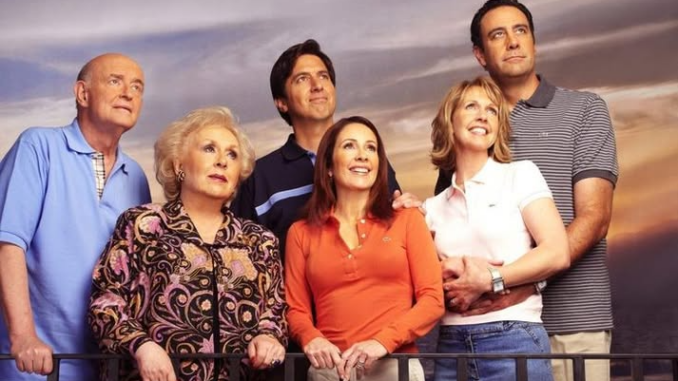
Have you ever sat down for a family dinner and realized that your life is basically a sitcom script, minus the laugh track? For nine glorious seasons, Everybody Loves Raymond captured that exact feeling of loving your family while simultaneously wanting to move to a different continent just to get some peace. Premiering in 1996, this show didn’t rely on flashy gimmicks or high-concept premises. Instead, it gave us a sportswriter, his exhausted wife, and a set of in-laws who lived exactly one driveway too close. It’s been decades since the series finale, but the Barone family’s antics remain as sharp and cringeworthy as ever.
The Premise: One Driveway, Endless Drama
The setup is deceptively simple. Ray Barone (played by the incomparable Ray Romano) is a successful sportswriter living on Long Island with his wife, Debra (Patricia Heaton), and their three kids. Sounds like the American dream, right? The catch is that his parents, Frank and Marie, live right across the street. And in the Barone universe, “across the street” might as well be “in the kitchen,” because they treat Ray and Debra’s front door like a suggestion rather than a boundary. Toss in Ray’s giant, perpetually jealous older brother, Robert, and you have a recipe for the kind of domestic friction that makes for legendary television.
Ray Barone: The Lovable, Lazy Everyman
Ray Romano’s portrayal of Raymond is a stroke of comedic genius. He’s not a hero; he’s a guy who just wants to eat a sandwich and watch the game without someone yelling at him. Is he a bit lazy? Yes. Does he try to manipulate his way out of chores? Absolutely. But that’s exactly why we love him. He represents that part of all of us that just wants to be the “favorite” without actually doing the work to deserve it. His dry, nasal delivery and “who, me?” attitude provided the perfect anchor for the show’s more explosive characters.
Debra Barone: The Voice of Reason (and Occasional Rage)
If Ray is the heart of the show, Debra is the backbone. Patricia Heaton played the “long-suffering wife” trope with such fire and nuance that she elevated it to an art form. Debra wasn’t just there to nag; she was a woman fighting a daily war for her own sanity. Watching her go toe-to-toe with Marie Barone was like watching two heavyweight champions in the ring. You could feel her blood pressure rising through the screen, making every one of her “episodes” feel completely justified.
Marie Barone: The Queen of Passive-Aggressive Love
We have to talk about Doris Roberts. As Marie, she created a character that was both terrifying and deeply familiar. Marie is the mother who shows her love through lasagna and subtle insults about your vacuuming skills. She’s the master of the “backhanded compliment,” and her devotion to her “favorite” son, Raymond, was the engine that drove half the show’s conflict. Even when she was being incredibly intrusive, Roberts played her with a warmth that made it impossible to truly hate her.
Frank Barone: The King of “Holy Crap!”
Then there’s Frank. The late Peter Boyle gave us one of the most quotable characters in sitcom history. Frank was a man of the “Greatest Generation” who had zero patience for feelings, health food, or Robert’s whining. His constant “Holy crap!” and his ability to turn any situation into a reason to raid the fridge made him an absolute fan favorite. Beneath the gruff, insulting exterior, however, the show occasionally let us see the soft spots, reminding us that he actually did care about his “idiot” sons.
Robert Barone: The Giant in the Shadow
Brad Garrett stands at 6’8″, but as Robert Barone, he spent most of the series feeling incredibly small. The sibling rivalry between Ray and Robert is arguably the show’s most realistic element. Who hasn’t felt like their sibling got the bigger piece of cake? Robert’s “crazy chin” habit, his deep, mopey voice, and his desperate need for Marie’s approval made him the show’s secret weapon. Watching him finally find happiness with Amy was one of the most satisfying character arcs in the entire run.
The Writing: Why the Jokes Still Land
What sets Everybody Loves Raymond apart from other 90s sitcoms like Friends or Seinfeld? It’s the sheer authenticity of the arguments. Most of the episodes were based on real-life fights that the writers—including creator Phil Rosenthal and Ray Romano—had with their own families. When Ray and Debra argue about a suitcase on the stairs for three days, it doesn’t feel like “TV writing”; it feels like something that happened in your own house last Tuesday. The show mastered the “one-act play” style of comedy, where a simple misunderstanding could spiral into a philosophical debate about marriage.
The Legacy of the Multi-Cam Sitcom
By the time the show ended in 2005, the “multi-cam” sitcom (the kind filmed in front of a live audience with a laugh track) was starting to fade out in favor of single-cam shows like The Office. However, Raymond proved that the format could still be sophisticated. It didn’t need shaky cameras or mockumentary interviews to feel real. The timing of the actors and the energy of the live audience made it feel like a nightly theater performance.
A Trophy Room Full of Emmys
You don’t stay on the air for nine years and win 15 Primetime Emmy Awards by accident. The show was a juggernaut during awards season, with the entire main cast eventually taking home trophies. It’s rare for a show to maintain such high quality from the pilot to the finale, but Everybody Loves Raymond managed to “stick the landing” with one of the most understated and perfect series finales in television history.
Nostalgia and the “Comfort TV” Factor
In 2026, we are living in an era of “prestige” dramas and high-budget sci-fi, but there’s still a massive hunger for what I call “Comfort TV.” Everybody Loves Raymond is the ultimate digital weighted blanket. Whether you’re watching a rerun on a rainy Sunday or binging it on a streaming service, there’s something incredibly soothing about the Barone’s predictable chaos. It reminds us that our families might be crazy, but hey, at least we don’t live across the street from Marie Barone.
The Supporting Cast: Beyond the Barones
While the core five carried the show, the supporting cast added layers of hilarity. From Amy’s hyper-religious and “wholesome” parents (the MacDougalls) to Ray’s buddies at the lodge, the world of the show felt lived-in. These characters provided the necessary “outside world” perspective that highlighted just how insane the Barone family dynamics actually were.
Cultural Impact: The Italian-American Experience
While the show didn’t lean heavily into ethnic stereotypes, the “Italian-American-ness” of the Barones was woven into the fabric of the show. It was in the food, the volume of the voices, and the specific way guilt was used as a primary form of communication. It resonated deeply with families from all backgrounds because, at its core, the “overbearing mother” and “emotionally distant father” are universal archetypes.
Why It Outranks the Competition
If you compare Raymond to other shows of its era, its staying power is remarkable. While some 90s humor hasn’t aged perfectly, the central theme of Everybody Loves Raymond—the struggle to be an adult while still being someone’s child—is timeless. It doesn’t rely on 90s pop culture references; it relies on human nature. That is the secret sauce of its longevity.
Conclusion: We Still Love Raymond
Ultimately, Everybody Loves Raymond succeeded because it didn’t try to be anything other than what it was: a funny, honest look at family life. It showed us that love isn’t always about big romantic gestures; sometimes, it’s about bringing over a container of lasagna, even if you’re using it to criticize your daughter-in-law. It’s a show about the small battles that make up a big life, and for that reason, we’ll probably still be watching reruns in another thirty years.
FAQs
1. Is “Everybody Loves Raymond” based on a true story? Yes! Many of the plotlines were based on the real-life experiences of Ray Romano and the show’s creator, Phil Rosenthal. The character of Robert was even based on Ray’s real brother, who was a police officer.
2. Why did the show end after 9 seasons? The creators and Ray Romano wanted to go out on top. They felt they had told all the stories they could and didn’t want the quality of the show to dip by staying on too long.
3. Did the kids on the show really play siblings? Yes, and they were siblings in real life! Madylin Sweeten (Ally) is the older sister of the late Sawyer and Sullivan Sweeten, who played the twins Michael and Geoffrey.
4. Where was the show filmed? While the show is set in Lynbrook, Long Island, it was actually filmed at Warner Bros. Studios in Burbank, California, in front of a live studio audience.
5. What is the most famous episode? While opinions vary, “The Suitcase” (Season 7) and “Italy” (the two-part Season 5 premiere) are often cited as the best examples of the show’s comedic brilliance.