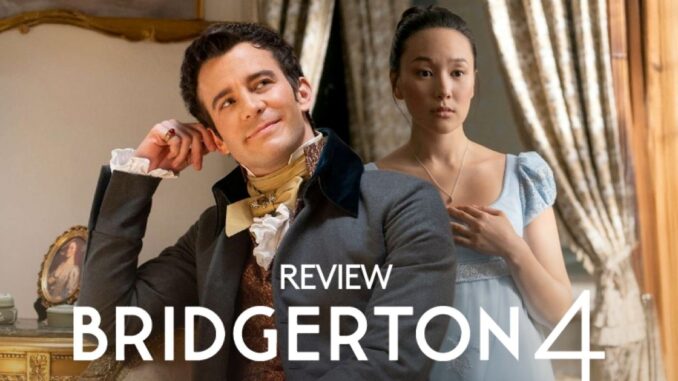
Bridgerton Season 4 marks the return of Netflix’s hit historical romance series, continuing to expand the lavish world of British aristocracy with a new love story full of drama and emotion. This season is released in two parts, with the first four episodes premiering on January 29 and the remaining episodes expected at the end of February.
This time, the spotlight shifts to Benedict Bridgerton, portrayed by Luke Thompson, the second son of the Bridgerton family, alongside Sophie Baek, played by Yerin Ha, a Cinderella-inspired character who begins as an anonymous servant. The series has received positive reviews from critics, earning an 80% score on Rotten Tomatoes, proving that Bridgerton still maintains its appeal through romantic emotion, polished visuals, and its ability to refresh a familiar formula each season.
💫 Is the Cinderella Story Ever Outdated?
The Cinderella story never truly gets old—at least not in Bridgerton Season 4. Netflix once again places its trust in a familiar trope that remains compelling when retold with a fresh perspective.
Inspired by the novel An Offer from a Gentleman by Julia Quinn, this season revolves around Benedict Bridgerton—a free-spirited, artistic man who often feels out of place within London’s rigid high society.
The story begins at a lavish masquerade ball, where Benedict falls for a mysterious Lady in Silver. It’s a classic fairytale moment—candlelight, music, and fleeting glances. But like Cinderella, she disappears before revealing her identity, leaving behind only a silver glove and a lasting romantic obsession.
That woman is Sophie Baek—a girl of low birth, living as a servant under the strict control of her stepmother.
Season 4 doesn’t hide its ambition to refresh this trope. Sophie is not just a passive Cinderella waiting to be rescued—she is a woman struggling to survive in a harsh, class-divided society. Fate reunites her with Benedict under completely different circumstances, where he fails to recognize the very woman who once captivated him.
This storytelling approach maintains the fairytale romance while adding tension through class differences and perception.
However, this loyalty to the Cinderella formula becomes a double-edged sword.
On the positive side, the season proves that an old story can still be captivating with strong emotional investment, visuals, and pacing. Ballroom scenes remain a signature highlight, featuring elaborate choreography, dazzling lighting, and modern music reimagined in classical style.
Benedict and Sophie’s relationship develops more slowly, allowing audiences to witness his growth—from a man afraid of commitment to someone forced to confront responsibility and the true cost of love.
On the downside, the familiarity of the trope can make the story predictable. Some viewers may feel impatient with the slower pacing, especially as the central romance dominates most of the screen time.
Subplots involving other Bridgerton family members exist but lack depth, making the season feel somewhat unbalanced. The near-total focus on Benedict and Sophie narrows the once rich and vibrant social world that defined earlier seasons.
🔥 A More Restrained Approach to Intimacy
One of the more debated aspects of Season 4 is its handling of intimate (18+) scenes.
Compared to earlier seasons—especially Season 1 and Season 2—the romantic scenes here are noticeably toned down, both in frequency and intensity.
Instead of passionate, emotionally explosive, and liberating moments like those seen with Daphne or Anthony, Season 4 opts for a more restrained, subtle, and “safe” approach.
Many viewers feel these scenes lack the intensity needed to fully convey the chemistry between the characters—especially given the already slow-burn nature of the relationship.
🌟 Strong Performances & Visual Appeal of the Main Couple
While the Cinderella storyline draws initial attention, it’s the performances and chemistry of the leads that sustain the emotional impact.
Sophie Baek, played by Yerin Ha, quickly becomes a fan favorite thanks to her depth and inner strength. Though inspired by Cinderella, Sophie is neither passive nor naïve.
Her difficult upbringing teaches her self-respect and resilience. She longs for love but refuses to sacrifice her dignity to enter high society. This balance makes her both fragile and strong.
Yerin Ha delivers a subtle performance, relying on quiet, emotionally charged moments rather than dramatic exaggeration. Visually, her delicate, classic beauty—with soft features and distinct Asian elegance—creates a striking contrast within British aristocracy.
Her appearance at the masquerade ball in a silver gown becomes one of the most memorable moments of the season—both dazzling and mysterious.
Opposite her is Benedict Bridgerton, portrayed by Luke Thompson, a familiar character given new depth this season.
Luke Thompson captures Benedict’s artistic charm while revealing the emotional instability and fear of commitment beneath his carefree exterior. His performance shines in moments of inner conflict between fleeting desire and the longing for true love.
The chemistry between the two leads is built not through exaggerated gestures, but through subtle glances, distance, and restrained tension. This slow, imperfect dynamic makes their relationship feel more realistic and emotionally resonant.
🎬 Final Thoughts
Overall, Bridgerton Season 4 succeeds with its natural romantic chemistry and visually stunning production—from costumes to settings and signature dance sequences.
However, its biggest weakness lies in the storyline. The Cinderella-inspired narrative feels safe and predictable, lacking major twists to create a distinctive impact.
The slower pacing and underdeveloped subplots also reduce the layered richness that once defined the series.
If the final four episodes fail to deliver a strong breakthrough, Season 4 may ultimately be remembered as a safe, easy-to-watch installment—entertaining, but not particularly groundbreaking in the long journey of Bridgerton.