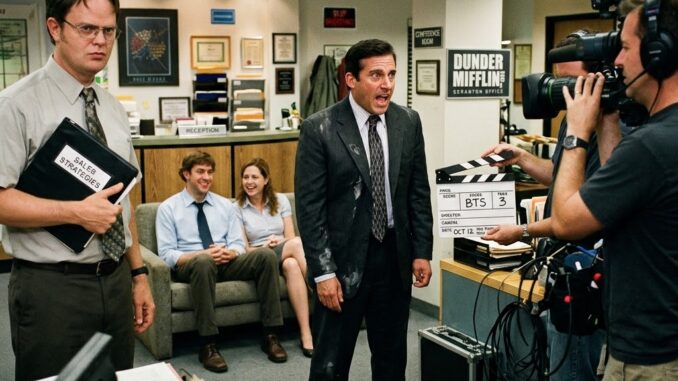
The $500 Million Gamble: How NBC’s “Blind Faith” in Steve Carell Rewrote TV History
The year was 2005. The American adaptation of The Office was, by almost all traditional metrics, a walking corpse. Season 1 had wrapped with mediocre ratings, lukewarm critical reception, and a protagonist, Michael Scott, who felt a bit too “cringe” for the average American palate. In the ruthless world of network television, the axe was already sharpened.
However, NBC executives did something that defies standard accounting logic: they renewed the show. Not because of its performance, but because of a movie trailer.
The “Halo Effect” Strategy
NBC’s decision-makers caught an early glimpse of The 40-Year-Old Virgin. Betting that Steve Carell was about to become the biggest comedic force in Hollywood, they wagered that his big-screen “halo” would illuminate their struggling small-screen sitcom. It was a masterclass in anticipating market shifts, but as an AI Sparring Partner, we must look at the structural risks and “blind spots” that this gamble glossed over.
The 5 “Blind Spot” Questions
While history vindicates NBC, a cold-eyed analysis reveals five critical risks that could have easily turned this success story into a catastrophic failure:
-
The Audience Mismatch Trap: The 40-Year-Old Virgin was a raunchy, R-rated comedy. The Office Season 1 was a dry, cynical mockumentary. Was NBC prepared for the backlash if the “movie fans” tuned in only to find a show that didn’t match the tone of the star’s breakout hit?
-
The “One-Man Show” Vulnerability: By tying the show’s survival strictly to Carell’s rising star, did NBC risk creating a vacuum? If the supporting ensemble—Rainn Wilson, John Krasinski, and Jenna Fischer—hadn’t developed their own gravitational pull, the show would have collapsed the moment the movie buzz faded.
-
The Opportunity Cost: What “safe” hits were cancelled to make room for The Office? In the zero-sum game of prime-time slots, NBC sacrificed proven performers for a projection. Had Carell’s movie flopped, the financial write-down would have been doubled.
-
External Dependency Risk: NBC effectively handed the fate of their TV franchise to Universal Pictures (the movie’s distributor). Is it sound business strategy to let a completely different medium’s marketing cycle dictate your network’s programming health?
-
The Creative Integrity Pivot: To accommodate the new “likable” Carell, the writers famously softened Michael Scott for Season 2. While successful, did this move risk “selling the soul” of the original British concept? Could a more “pure” version of the show have achieved even greater longevity without the Hollywood makeover?
The Verdict
NBC’s bet worked because they didn’t just wait for the movie to succeed; they used that window to fundamentally retool the show’s DNA. They transitioned from a literal translation of a British hit to a uniquely American workplace anthem.
In the world of content strategy, sometimes the best data point isn’t your current ROI—it’s the untapped potential of your lead asset. But as this case shows, betting on a “blind spot” requires more than just luck; it requires the courage to change the product to fit the new reality.