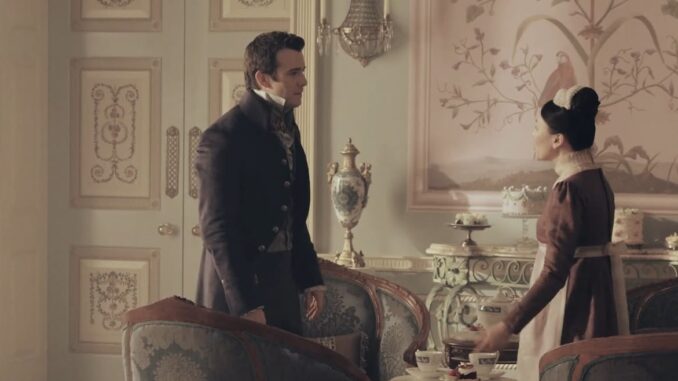
Bridgerton modernizes female desire without renovating female agency or the system that limits it. I can’t help but wonder if what I call escapism is quietly reshaping my perspective.
“Ladies do not have dreams. They have husbands,” Portia Featherington says in a dimly lit drawing room after noticing that Penelope and Colin seem distant. Penelope has secured the match of the season, Portia reminds her. Penelope’s focus now should be her husband’s desires. When Penelope quietly asks, “What about my dreams?” Portia barely pauses before answering.
The line is meant to sound outdated. However, the season never really proves her wrong.
In season three, The Featherington’s plot revolves around producing a male heir. Penelope’s professional triumph, getting away with being an established writer for years, ends with motherhood. Watching that scene now, it doesn’t feel like satire. It feels like structure.
As Lady Whistledown, she builds a profitable career. She earns real money. In a world where most women rely on marriage for survival, she creates her own form of security. Yet, when the Featherington family faces ruin, it is not her income that secures their future. It is the birth of a son. Her success as a writer carries influence, but inheritance carries authority.
Bridgerton is entrancing at first glance. The silk gowns. The orchestral pop covers. The kind of eye contact that lasts longer than most modern relationships. It’s indulgent and dramatic and just self-aware enough to feel current.
I watch it without irony. I get invested. Although, when the season ends, I’m not just thinking about who married whom. I’m thinking about what the show is actually selling.
On the surface, it feels progressive. In season one, Daphne directly asks Simon about pleasure and confronts him about contraception, refusing to remain ignorant about her own body. In season three, Penelope tells Colin she will not give up writing simply to make him more comfortable. Eloise, throughout the seasons, openly rejects the marriage market altogether, questioning why a woman’s entire worth should hinge on securing a husband.
The women speak openly about sex and ambition. They question marriage. They negotiate their futures instead of accepting them. The tone is modern, almost defiantly so. It feels good to watch — depictions of bold women, especially ones who still embrace their femininity, can feel hard to come by.
Yet, historically, the world they make speeches in was harsher than Netflix suggests. In “Was the Regency era a good time to be a woman?” published in HistoryExtra, Catherine Curzon reminds us that the real Regency was far less forgiving. Upper-class women were trained in music, art, and dancing — not as hobbies, but as marketing. Their accomplishments were intended to attract a husband.
Under English common law, once married, a woman’s legal identity — along with her property and income — was absorbed into her husband’s through a doctrine called coverture. Marriage wasn’t a sweeping romantic payoff, it was economic necessity.

Our current world isn’t much better. In The Harvard Crimson, Serena Jampel argues that season three’s fixation on reproduction feels especially uneasy in a post-Roe v. Wade world.
This is the first season released after the right to abortion was overturned in the United States, which made it especially politically charged. In season three, the Featherington family’s story hinges on producing a male heir. The sisters’ lack of sexual knowledge is played for comedy, yet their bodies are treated as urgent economic instruments. Their reluctance and confusion do not matter, only the outcome: a pregnancy.
The third season treats reproduction as inevitable and desirable at the exact moment many women are watching their reproductive rights shrink in real time. The female characters are allowed witty speeches about independence, yet their storylines narrow when it comes to their bodies. Against that backdrop, Bridgerton’s confident, self-aware heroines feel less historically accurate and more carefully reimagined.
This matters because media doesn’t just reflect culture — it shapes it.
According to What’s on Netflix and Parrot Analytics, Bridgerton reaches millions of viewers, many of them young women.
At a time when conversations about gender roles, marriage, and autonomy are more politically charged than ever, the fantasy we consume about “freedom” is not neutral. If empowerment continues to be framed as succeeding within old systems rather than challenging them, that framing becomes influential.
As a woman watching, I can’t ignore the contradiction of feeling seen inside a system that is still quietly steering the woman to the altar. I also can’t deny the appeal of seeing a woman’s emotions taking center stage.
The show centers female desire. Emotional intensity isn’t mocked. Romance isn’t framed as weakness. In a media landscape that often trivializes women’s feelings, Bridgerton treats them as the main event.
Nevertheless, empowerment in the Bridgerton world still ends in marriage and children. Freedom doesn’t look like leaving the system; it looks like succeeding inside it.
If there’s one thing Bridgerton understands, it’s messaging. Netflix is not naïve about what it is sending out into the world — especially to an audience in millions.
Over 80% of Bridgerton’s audience is female, according to Parrot Analytics. The show centers women in a way most period dramas never have. It offers a best-case scenario version of patriarchy. A fantasy where hierarchy is elegant, where social rules are strict but fair, where love smooths over inequality. The system remains, but it looks better, feels better, and most importantly, pretends to work in women’s favor.
I don’t think loving Bridgerton makes anyone regressive. I’m not interested in cancelling it (I enjoy it too much for that). I do think it’s worth noticing what kind of empowerment it offers. It doesn’t imagine a world without the marriage market. It imagines one where we would thrive in it.
It’s not a revolution. It’s a renovation. The fact that silk and sparkles can make us forget about the damaging sexist system they decorate is dangerous.