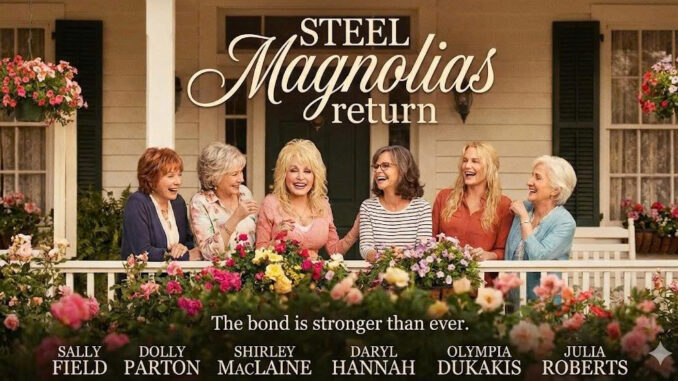
There is a shift in Steel Magnolias that many viewers do not notice—until it is too late.
At first, the film feels alive with energy. Conversations flow effortlessly, jokes land sharply, and the bond between the women feels unbreakable. The salon is not just a setting—it is a refuge, a place where life is manageable, even when it is difficult.
But that warmth is not permanent.
It is fragile.
And the film slowly begins to prove it.
The Safe Space That Could Not Hold Forever
The beauty salon represents control. Inside it, the women define their own world:
They laugh louder than their problems.
They speak truths wrapped in humor.
They support each other without hesitation.
It feels like nothing can penetrate that space.
But reality does not need permission.
As Shelby’s condition worsens, the salon begins to feel different. The same room, the same voices—but something underneath has changed. The laughter becomes shorter. The pauses become longer.
And for the first time, silence starts to matter.
When Support Isn’t Enough
The strength of these women is undeniable. They show up for each other in every way that counts.
But Steel Magnolias dares to confront a painful truth:
Support cannot fix everything.
No amount of love can reverse what is happening.
No amount of presence can stop what is coming.
This is where the film becomes emotionally relentless. It does not remove the bond between the characters—it strengthens it, only to show its limits.
And that is what makes it hurt. 
The Breaking Point That Changes Every Character
After Shelby’s death, the group dynamic does not just shift—it fractures.
Grief enters the room in a way that cannot be controlled or softened.
Each woman responds differently:
- Some try to hold onto routine
- Some break down completely
- Some search for meaning where there may be none
The unity that once defined them is still there—but now it is strained, tested by something they cannot collectively solve.
The Scene That Redefines Everything
One moment stands above the rest—not because it is dramatic in a cinematic sense, but because it is emotionally raw.
Shelby’s mother reaches a point where grief is no longer contained. It erupts—messy, painful, and honest.
There is anger.
There is confusion.
There is a desperate need to release something that has no clear outlet.
And then, unexpectedly, there is laughter again.
But it is not the same.
This laughter is not light.
It is survival.
From Comfort to Confrontation
Just like Roseanne, the film transforms its tone without warning.
What once felt like a comforting story becomes a confrontation with reality.
- The humor no longer distracts—it coexists with pain
- The relationships no longer feel safe—they feel necessary
- The world no longer feels controlled—it feels uncertain
And the audience is forced to stay with that discomfort.
Why This Is the Film’s Most Powerful Shift
This is where Steel Magnolias proves its depth.
It is not just about loss.
It is about what happens after loss.
- How people continue when something essential is gone
- How relationships adapt under emotional pressure
- How strength is redefined in the absence of control
The film does not offer easy healing.
It shows something more realistic:
Healing is uneven.
Sometimes it includes laughter.
Sometimes it does not.