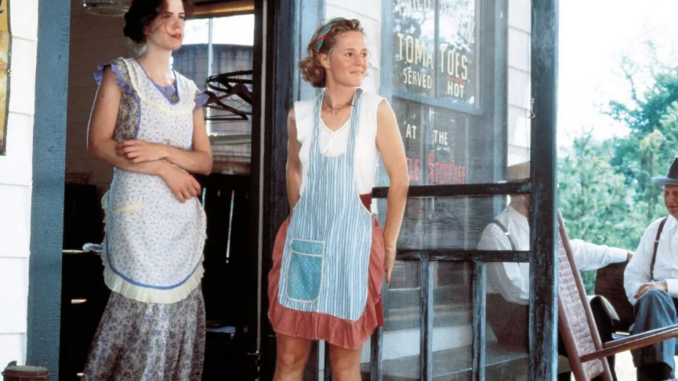
Before the release of 1991’s box office hit Fried Green Tomatoes, the film’s title dish wasn’t widely understood to be Southern at all. At the start of the project, one of its two leading ladies, Marie-Louise Parker—who spent part of her childhood in the South and had, by her own account, eaten just about everything that could be fried—had never even tasted one. In fact, the dish’s Southern identity, now accepted as regional canon, largely emerged after the movie’s release, less long-standing foodway than case study in cinematic mythmaking.
“People would fry up most anything and pretend it was meat or fish,” writes Fannie Flagg, author of the film’s screenplay and the book it was based on, in her 1993 Original Whistle Stop Cafe Cookbook. “A pitcher full of sweet iced tea and a plate of fried green tomatoes turned out to be a delightfully tasty and light summer supper on nights when it was so hot you didn’t feel like having a big heavy meal.” Well, sure. For farmers, gardeners, and cooks with a surplus of underripe tomatoes—both in the South and beyond—frying the green ones has long been a pragmatic, seasonal practice, akin to making apple pie in the fall. Bounty is part of the draw.
But watching Fried Green Tomatoes today is like floating through a Disney-fied version of the American South in the 1920s and ’30s—one where the crispy, tangy pucks are a regional delicacy, and where two women can live, run a business, and rear a child together without raising eyebrows. In an iconic flirty scene, Idgie (Mary Stuart Masterson) burns a batch of fried green tomatoes before hand-feeding one to Ruth (Parker), who calls it terrible, kicking off a full-throttle food fight between the two “roommates.” According to director Jon Avnet’s DVD commentary, this tender, rambunctious moment is meant to stand in as a sex scene—a way to signal to the audience, as loudly as he could in 1991, that yes, Idgie and Ruth are lovers!
It’s a pivotal moment of female companionship and self-actualization—love, even—unfettered by men. Watching the food fight unfold, Grady, the local sheriff, warns the pair, “You better stop this or I’m gonna have to arrest you for disorderly conduct.” In response, Ruth smears chocolate frosting all over the officer and the women burst into laughter again.
Centering the female experience without male interference was key to this film’s success at upending gender norms. The fried green tomato is a plot device as much as it is a marketing tool and a mythmaking machine. Over the years, fans have flooded podcasts, message boards, and Reddit threads with discussion of the pair’s queer-coded friendship. In multiple interviews promoting the film, Masterson and Parker admit to playing up the sexual nature of their characters’ connection, despite the script’s hesitancy to say outright that they’re a couple. (In the book, Idgie and Ruth’s relationship status is made much more explicit.)
Many note that Flagg dated women herself, including actress and director Susan Flannery and writer Rita Mae Brown. But when asked about Idgie and Ruth’s romantic love in a 1994 interview, Flagg skirts the question. “Those were innocent times in that part of the world, and I’m not sure people knew the word ‘lesbian.’ Maybe they didn’t have a name for the girls, and maybe it doesn’t matter.”
That part of the world was Alabama, where Flagg’s great aunt Bess ran the Irondale Cafe, whose signature dish was, apparently, fried green tomatoes. If that’s Flagg’s lived experience in the South, then who are we to argue? But some might say the fried green tomato is no more Southern than Idgie and Ruth’s relationship is purely platonic.
By the time of the film’s release, fried green tomatoes had yet to become a ubiquitous feature on Southern tables. Only after the movie’s massive success (grossing $119.4 million at the box office and earning two Oscar nominations) did its headlining dish crystallize as a symbol of Southern cooking.
In fact, according to culinary historian Robert F. Moss, fried green tomatoes likely originated in the Midwest and the North, with the earliest known recipes printed in Jewish American cookbooks from the turn of the 20th century. “I grew up in South Carolina with parents and grandparents who had their own gardens and grew tomatoes by the bushel,” Moss writes in his essay, “The Fried Green Tomato Swindle.” He notes, “I never once remember anyone in my family battering and frying tomatoes, green or otherwise.”
Like sweet potato casserole, shrimp and grits, and pimento cheese, fried green tomatoes traveled from northern latitudes to the South, where they developed their apocryphal pedigree. I was born in Georgia the year Fried Green Tomatoes came out but didn’t taste one myself until I moved to New York City as an adult. A Cleveland-native friend of mine who grew up eating them in the 1980s tells me, “Ohioans were pissed when the movie came out and everyone thought they were a Southern thing.” My ex-boyfriend, a child of 1990s Dodge City, Kansas, was raised on them, too. His dad grew bushels of tomatoes in the garden, and frying the green ones was just “one of the things we did,” he says.
The fried green tomato’s Southern identity is “kind of a stereotype,” confirms Wendell Brock, a longtime editor and writer for the Atlanta Journal-Constitution. “Feels a bit Cracker Barrel to me. Tourist food,” he says. Chef Steven Satterfield, who grew up in Savannah, Georgia, is certain the dish’s popularity surged in the ’90s, and he too sees it as a “Disney version” of Southern fare, part of a fetish that people, Southerners included, have about the region and its cuisine—not unlike how Avnet’s food fight is a sanitized stand-in for sapphic love.
In Flagg’s imagined world, the fact that fried green tomatoes aren’t quite Southern is beside the point. Myths reveal broader truths, such as: One way to introduce queer love to a mainstream audience is to Trojan-horse it in. And another: When life gives you an unfavorable outcome (an underripe tomato, say), you may as well fry it.