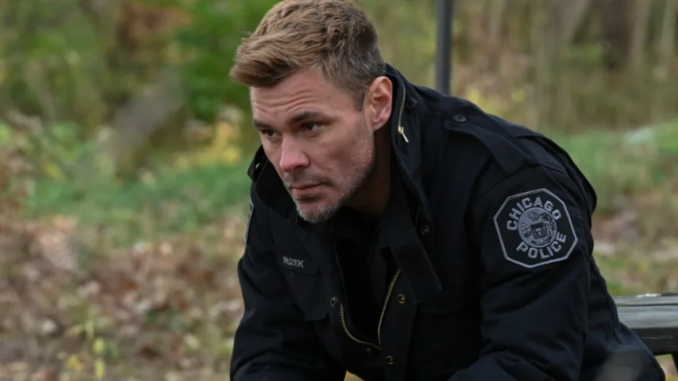
The One Chicago franchise has built its massive success on the foundation of characters who are deeply human, often struggling with the ghosts of their past while trying to maintain order in a chaotic city. Among the grit and steel of Chicago P.D., Officer Adam Ruzek stands out as a character whose journey has been defined by a volatile mix of passion, loyalty, and a certain degree of recklessness. While he has matured significantly since his days as a recruit plucked straight from the academy, the shadow of his early years and the complicated legacy of his family in the department often loom large. This tension reached a fever pitch in a recent high-stakes investigation where Ruzek’s past didn’t just linger in the background—it stepped into the light to threaten everything he had built.
The investigation began as a standard undercover operation targeting a sophisticated narcotics ring, a task Ruzek is uniquely qualified for given his history with deep-cover work. However, the situation took a sharp turn when a key player in the criminal organization turned out to be someone from Ruzek’s pre-Intelligence life. This wasn’t just a former acquaintance; it was a figure linked to a period of his career he had fought hard to move past, involving old debts and questionable associations that predated his time under Voight’s wing. In the high-pressure environment of the 21st District, where trust is the only currency that matters, the sudden emergence of a personal liability put Ruzek in an impossible position.
As the case intensified, the narrative masterfully explored the psychological strain of living a double life. Ruzek found himself caught between his duty to the badge and the lingering sense of obligation to a ghost from his past. The brilliance of this storyline lies in how it subverts the typical police procedural. Instead of a straightforward hunt for a criminal, it became a battle for Ruzek’s soul. Every move he made was scrutinized not just by the criminals he was infiltrating, but by his own team. The Intelligence Unit operates like a family, but when one member has secrets, the foundation begins to crack. The show highlighted the isolation Ruzek felt, as he was unable to fully disclose the extent of his connection to the case without risking his position or the safety of those around him.
The high-stakes nature of the investigation meant that there was no room for error. As Ruzek was pushed deeper into the criminal underworld, the lines between his undercover persona and his true self began to blur. His past came back to haunt him in the form of old habits and emotional triggers that threatened his composure. There is a specific kind of vulnerability that Patrick John Flueger brings to Ruzek—a raw, edge-of-the-seat energy that makes the audience feel the character’s desperation. When the investigation reached a breaking point, Ruzek was forced to make a choice that would either bury his past for good or let it destroy his future.
The climax of the arc featured a tense confrontation where the truth finally surfaced. It wasn’t just about catching the villain; it was about Ruzek facing the consequences of his own history. This moment served as a powerful reminder of why the One Chicago universe resonates so deeply with its audience. It doesn’t shy away from the fact that our pasts are often messy and that the people we used to be can sometimes sabotaging the people we are trying to become. By forcing Ruzek to confront his demons in the middle of a life-and-death operation, the writers elevated the stakes from a mere police action to a profound character study.
In the aftermath, the investigation was deemed a success by the department, but for Ruzek, the scars were evident. The case forced a level of transparency with his partner, Burgess, and with Voight that changed the dynamic of the team. It proved that in the Intelligence Unit, your past is never truly dead; it’s just waiting for the right moment to resurface. For fans of Chicago P.D., this storyline was a standout because it focused on the internal cost of the job. Ruzek’s struggle demonstrated that being a hero isn’t just about bravery in the face of a gun—it’s about the courage to face your own mistakes and the strength to keep moving forward when the weight of the past feels too heavy to bear. This blend of high-octane action and deep emotional stakes is exactly what keeps the One Chicago world at the top of the charts, making Ruzek’s journey a compelling narrative for anyone who appreciates the complexity of the human spirit.