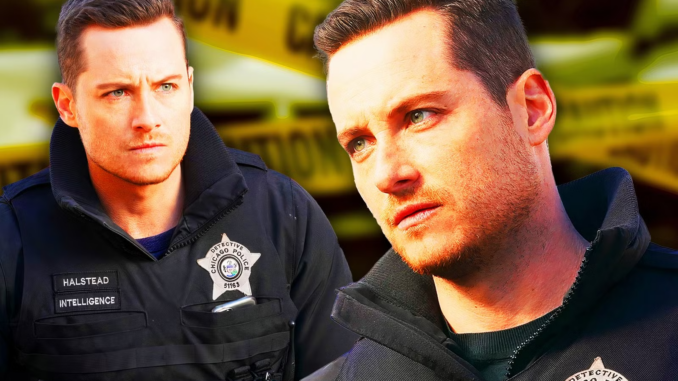
The One Chicago universe has always been a masterclass in testing the moral fortitude of its heroes, but perhaps no character has faced as many internal storms as Jay Halstead. As a former Army Ranger turned detective for the Chicago P.D. Intelligence Unit, Halstead was long considered the moral compass of the team. He was the counterweight to Voight’s more ruthless methods, the one who believed that the badge should stand for something beyond just results. However, the gritty reality of the Windy City has a way of eroding even the strongest foundations. In a high-stakes narrative arc that left fans on the edge of their seats, Halstead found himself entangled in a moral dilemma so severe that it threatened to end his career and his legacy in the department forever.
The conflict began during a complex investigation into a string of high-end robberies that took a violent turn. As the Intelligence Unit closed in on the suspects, Halstead made a split-second decision to protect a civilian informant who had become a vital link to the case. While his intentions were rooted in his typical desire to save lives, the situation quickly spiraled out of control. The informant, driven by fear and desperation, committed an act that placed Halstead in a position of complicity. Suddenly, the detective was no longer just chasing a criminal; he was covering for one to prevent a larger catastrophe. This moment marked the beginning of a downward spiral where the line between right and wrong became a blurred, indistinguishable haze.
For a man who prided himself on his integrity, the weight of this secret was suffocating. The show expertly portrayed the psychological toll on Halstead as he attempted to navigate the fallout. He was forced to lie to his partner, to the department, and most painfully, to himself. In the world of One Chicago, the chemistry between the characters is built on a foundation of absolute trust, and as Halstead began to withdraw, the tension within the unit became palpable. The dilemma wasn’t just about a single lie; it was about the realization that in order to solve the case and protect the city, he had to become the very thing he had spent years criticizing. This internal friction is what makes Halstead such a compelling figure, as his struggle reflects the impossible choices faced by those in high-pressure law enforcement roles.
As the investigation reached its climax, the walls began to close in. Internal Affairs started sniffing around the edges of the case, and Halstead’s past decisions were brought under a microscopic lens. The stakes were no longer just about catching a thief; they were about a veteran detective facing the total loss of his livelihood and his reputation. The narrative leaned heavily into the theme of sacrifice, asking the audience how much one person should be expected to give up for the greater good. If Halstead told the truth, a dangerous criminal organization would go free and his informant would likely be killed. If he stayed the course and maintained the cover-up, he would be betraying the oath he took when he first put on the uniform.
The tension peaked during a confrontation that forced Halstead to look into the mirror and decide who he really was. This wasn’t a standard action sequence with guns drawn; it was a quiet, devastating battle of conscience. The brilliance of Chicago P.D. lies in these moments of vulnerability, where the armor of the police officer is stripped away to reveal a man haunted by the consequences of his own choices. By placing Halstead in such a precarious position, the writers pushed the character to a breaking point that felt both earned and inevitable. It served as a stark reminder that even the most righteous individuals are susceptible to the pressures of a system that often demands moral compromise.
The resolution of this dilemma provided one of the most emotional exits and shifts in the series’ history. It proved that some bells cannot be un-rung and some stains cannot be washed away. While Halstead eventually found a way to resolve the case, the cost was his career as he knew it. The experience changed him fundamentally, leading to a profound reassessment of his place in the world and his future in Chicago. This storyline resonated deeply with the audience because it didn’t offer an easy out or a Hollywood ending. Instead, it offered a realistic and painful look at the price of integrity in a world that often rewards the opposite.
Ultimately, Jay Halstead’s journey through this career-ending moral dilemma remains a definitive chapter in the One Chicago saga. It highlighted the show’s ability to balance high-octane procedural drama with deep, character-driven storytelling. For fans, it was a reminder that while the city of Chicago is tough, the battles fought within the hearts of its protectors are often the most difficult to win. Halstead’s legacy as a man who tried to do the right thing, even when it cost him everything, continues to influence the show and its fans, proving that true heroism isn’t about being perfect—it’s about how you handle the moments when you fail.