
Eric Ledgin has spent more than two decades building a resume that spans late-night staples, scripted hits, and high-profile specials. From writing for Late Night with Jimmy Fallon and It’s Always Sunny in Philadelphia to developing original series of his own, such as Superstore and American Auto, Ledgin has consistently blended sharp humor with character-driven storytelling.
Now, he’s bringing that same sensibility to NBC’s St. Denis Medical, a workplace comedy he co-created with longtime collaborator Justin Spitzer. Recently renewed for a third season, the series follows an eclectic group of underfunded, yet dedicated, doctors and nurses who navigate caring for patients while keeping it all together at an Oregon hospital.
We spoke with Ledgin about character development, the mockumentary nature of the series, and working with Justin Spitzer.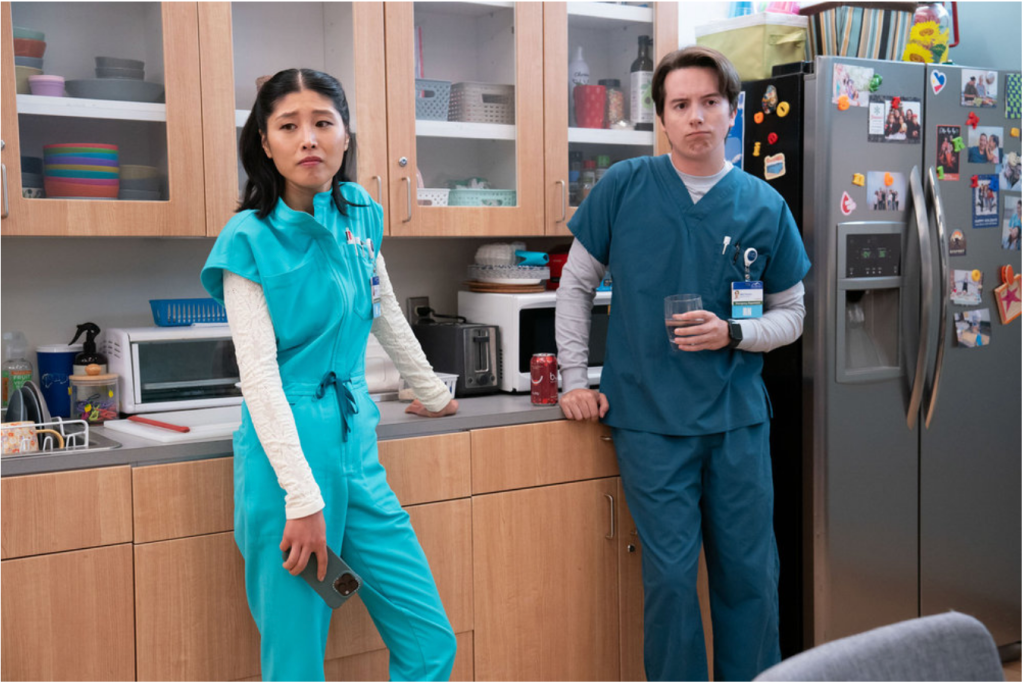
Congratulations on the success of the show, and more importantly, the third season pickup.
Oh, thank you so much. I’m truly excited to be making more. We’re getting back to it right now, and it’s just like a joy to be back in the room.
Did you know that you were being picked up for season two when you started writing this season?
Oh, that’s a good question. This is how much time has been compressed in my mind in the last two and a half years. I couldn’t tell you. We finished airing them in like April, and did we know by then? Damn, I don’t know.
Did you at least have season two planned just in case?
No, we didn’t plan in the sense of knowing what we wanted to do. I had a sense of some of the thrusts that we would follow just based on how we wrapped up season one and where I thought it would naturally lead. Alex’s story was pretty tied up, and the thrust of her character arc in season one felt satisfying to me.
Part of that was that I didn’t know if this was my only shot at making a season of a show. I want it to feel satisfying. Season two was really saying, “Okay, what worked really well in season one? What do we feel worked well? What do I want to see from these characters?” And I had a few tentpoles going into the writer’s room, like “I think Joyce should get engaged and then break up almost immediately.” I had like a few loose ideas like that. And the room really helped me fill in all the blanks.
Can you talk a little about creating likable and relatable characters, despite them possessing some relatively flawed character traits?
Yeah, I think that’s my experience with a lot of people. I went on an organized hiking trip once, and there were like 25 people on it. At first, all I could see was everyone’s weird quirks and reasons why I probably wouldn’t like them. And by the end of this four-day trip, my wife and I were crying over leaving all these people that we had bonded with. Who knew that this weird, seemingly rude guy, this was the first trip he’s ever left his family, because he was diagnosed with cancer and realized he had never followed his dream of going on this hike. When you get to know people, you go deep enough.
Everyone is lovable. That’s just my experience of life. So, it feels like when you’re making a show filled with people who are kind of stuck together every day, the nice thing about being stuck together is like they didn’t really choose each other. So, they might have stuff that bothers each other really gets on each other’s nerves. But there is an underlying idea that there is some beauty or compassion or something really deep and wonderful about each of them.
What was the inspiration for the mockumentary style of the show?
You know, at first, I think it was a little bit of just being drawn to that format, just because I it makes a situation feel more real, which makes it feel easier to sort of undercut it. And it makes the stakes sort of feel higher when something feels like it’s actually happening. But I think what I’ve grown to appreciate about it, in a hospital specifically, is just how much of that aspect is magnified, because you’re ultimately in a life and death environment. But you’re seeing all the little grime and the dirt and the little looks and the little foibles and and all that stuff that sort of like cuts against this kind of serious backdrop.
I spoke with most of the cast last season, and David Alan Grier told me that he pitched to you the idea of actually seeing a version of the finished documentary when the series is over. I’m just curious how you think St. Denis will be portrayed in that documentary by the fictional filmmakers?
Man, that’s a good question. I’ve always told myself, if you just find five, or six, or seven people, would they be this interesting? Maybe not. But the documentarians chose these people because they were compelling. There was something about them. I feel like if you were following these characters, you’d have to sort of portray them much like the show, which is that there’s no denying that there is something super noble and serious. And there’s like a calling to what they’re doing. But most of their day-to-day is either silly or annoying or funny or absurd in some way, which I think is probably close to true for a lot of people who really work in these in the healthcare industry.
You spent a lot more time leaning into the supporting characters this season. I’m wondering if that was a game plan going into the season or something that kind of happened naturally in the writing room.
I think the more we do the show and get through having a whole season where you’re laying tracks, where it’s every track is like a little piece of information about a character or a little piece of their past or a dynamic about their relationship with another character. So much of season one is just building that and building that and building that. And then in season two, you want to ride the tracks. “You want to be like, “Okay, we have all this stuff now, what can we do with all these characters now that we’re really like building on something that already exists?” When you first come in, you’re doing a pilot, and no one knows anything about these characters. You can’t just jump into these like complicated relationships. And so that was really what was so fun about season two, is like pairing everyone with everyone and getting all the dynamics going and just like seeing what everybody was capable of together.
How would you describe your working relationship with Justin?
It’s great. I would say at this point, he’s a friend first and foremost. And we had a really easy time building out the bones of this show when we were developing it together. I learned a lot when I was working alongside him. And now he is sort of available whenever I need him. He’s a great supporter and great writer, and I just have always loved working with him.
Josh Lawson told me that Justin is more cerebral and you’re more emotional. Would you say that’s accurate?
(Laughing) Yes, I would say that’s very accurate. Except I would add that I’m as cerebral as he is. I’m joking. I think that’s fair.
Do you know what you want out of season three yet?
Yeah, it’s a tricky thing. I think you have to know what you want and be willing to let go of all of it. So, I think it’s bad not to know anything that you want. But also, not so great to go on being like, “I want this, and it’s going to happen even if it doesn’t make sense.” So, I have some ideas.
Well, thanks again for taking the time. And again, congratulations on the success of the show. I’ve been really enjoying it.
Thanks a lot. Appreciate it.
You can watch our full interview with Eric Ledgin below.
St. Denis Medical airs on NBC on Mondays at 8/7c and streams the following day on Peacock.