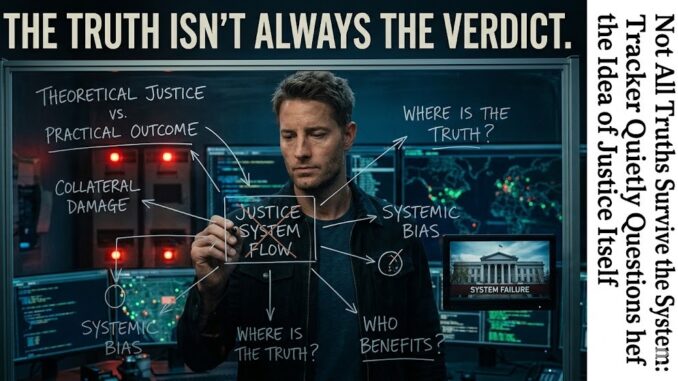
At first glance, the legal storyline unfolding in Tracker appears to be an expansion of scope—a way to introduce higher stakes and more complex conflicts. But beneath that surface lies something far more radical: a challenge to the very concept of justice that the series has relied on since its beginning.
Traditionally, Tracker operates on a simple moral equation: truth leads to resolution. Find the missing person, uncover what happened, and the story reaches closure. But the current arc complicates that equation in ways that are both subtle and profound.
The missing witness is not just someone who needs to be found—they are a piece of evidence. And evidence, in a legal context, is not defined by its existence, but by its admissibility. This distinction is crucial. It means that even if Colter succeeds in locating the witness, that success does not guarantee impact. The truth can be discovered and still remain powerless.
This is where the show begins to interrogate the structures it once took for granted. The legal system is not portrayed as inherently corrupt, but it is shown to be vulnerable—to influence, to delay, to manipulation. It is a system that can be navigated, but also one that can be exploited.
For Colter, this creates a dile mma that goes beyond logistics. His role has always been external to the system. He finds what others cannot. But now, finding is only the first step. The real question is whether what he finds can be used—and whether it can survive long enough to matter.
This shift transforms the stakes in a way that is difficult to ignore. The danger is no longer limited to physical harm. It extends to the erasure of truth itself. And in that context, victory becomes ambiguous.
Because in a world where power shapes outcomes, solving the case may not be the same as winning it.