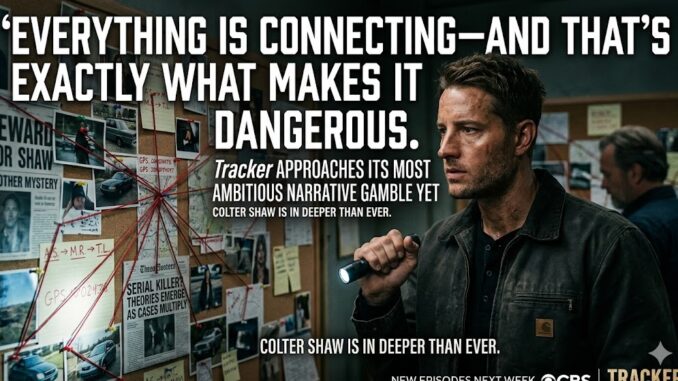
For much of its run, Tracker has maintained a careful balance between independence and continuity. Episodes could be watched on their own, yet small threads hinted at a larger story. That balance is now collapsing—intentionally.
As the series moves toward Episode 20 and beyond, the separation between storylines is disappearing. The legal case, the recurring references to larger systems, the emotional fallout of Colter’s past, and the looming return of Russell Shaw are no longer parallel narratives. They are converging.
This convergence represents one of the most ambitious storytelling choices the show has made. It transforms the viewing experience from episodic consumption into cumulative engagement. Every detail matters. Every callback gains significance. Every unresolved moment becomes a potential turning point.
But this ambition comes with risk. The more interconnected a narrative becomes, the less forgiving it is. Inconsistencies stand out. Weak links disrupt the chain. And the margin for error becomes increasingly narrow.
What makes this moment partic ularly fascinating is that Tracker is not just increasing complexity—it is restructuring itself in real time. It is shifting from a format defined by repetition to one defined by progression. And progression, by its nature, demands payoff.
The question is not whether the show can handle this level of complexity. It is whether it can resolve it in a way that feels both surprising and inevitable. Because once everything is connected, the audience expects everything to matter.
And if it does—if the show manages to bring these threads together with precision—then this season will not just be remembered as an evolution. It will be remembered as a transformation.