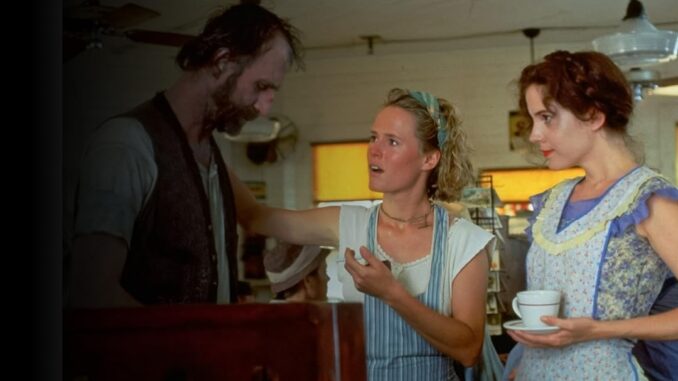
More than three decades after its release, Fried Green Tomatoes is undergoing one of the most fascinating cultural re-evaluations in recent memory. What was once widely marketed as a sentimental Southern drama about friendship is now increasingly being discussed as something much more daring—and perhaps much more restrained than audiences originally realized.
By May 7, 2026, the conversation surrounding the film has shifted dramatically. Critics, viewers, and even casual first-time audiences are revisiting the story with a question that refuses to disappear:
What if the film was trying to say far more than it was ever allowed to openly show?
At the center of this discussion is the relationship between Idgie and Ruth, a bond that many modern viewers no longer interpret as simply emotional companionship. Instead, audiences are examining the film through the lens of coded storytelling—a technique historically used in Hollywood when certain relationships could  not be portrayed explicitly without risking backlash, censorship, or commercial limitations.
And suddenly, scenes that once appeared subtle now feel loaded with meaning.
The emotional intensity between the two characters, the domestic intimacy they share, the way the camera lingers during quiet moments—all of it is being analyzed with fresh eyes. In 1991, many of these elements were softened in mainstream discussions. In 2026, they are becoming central to the film’s identity.
What makes this reinterpretation especially powerful is that it doesn’t feel forced. In fact, many viewers argue the opposite: that the emotional truth of the story becomes clearer once those layers are acknowledged openly.
Some critics now believe the film exists in two versions simultaneously:
- the version audiences were told they were watching in 1991,
- and the version audiences are discovering in 2026.
That duality may explain why the film suddenly feels so modern. Contemporary viewers are accustomed to reading subtext, recognizing coded narratives, and questioning what stories were historically permitted to say openly. As a result, Fried Green Tomatoes no longer feels like a relic of the past—it feels like a conversation that was paused for thirty-five years and is only now being completed.
Of course, this evolution has sparked debate. Some longtime fans argue that redefining the relationship changes the spirit of the film. Others believe it finally allows the story to be understood in its full emotional complexity.
But perhaps the most striking part of this entire resurgence is what it reveals about storytelling itself.
Sometimes, the most powerful stories are not the ones that shouted their meaning openly.
Sometimes, they are the ones that survived by whispering.
And in 2026, audiences are finally listening more closely than ever before.