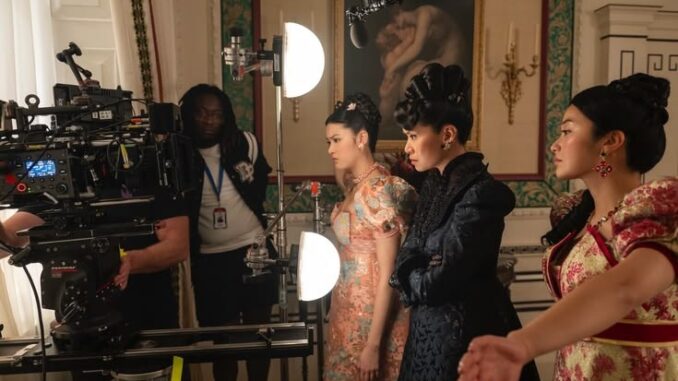
For the fourth season of Bridgerton, the show’s cinematographers, Jeffrey Jur and Alicia Robbins, had a unique task. After three seasons of visuals tethered to a glowing aesthetic expected of the time and place, “the show has taken a turn,” says Jur.
“[We’re seeing] the working staff now,” he continues. “It was exciting to do, and it gave us a chance to create a different look. In the kitchens, in the basement, and the staff living quarters, these working areas of the house, we had all-new sets [both built and on location]. It shows a contrast, but still, we’re in the beautiful homes and at the fantastic balls and filming on the spectacular stages.”
Dare we say they leaned into a grittier look for season four? Perhaps we won’t go that far, but Robbins and Jur do admit that it’s different from any of the previous seasons, and they wanted to truly embrace getting to try new things on an already well-established show.
Jurr shot episodes one, three, five and six, while Robbins took on episodes two, four, seven, and eight. Normally, a cinematographer would handle two consecutive episodes, filming back-to-back, but they had to get creative as winter was quickly approaching. Episode three needed to be pushed up because of the many exterior scenes, not to mention Benedict (Luke Thompson) getting into a lake fully nude [My Cottage]. It was preferable for everyone to not have that filmed in the dead of winter.
“Because of this new block split,” says Robbins, “Jeff and I were very cognizant of trying to match each other’s cinematography and stay visually consistent. And it was cool because after all eight episodes were color-timed, one of the comments from the executives was that it did feel consistent throughout. That’s such a different kind of collaboration than a lot of people have on shows.”
Jur adds, “It isn’t always so supportive and collaborative, for sure. Sometimes, it’s more competitive, and a production will use the two DPs against each other, but that is so far from what it’s like on Bridgerton — a supportive and inclusive environment.”
Here, we talk to our resident directors of photography about the show taking on a new look for season four, their favorite and most complicated sequences to film (hint: One involves a staircase!), and so much more.
Departing from that signature Bridgerton look
ALICIA ROBBINS: This season, it was less about the balls and more about the development of these two characters and their relationship. It felt different because it’s not just about the glitz and the glamour of it all — though that still exists, of course — it really is about the relationship between Benedict and Sophie. And one thing that I really loved about it too were some of the intimate scenes between those two. I filmed what turned out to be my favorite intimate scenes ever so far in my career: Benedict and Sophie in the stairwell and them in the bathtub.
JEFFREY JUR: Some new things for this season were that we had quite a few more sets built, including the back lot, and a lot less location work. We also started filming very late in the year — early September — so we embraced that in the story. We had some conversations about how the costumes would be adapted for that and what the feel of the weather was going to be. Tom Verica, our guiding-light director, said that it was going to look wintry during our filming, and “we don’t want to spend a lot of money trying to make it look like something it wasn’t, so let’s embrace the fall feel.” Which, for us, was actually lovely, and the color shift in the show feels quite beautiful.
The first season shooting on the back lot
JJ: Whenever there’s a carriage ride in the ton or people walking around the shops, the Royal Crescent, the front exteriors of some London houses like the Gun family [house], that’s all now filmed on the back lot at Shepperton Studios. It’s an amazing, spectacular space. And while it provided so much more control, it also came with a few challenges, one being that it is a fully outdoor set, and we had to keep the sunlight consistent with the lighting throughout a day or a couple days of shooting one scene. But what worked so well was that instead of showing up on location and trying to pre-rig a scene with all the restrictions of practical locations, we were able to put lights and cameras almost anywhere we needed to. I love that we had a lot more control this season. Even the grand rooms of Queen Charlotte’s scenes, which we normally shot at Wilton House, have been built into a set now. [Production designer] Alison Gartshore and her team have beautifully brought the grandness of that space onto our regular stage.
AR: It’s always so exciting stepping onto the back lots at Universal and Warner Bros., and this being a period-piece back lot, it was pretty neat to see that for the first time. We had all the different street scenes we could utilize, like a street where lower-class people might be or a posh shopping area. It just allowed us to create all these different scenes on one back lot. And then, being able to have the big lighting sources to make that backlight consistent was really helpful. The producers were great about giving us what we needed for that. And even though I love Bath, it was nice not having to go all the way out there and deal with all the restrictions. The back lot gave us more of a 360-degree vantage point. There were still places where we’d have to put a blue screen to change the background, like when the lower-class street looks into what would be the Royal Crescent, but that’s a pretty simple fix.
Using handheld cameras
JJ: There was a lot of hesitation about handheld [cameras]. It’s so different from what the show has already established in terms of how the camera moves, but I reassured everybody that we could have a good handheld, that it didn’t have to be a “shaky cam.” We have fantastic operators, both returning from season three — Doug Walshe was our A-camera/Steadicam operator, and he did all the walk-and-talks; B-camera was Ashlea Downes. We used a mix of handheld and Steadicam for the first episode scenes to establish the kitchen activity and the business of balls being set up, things like that. We wanted to create a sense of energy and movement, and moments handing off to other moments. It was a different energy to the sort of precision and elegance that we’re used to seeing inside the Bridgerton house and other houses. It was a very conscious effort, and I think that once we started showing them how we could do it well, they embraced it.
AR: Though for episodes two and four, it was used more sparingly, depending on the scene we were shooting. That was [director] Jaffar Mahmood’s choice. In general, we tended to use it more when Sophie was very excited or worked up, especially in episode one. Because she was calmer when working at the Bridgerton house, we still aligned with what Jeff and Tom established but decided where it was appropriate or not appropriate to blend it in.
JJ: The walk-and-talk where we follow Mrs. Wilson [Geraldine Alexander] in the first scenes of the first episode, it’s the first time we’ve followed one of the staff. They’ve always exited the room or entered it; they’re always present, but the other characters rarely engage with them. So, to finally travel with them into their space was a thrill. And that move was very intentional. It felt important that we suddenly peel off with her, go down the hall, into a doorway that then heads into a stairway that brings us into the kitchen. I wanted it to have a very different feel, and I hope that comes through.
AR: I love that scene because it immediately tells the audience, “Oh, this is going to be different.”
The trials of Loseley House, aka My Cottage
JJ: It was the most challenging filming I’ve done on the show, I think. The scenes when Benedict and Sophie arrive at My Cottage in an open carriage while it’s raining were some of the biggest night exteriors that I’ve ever lit; I knew I had to light a half mile of road somehow. With our gaffer [chief lighting technician] Andy Long, we figured out a way to create as much backlight as possible while maintaining the darkness. It was a massive operation. And we also had practical rain effects, so with camera and support vehicles and the carriage being towed, all trundling along down a dirt road at night, it was challenging!
When they arrive at the cottage, no one is there to greet them, the door is locked, and so it’s completely dark. We had this spectacular house that we shot at night. I was able to bring in some moonlight. Moonlight and rain don’t necessarily occur at the same time, but I needed some source so our actors weren’t in total darkness. I tried to soften it so that it would feel just like ambient light rather than hard moonlight. Inside, I did want to see rain on the windows, so we set a few lights coming in from outside and very little of anything set up on the inside. Once they enter the house after Sophie breaks them in, they eventually light a fire, so thank God I had a source I could work with at that point. Prior to that, though, it’s always a big challenge for any DP to light someone when there’s no source within the scene. One trick I like to use is staging the actors in silhouette but lighting the wall behind them. In this, we had the rain effect and light behind them so that they can be dark — you hear them, you know who they are, but you still see them outlined against a background.
Capturing the energy of “The Offer” scene
AR: The idea for the stairwell scene — where Sophie and Benedict bump into each other and then make out — was to have a lot of energy behind it. They literally come crashing together, so it was about creating the energy of that moment when they hit each other. We had several devices that created that movement: We created a rig that went up through the middle of the stairwell that could rotate 360 degrees and follow Sophie going up the stairs and rotate again and follow Benedict going down the stairs. And then, the moment when they crashed together, we ended up doing this kind of crazy shot where we pulled a whole wall and then just crashed into them with the camera on a large Technocrane. Once they’re making out, we’re mostly handheld, trying to just get down and dirty with that. Then, when they separate, we’re able to kind of slowly let that energy die as we see her walk away.
Splashing around in an intimate bathtub moment
AR: When working with intimacy scenes in water, there are different pieces that the actors wear depending on what parts of bodies are going to be seen and depending on if they are going to be immersed in water or not. When Benedict is outside of the tub, there is one kind of intimacy wear versus when he’s in the tub, so [we had] to strategically shoot [it in] a way [to know] who is in the tub and when.
Not to take all the romance out of this very romantic scene, but there is so much detail in how to shoot an intimate moment that includes water. Plus, at that point in filming, it seemed like Yerin [Ha] and Luke were just really comfortable with each other. They’ve already had all these intimacy scenes together, and it felt like it was just a fun day for them — they were laughing and splashing around and having a good time. Which I think helped with how we had to break it up to film it; it didn’t seem to throw them at all that we had to separate all these different shots into different sections.
The opportunities in filming flashbacks and funerals
AR: I love that I got to shoot the flashbacks of Sophie’s early life.
JJ: I was so jealous when I read the scripts and saw that you’d get those scenes! You did them beautifully, of course.
AR: Thank you, Jeff! I love how those scenes turned out because they felt different to when you pop back into the episode.
Bridgerton has used flashbacks in seasons one and two, and there was always a distinct look to them. For this season’s flashbacks, I tested a variety of lenses at Old Fast Glass in [Sun Valley, California,] before I headed to the U.K. since I knew I would be doing the flashback sequences. They set me up with a fantastic demo of lenses to test. I ended up going with the Petzvals, which have the ability to dial in variable levels of the effect, which had a swirling, soft-edge look. I loved these because I knew I could either push or pull back the effect depending on the frame size and intensity of the moment. This, alongside a color profile that I made with our colorist, helped establish a unique look that clearly separated the flashbacks from the present.
Seven is also a very different episode because it’s mostly about John’s [Victor Alli] funeral. That whole episode is just so sad. I remember having a conversation with Tom, actually, before shooting that episode because there was some concern about going in to this very sad episode and how to stay away from making it too sad. There were moments where the crew was crying on set because of some of these scenes. It was intense. We stuck to a moody look for these very intimate moments sitting by firelight having these intense conversations and just trying to keep it on the dimmer side just for this episode. Also, when episode eight hits, we bring it back out into the brightness of Bridgerton with all the color of that. But seven is its own little sad story, so I felt that leaning into that lighting-wise was important to maintain the mood of what was written.
Reflecting on season four
JJ: I think it’s [one of the] best seasons we’ve done. Something about the contrast of the two worlds, the romance of it, those two characters, and those two actors who are just spectacular together. I realized that their chemistry was so important, and if it didn’t work, the season wouldn’t work. They had it right from the first day of shooting. It was lovely to capture — they’re so [at ease] in front of the camera.
Also, I think because we’ve been doing this for a while now, I certainly feel comfortable going in because I know what to expect, and I can extract the best of what I know is going to work and ignore the stuff that maybe doesn’t work out. I know how far I can go. These are the things you learn as you do a series over the course of many years. It gets refined. I think we’ve reached a really nice point with the look and the style and the photography.
AR: Exactly. Season four has the feel of a well-oiled machine. There was something about it that made it feel like everything clicked into place. We have a seasoned crew now that has been with us for two seasons, so there is a shorthand with everyone on how we shoot Bridgerton. I feel like this collaboration really shines through, and you can see and feel the synchronization of all the parts coming together.
Every season, we look to heighten the look of Bridgerton. This year’s storyline, with the dichotomy of the servant universe and the upper class, made it possible to push us in a direction we haven’t shown before. And I believe this lent season four to being one of the best seasons visually, as well as for its story.