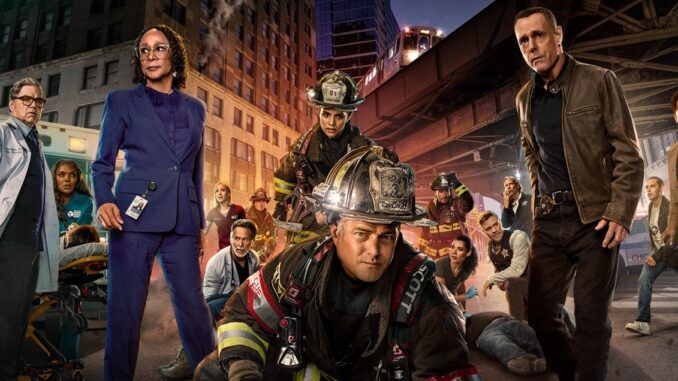
For more than a decade, One Chicago crossovers have followed a familiar rhythm: a case begins on one show, spills into another, and resolves by the end of the night. It’s a reliable formula—comforting, even. But the 2026 crossover is different. This time, NBC and Wolf Entertainment aren’t just passing a storyline from Chicago Fire to Chicago P.D. to Chicago Med. They’re testing whether a long-running broadcast franchise can evolve into something far more ambitious: a cohesive, cinematic event that treats three series as chapters of a single film.
That shift alone makes the 2026 crossover a high-stakes experiment.
At first glance, the setup feels classic One Chicago—shared emergencies, overlapping characters, escalating tension. But beneath the surface, the creative approach signals a deliberate departure from the traditional “hand-off” structure. Instead of each show protecting its own narrative bubble, the crossover reportedly unfolds as one continuous story, with character arcs, emotional consequences, and visual language carrying seamlessly across all three hours. The goal isn’t just connectivity. It’s immersion.
What makes this risky is that One Chicago has never truly needed to change. The franchise remains one of broadcast TV’s most dependable performers, anchored by loyal viewers who value consistency. Experimentation, especially at this scale, introduces uncertainty. When you blur the lines between shows so completely, you risk alienating casual viewers who tune in for just one series. You also raise expectations—once audiences taste something cinematic, it’s harder to go back.
Yet that’s exactly why this crossover matters.
The 2026 event appears designed to be watched not as episodes, but as acts. Chicago Fire doesn’t simply ignite the crisis; it establishes tone. Chicago Med doesn’t just treat the wounded; it deepens the moral and emotional stakes. Chicago P.D. doesn’t merely hunt answers; it delivers the consequences. Each hour builds on the last, not structurally, but emotionally. Miss one chapter, and the story doesn’t quite land the same way.
This approach borrows more from prestige streaming dramas than traditional network procedurals. It assumes audience commitment. It trusts viewers to follow nuance, remember details, and track emotional continuity. That trust is bold—and dangerous—on broadcast television, where episodic accessibility has long been the rule.
Cinematically, the crossover is also pushing boundaries. Reports point to a more unified visual style across all three shows during the event: darker lighting, longer takes, fewer resets between scenes. Rather than snapping back to each series’ usual pacing, the crossover maintains momentum, allowing tension to breathe and emotions to linger. It’s less about spectacle and more about weight.
That weight is crucial, because the 2026 crossover isn’t just about plot—it’s about legacy.
One Chicago is at a crossroads. Veteran characters are returning. Others are stepping back. The franchise is clearly aware of its own history, and this crossover functions as both celebration and stress test. Can these characters still carry a story that demands this level of emotional and narrative investment? Can a network franchise built on repetition reinvent itself without losing its soul?
The answer depends largely on character integration. Early indications suggest the crossover doesn’t rely on novelty pairings for fan service. Instead, it leans into relationships that already exist—professional trust, old wounds, shared trauma. When characters cross into unfamiliar territory, it’s not for gimmicks, but for growth. That restraint gives the experiment credibility.
There’s also a strategic reason NBC is willing to take this risk now. In an era where streaming dominates the conversation around “event television,” broadcast networks are under pressure to prove they can still deliver must-watch moments. A crossover that feels like a three-hour movie airing live, in sequence, is a statement. It says broadcast TV doesn’t have to imitate streaming—it can adapt its own strengths.
But adaptation always comes with a price.
If the crossover succeeds, it raises the bar for everything that follows. Viewers may expect future crossovers—or even standalone episodes—to carry similar narrative ambition. If it fails, it reinforces the argument that procedural franchises should stick to what they know best. There is very little middle ground.
Perhaps the most fascinating aspect of this experiment is its emotional intent. Rather than resetting characters by the end of the night, the 2026 crossover is expected to leave marks—decisions made here will echo into subsequent episodes across all three shows. That alone challenges one of broadcast TV’s oldest safety nets: the clean slate.
In other words, this crossover dares to matter.
Beyond the explosions, rescues, and investigations, the real experiment is whether One Chicago can convince its audience to experience the franchise as a single, living universe rather than three parallel comfort shows. It’s a gamble rooted in confidence—confidence in its characters, its viewers, and its longevity.
The hand-off is over. What comes next is something closer to cinema than television routine. And whether it soars or stumbles, One Chicago’s 2026 crossover may be remembered as the moment the franchise chose evolution over safety—and found out just how far its universe could stretch.