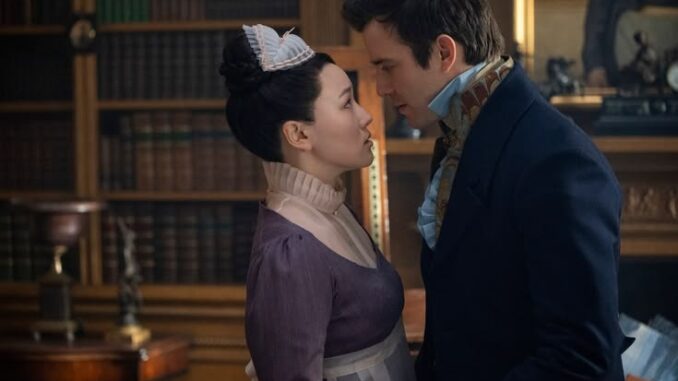
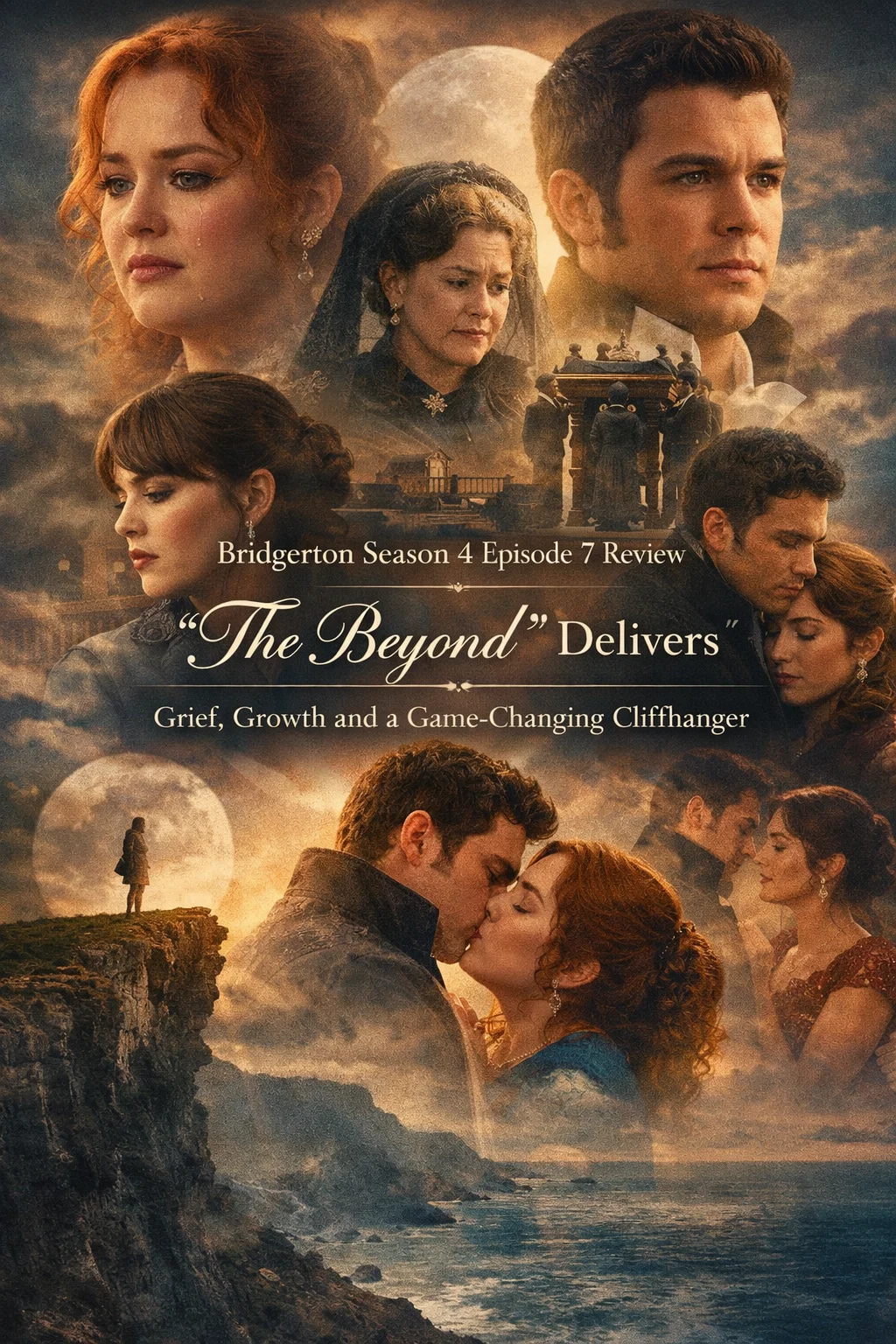
Bridgerton Season 4, Episode 7, “The Beyond,” gives Benedict and Sophie a fighting chance, and it’s also a penultimate outing unlike any other in the show. This episode, written by Tess Leibowitz and directed by Anya Adams, wades through the vastness of grief and inspects society’s expectations with a magnifying glass. “The Beyond” feels like a tonal expansion for Bridgerton. Even so, it’s not jarring since this season builds to this place. It’s darker in its content and composition (There’s little daylight or artificial light).
The episode’s opening portrays how the main cast of characters exist in contrast to the ton at the moment. That world still spins with color and laughter, with bee decorations that feel like salt in the wound. Meanwhile, Kilmartin House and Bridgerton House are shrouded in mourning black as they participate in the accepted societal customs to mourn John. There are no pop music covers. There are no Lady Whistledown pamphlets. There’s no familiarity, in that regard, to cling to during this trying and sometimes uncomfortable time.
The Loss of John Stirling
“The Beyond” is untethered from those guides as Bridgerton illustrates the ripple effects of John’s death. For instance, the Bridgertons’ grief over their patriarch is an ever-present undercurrent, but this episode makes that loss another character. “The Beyond” pierces time when Hyacinth voices that she wasn’t at Edmund’s funeral. (And Gregory is trying to lift her spirits!) Her realization that so many men have died understandably snowballs into a harsher reality of love that shocks her out of any fantasy.
Hyacinth’s new perspective shines a different light on Eloise. She doesn’t want her sister to become jaded, rejecting any simplified perceptions of Eloise’s perspective. Her disappointment in seeing that spark disappear in Hyacinth proves that Eloise has more complex thoughts on love and marriage. On the other hand, Eloise’s presence in a scene discussing the cathartic effects of writing feels like a nod to a possible future.
The discussions about loss also open the door for Bridgerton to explore more about Marcus and his wife, Nessa. Sadly, most of that islost in his full (and endearing) support of Violet. Meanwhile, “The Beyond” even tugs on the prequel when Charlotte says that losing a husband at any age is awful. The grief also pulls back to Lady Danbury’s feeling of release when her husband died, and the pain of losing Lord Ledger.
The episode also frequently pivots in the opposite direction – to a distraction – when things become too comfortable or vulnerable. Charlotte switches the subject to Francesca’s attire when that conversation moves too close to her own feelings. That scene also productively uses its composition to show Alice’s progress, as she’s in front of the ladies-in-waiting. Also, the line, “It is a shame when a good thing changes,” reaches across practically every story.
Francesca and Michaela Grieve Differently
Hannah Dodd is remarkably raw and real in “The Beyond.” It feels honest for Francesca to cling to the calm amid grief’s chaos, pivoting to biscuits. That scene plays similarly to one of TV’s best – Rebecca Pearson eating the candy barn This Is Us. That choice results in one of the best and most heartbreaking Bridgerton sibling scenes in the show. The only thing that could make it better is if every sibling were in it (At least Anthony and Kate sent flowers).
The confirmation of Francesca’s false pregnancy is akin to the invasive procedure in Queen Charlotte: A Bridgerton Story. Benedict’s reaction to Dundas’s persistence to get there is personal, tied to his obstacles in loving Sophie, but also his love for his sister. That bond is present in that piano scene at the piano. It’s endearing, honest, and ties back to Benedict’s struggle with commitment. (Again, it’s fun to watch Luke Thompson pretend to be less than excellent at piano). Society’s reach knows no bounds; Benedict’s outburst is justified – and accepted. The same would not be true for Francesca.
“The Beyond” also features the first Francesca and Sophie scene that organically provides more of Sophie’s backstory. Its content – knowing different versions of the same person – folds into Francesca and Violet’s scene. There, Dodd steals the episode. Francesca’s desperation and exhaustion for Violet to understand that her grief is different from Violet’s is palpable. It’s a stunning reflection of Francesca’s fears that she hasn’t lived up to the role she was meant to fill.
All the while, Masali Baduza showcases another side of Michaela – the cut to her on the other side of the wall! It’s also reasonable that Francesca and Michaela bump heads. Francesca grieves the way she believes is proper, and it takes time for her to move away from that. Logically, Francesca’s steadfast approach to the grieving process chafes against Michaela’s experiences in Scotland. Those distinctions isolate them until they bring them together, where they find joy in the stag dance and a celebration of John.
A Mother and Her Son
In the Season 3 finale, John tells Violet that he sees her openness in Benedict, and her scenes with her son in this episode test that quality. Their initial confrontation is a valve-release for Benedict, who apologizes for going too far. Even so, there is truth in what he conveys – Violet stands for love matches for her children, but society dooms Benedict’s love match. That dialogue is also the first time that Benedict says he loves Sophie to someone who isn’t her. That’s a perfect beat for Violet to realize how serious her son is about Sophie.
“The Beyond” backs that scene up with one between Sophie and Violet. It’s short, but it focuses on the seriousness of this match – both in feeling and impact. Ruth Gemmell supports that by packing so much into Violet, saying, “I wish the world were different.” The reality is that the Bridgertons’ world is different after losing John. So, it’s understandable that Violet’s take changes. It’s also evident that she approaches the context of Benedict and Sophie’s future from a different perspective than Anthony.
Violet’s approach is more about Benedict wanting him to understand his choice, whereas Anthony doesn’t want Benedict to make it. Therefore, Violet’s monologue is paramount; from how the loss of his father impacted him to the effects of his privileged life, Benedict needs to hear it. Even as Benedict is more receptive to grasping the gravity of an isolated future with Sophie, there’s still a part of him that doesn’t think Sophie wants him. “The Beyond” takes the time for Benedict to move from denial to acceptance there. It’s moving for Francesca’s speech about love outweighing pain to be Benedict’s final push.
Movement at Penwood House
Meanwhile, Sophie feels disconnected from her mother after losing her necklace, which corresponds with losing a part of herself by being “caught up” with Benedict. The truth lies in Sophie finding herself through love, so the symbolism of Benedict finding that part of her really sings on screen. Notably, that necklace (and the glove) inspires him to pull the portraits of the Lady in Silver and Sophie Baek together – to see the whole person.
Araminta is a key player in making Sophie believe that her mother’s experiences are mistakes. Relatedly, “The Beyond” contextualizes Araminta’s motivations through her own losses. The earlier flashbacks tease what Araminta articulates – she moves from being like Posy to being more like Rosamund. It’s unfair that Araminta had to walk a tightrope when society believed her to be “damaged goods.” That alone reflects society’s cyclical efforts to maintain the marriage mart.
That scene explains, not excuses, why Araminta calls Sophie a “bastard child” and a “stain on our name.” To Araminta, Sophie is the mistake Araminta has tried to avoid to secure a life for her and her daughters. Sadly, instead of choosing otherwise, Araminta perpetuates society’s toxicity. Posy, on the other hand, is clear-headed in using others’ underestimation of her to her advantage to protect Sophie. Benedict Bridgerton may not climb out of his bedroom window at My Cottage, but Posy does in “The Beyond.”
Isabella Wei and Yerin Ha shine in this scene with a Cinderella reference. (Posy tells Sophie, “You were always so kind and courageous.”) It’s beautiful that, amidst new levels of uncertainty, Posy reminds Sophie that she gets her strong will from her mother. It’s not something that can be lost; it’s a part of her. Perfectly representing the character, Sophie doesn’t let Posy leave without reminding Posy of her strength, too.
Benophie’s Secret, Stolen Moments
The Benedict and Sophie scenes in “The Beyond” come with less frequency. When they do, they pack a punch and call back to Henry Granville’s words to Benedict in Season 1. Benedict and Sophie are stealing glances (one of which Lady Danbury sees) and disguising their touches. Perfectly, Benedict goes outside to feel the cold, only for Sophie to accidentally find him there, making him feel the opposite – warmth, comfort. His body language tries to close him off to protect himself from a more fractured heart. Benedict’s self-proclaimed torment over her is visible when he tries to distance himself from her.
There’s still sharp banter and palpable chemistry between them, as there has been from the start. Also, Sophie doesn’trealize how much Benedict needs to hear that his siblings are lucky to have him. He spends much of the episode apologizing for not doing enough, for not being Anthony. That self-doubt snowballs into panic in the study, where Sophie grounds him. This scene feels like Bridgerton’s version of the book’s “Let me be your anchor.”
Any intimacy is fleeting between the characters, butHa and Luke Thompson know how to mine gold in even those short scenes. It’s enough for Benedict for Sophie to reach her hand out first, for their foreheads to touch, for him to finally take a breath. It’s yet another example of Bridgerton depicting love as a lifeline that exists alongside death. “The Beyond” (and the show, as a romance) holds it as something to cherish.
The episode’s structure echoes that. Starting with a funeral and ending with a wake compelements Benedict moving from losing hope to gaining it back. There’s a clear arc from being in darkness to finding light. That’s in Francesca’s effective speech, too. The edit of Benedict racing to find Sophie feels like this season’s spin on that romantic comedy trope. Then, Benedict’s hope contends with Sophie’s lack thereof, having left any trace of the fantasy behind with the glove (How did she get that back from Cavender House?). Little does she know that’s the final clue Benedict needs to put it all together, giving Bridgerton Season 4’s penultimate episode one eventful cliffhanger.