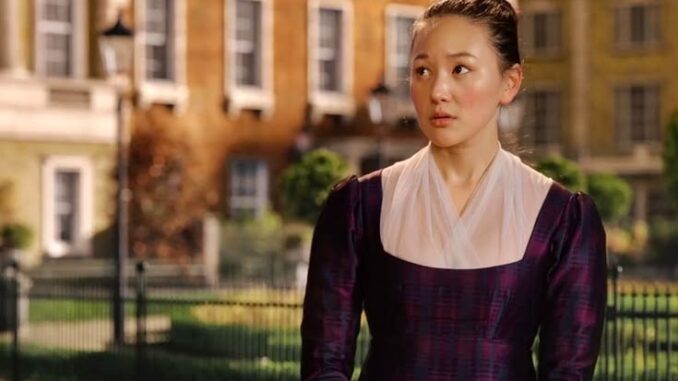
Just in time for the season of love, “Bridgerton” Season 4 celebrates the romance between Benedict Bridgerton (Luke Thompson, “Transatlantic”) and Sophie Baek (Yerin Ha, “Halo”).
After the litany of criticisms of the previous season, from its fragmented and overstuffed subplots to its rushed romance, I was skeptical of what “Bridgerton” Season 4 had to offer. Even so, the praise for continued Asian representation within the series and the prospect of seeing free-spirited Benedict transform into a reliable gentleman brought a semblance of hope that perhaps this season would surpass expectations.
I was hesitant to believe that this season would accomplish feeling new — its central plot uses an endlessly retold fable, largely to protect against poor on-screen chemistry. I have no qualms with retellings — they give writers a chance to offer refreshing reimaginations of familiar narratives — but when they’re used as a crutch and add nothing new, I question the use of the trope in the first place.
“Bridgerton” Season 4 adds to the vast canon of “Cinderella” retellings, casting Benedict as its Prince Charming and housemaid Sophie as its damsel in distress. The two first meet serendipitously at Lady Violet Bridgerton’s (Ruth Gemmell, “Penny Dreadful”) masquerade ball, but Sophie flees at the strike of midnight, dropping one of her gloves instead of leaving behind a shoe. What ensues for the rest of the season is Benedict’s wild goose chase to find the mysterious woman — dubbed later as “the Lady in the Silver Gown” — who had so deeply enchanted him at his mother’s ball.
Outside the main fairy-tale plotline, Season 4 contains various subplots, adopting an ensemble cast like the previous season. However, whereas Season 3’s extra storylines felt disjointed, mainly contributing to the development of the main couple’s relationship, the most recent season writes subplots that don’t overpower the main love story. Instead, they highlight relationship struggles not often presented in period pieces — let alone modern media.
Violet’s romance with Marcus Anderson (Daniel Francis, “Once Upon a Time”) navigates the insecurities of physical intimacy at an older age. Francesca Bridgerton’s (Hannah Dodd, “Find Me in Paris”) doubts as a newlywed prompt hesitations about her steady marriage with Lord John Stirling (Victor Alli, “Last Light”). Queen Charlotte’s (Golda Rosheuvel, “Queen Charlotte: A Bridgerton Story”) possessiveness of Lady Agatha Danbury (Adjoa Andoh, “Queen Charlotte: A Bridgerton Story”) pays homage to their long-standing friendship, which the prequel gave us context for.

Despite these nuanced portrayals of love from the sidelines, our main players sadly do nothing but predictably rehash a classic fairy tale. Benedict is completely enamored by Sophie, not because of her beauty, nor her personality, but because she wasn’t like the other girls. She didn’t try embarrassingly hard to impress him or catch his attention by aggressively fluttering her hand fan and batting her eyelashes. His attraction to her is solely based on the fact that she was more taken by the spectacle of the ball than the most eligible bachelor in the room. Their relationship is hinged on mystique and light banter about surface-level nothingness, like deep and shallow waters, which are hardly any grounds for grand declarations of love, let alone marriage proposals and edits of romantic tension.
As of Part 1, the two have yet to have a vulnerable heart-to-heart connection, one where they’re doing more than smiling, teasing and laughing at each other. Whether it be at the ball where Sophie is percieved as a fine lady or at Benedict’s countryside cottage where Sophie is just a modest maid, their dialogue is hardly meaningful enough to be remembered. Benedict is in a strangely shaped love triangle (or just a straight line?) where he falls for both Sophie and her alter ego “Lady in Silver,” but his interactions with both never really go past marvel and intrigue. His conversations with Sophie typically revolve around his fascination with her level of literacy and his advances towards the “Lady in Silver” are driven by her vague responses. Benedict hasn’t changed since we’ve last seen him: only excited by the thrill of the chase, but never the prize.
While watching the show, I couldn’t help but think back to successful adaptations of the “Cinderella” story with thought-provoking takes that established romances on more than the magic of a good disguise. In The Selection book series, the Crown Prince Maxon develops a friendship and reverence for protagonist America after she shares her experiences from her childhood growing up in poverty, resulting in a relationship founded on mutual respect. In “Cinder” from the Lunar Chronicles Series, the central relationship is challenged through civic duties and dark secrets, making the happily ever after all the more rewarding. “Bridgerton” Season 4 could have spun its “Cinderella” story in more interesting ways, like illuminating Benedict on the working conditions of maids or illustrating Sophie as an active agent in her life, rather than waiting for Benedict’s noble rescuing.
Clearly, “Bridgerton” Season 4 needs to rethink its definition of building chemistry because the only representation on screen right now appears to be a Regency-era version of a situationship. Our generation doesn’t need a poorly rewritten “Cinderella”-esque romance — we lack an illustration of commitment and authenticity. There is still half of the series left, so let’s hope that our resident rake can finally learn what it means to commit oneself to another.