Major spoilers for “Bridgerton” Season 4.
The second part of “Bridgerton”’s fourth season dropped on Netflix on Feb. 26, bringing the final four episodes of Benedict Bridgerton (Luke Thompson) and Sophie Baek’s (Yerin Ha) Cinderella-inspired love story to a close. It arrives with a noticeably sharper emotional edge than what audiences have come to expect from the beloved period romance. Gone is much of the breezy flirtatious lightness that defined earlier seasons. In its place is something more grounded, more introspective and, depending on your tolerance for the slow-burn trope, more rewarding.
Part 2 picks up almost immediately after Part 1 left off, with Sophie still reeling from Benedict’s request that she become his mistress following their charged kiss on the back stairwell of Bridgerton House. It is a gut-punch of an opening. Sophie, a hardworking maid whose own mother was a maid-turned-mistress, flees the scene without giving an answer, and what follows is a season-long reckoning with what it actually means to love someone across an impossible class divide.
While Part 1 felt like a fairly straightforward Cinderella retelling, Part 2 steps beyond the fairy-tale trope to address passion, loss and what is truly at risk for high-society women who fail to secure a good match in the Regency-era marriage market. The narrative slows down just enough to let those stakes breathe, allowing characters to confront insecurities, social expectations and personal flaws in ways that feel genuinely earned. What immediately stands out is how deliberately the writing handles emotional payoff this time around. The mystery that drove so much of the season’s earlier tension—Benedict’s relentless search for his Lady in Silver—finally resolves in Episode 7 when he discovers that both Sophies, the woman he has fallen for and the masked stranger from his mother’s masquerade ball, are one and the same. Her lost necklace, once belonging to her late mother, becomes the key that unlocks the truth. It is the kind of reveal that lesser shows would rush. Here, it lands with real weight.

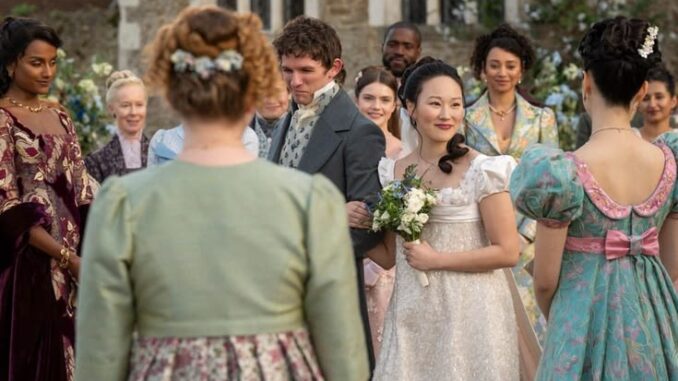
The season also delivers a satisfying confrontation with one of the show’s more compelling villains. Sophie’s scheming stepmother, Araminta, had long manipulated Sophie into believing she was excluded from her late father Lord Penwood’s will, trapping her in a life of servitude. It takes Benedict, armed with fresh eyes and genuine love for Sophie, to finally point out that Sophie had never actually seen the will herself. It is one of the most quietly powerful moments of the season, a reminder that love, at its best, helps people see what they could not see alone. The finale seals everything with a surprise mid-credits wedding scene at My Cottage, the country estate where Benedict and Sophie’s relationship first began to flourish, closing their arc with exactly the warmth and intimacy the story had been building toward.
The production design continues to be nothing short of extraordinary. Ballrooms drip with candlelight, and every frame feels like it was pulled from a fever dream of Regency-era excess. Costumes do a great deal of narrative heavy lifting, with subtle shifts in color palette and silhouette tracking character development in ways that reward attentive viewers. But the real emotional work of Part 2 happens far away from the ballrooms, in drawing rooms barely lit by firelight, in garden conversations cut short by approaching footsteps and in late-night exchanges where characters finally say the things they have been avoiding for weeks. The supporting storylines add considerable texture to the season. Penelope Bridgerton—now publicly known as the infamous Lady Whistledown—grapples with being in the spotlight, while a younger Hyacinth begins to reckon with the pressures of an impending debut season and the question of what it actually means to find a compatible match. Lady Danbury pushes for the freedom to forge her own path, while Lady Violet Bridgerton and Lord Marcus Anderson decide what they genuinely want from the next chapter of their lives.
The pacing does occasionally work against the show. Certain emotional conflicts circle the same territory one too many times before moving forward, and a handful of supporting subplots feel like they were given a strong opening act without a satisfying follow-through. The show is clearly juggling a lot of storylines at once, and not all of them land with equal weight. Still, when Part 2 pulls everything together in its final stretch, the payoff is remarkable. The season closes with emotional resolution rather than manufactured cliffhangers, which feels like a conscious and confident choice from the writers. Some storylines wrap cleanly. Others leave threads deliberately loose, setting up what comes next without feeling manipulative.
Bridgerton has always been a show that knows exactly what it is. Part 2 suggests it is also figuring out what it wants to become. That evolution, uneven as it sometimes is, makes it one of the more interesting ongoing dramas on streaming television right now.