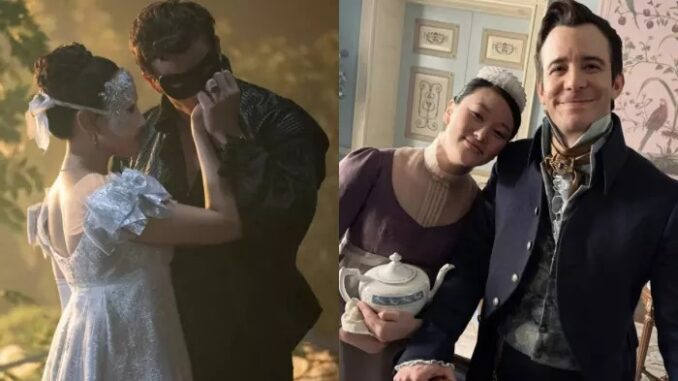
By the time Benedict Bridgerton stands in Sophie Baek’s bedroom holding a silver glove he’s carried for weeks, finally—finally—understanding that the woman he’s been searching for and the woman he’s fallen in love with are the same person, Bridgerton has earned something it’s been chasing since its premiere. Genuine. Emotional. Resonance. And resonance, by the way, that transcends spectacle.
Bridgerton Season 4 Part 2 does what some of the best romance storytelling manages. It makes you believe the obstacles matter while delivering the happy ending you came for. This is trickier than it sounds. The genre demands satisfaction, after all. The best examples of that genre also demand you work for it. That the path from separation to union feels emotionally true rather than mechanically inevitable. These four episodes—”Yes or No,” “The Passing Winter,” “The Beyond,” and “Dance in the Country”—thread that needle better than any Bridgerton season to date, including the previously unimpeachable Season 2.
Which brings us to an admission. This is indeed the show’s best season. There. Said it.
The Education of Benedict Bridgerton.
Bridgerton Season 4 Part 2 opens where Part 1’s cliffhanger left off. Benedict has asked Sophie to be his mistress, and Sophie has responded by burning his letters and avoiding him entirely. The episode’s title, “Yes or No,” turns out to be somewhat misleading. Sophie gives no verbal answer at all. Her silence is the answer. The point of the episode is watching Benedict fumble his way toward understanding why silence is the answer.
Luke Thompson has spent three and a half seasons playing Benedict as the sensitive Bridgerton. The artistic one. The brother who reads poetry and questions social conventions while still enjoying every privilege those conventions afford him. In Part 2, the show finally calls that bluff. Benedict has imagined himself progressive, enlightened, different from his peers. Then he offers the woman he loves a position that would strip her of dignity, security, and any hope of a respectable future. And he even seems surprised when she’s insulted.
The mistress proposal reveals something crucial about Benedict. He lives in fantasy. He sketches obsessively. Escapes to his country estate. Imagines a world that operates by his desires rather than its actual rules. Sophie lives in brutal reality. She knows exactly what becoming a mistress would mean because her mother died as one. Died with no money, no title, no dignity, no husband. And most importantly, no legal protections for herself or her child.
No woman wishes to be hidden.
Will Mondrich’s intervention gives Benedict the framework he needs, though. “No woman wishes to be hidden. If you cannot trust her with legitimacy, how can she trust you with her heart?” It’s a simple observation that cuts through Benedict’s romantic delusions. Love that requires one person to sacrifice everything while the other sacrifices nothing isn’t love. At best, it’s inequality dressed in softer language.
Watching Benedict process this education—actually process it, not just perform understanding—makes his eventual love confession in Episode 5 feel earned. When he tells Sophie he could never look twice at another woman, when he says he loves her without conditions or contingencies, you believe him.
Thompson sells the transformation from entitled obliviousness to vulnerable honesty. Benedict has become, against all odds and previous characterization, Mr. Darcy. A man whose privilege blinded him to his own shortcomings until love forced him to see clearly.
Yerin Ha’s star-making season.
Sophie Baek could easily have been a passive figure in her own story. Just the mysterious woman at the ball, the object of Benedict’s search. The reward for his growth. But Yerin Ha makes that interpretation impossible.
Ha plays Sophie with a sharp intelligence that cuts through every scene. This is a woman who has survived impossible circumstances through quick thinking and careful self-protection. She’s educated herself beyond her station. Speaks multiple languages. She understands art and literature and music. The tragedy is that all this intelligence, all this capability, means little when society has decided her birth makes her worthless.
The scene in Episode 5 where Sophie confides in Alfie about the mistress proposal showcases Ha’s range beautifully. Sophie lets Alfie imagine the luxuries—the fine dresses, the comfortable life—before quietly grounding him in reality. Her delivery of the lines about her mother’s fate carries zero melodrama. Only matter-of-fact acknowledgment of what awaits women in her position. Ha makes Sophie’s refusal of Benedict an act of self-preservation rather than romantic martyrdom. She’s protecting herself because she’s the only one who will.
High standards for the “low” class.
Later episodes deepen Ha’s showcase. The pregnancy scare in Episode 6 plays out almost entirely through Ha’s physical performance. The counting of days, the quiet panic, the recognition that consequences fall on her body. Not Benedict’s. When Sophie overhears Anthony telling Benedict that their children would be outcasts, Ha’s face shows the death of hope in real time. She knows Anthony is right. She knows Benedict’s love, however sincere, might not be enough.
By Episode 8, when Sophie faces Araminta Gun at the Queen’s ball—wearing silver with a bit of Bridgerton blue, with Benedict and Violet flanking her—Ha has completed Sophie’s arc from frightened servant to woman who claims her space in the world. The confrontation with Araminta could have been pure triumph, but Ha plays it with something more interesting. Satisfaction…mixed with sorrow. Sophie has won. But winning required surviving years of cruelty. That cruelty doesn’t disappear just because the story has a happy ending.
Overall, Ha carries this season. Her chemistry with Thompson gives the central romance its heat, obviously. But more than that, she makes you understand why Benedict becomes the man worthy of her. Sophie’s standards are high because they have to be. Watching Benedict rise to meet them provides the season’s key emotional arc.
Four Weddings and a Funeral (Literally?!)
Leave it to Bridgerton to look at the beloved Richard Curtis formula and think, “Yes, but what if we made it absolutely devastating?”
John Stirling’s death at the end of Episode 6 represents the show’s biggest risk this season. Book readers knew it was coming. The rest of us watched with growing dread as John mentioned a headache, went to lie down for a nap, and then simply… didn’t wake up. Francesca’s discovery of his body hits like a gut punch precisely because the show has spent Part 1 making us love John’s gentle kindness.
Episodes 6 and 7 become a two-part meditation on grief that’s unlike anything Bridgerton has attempted before. Hannah Dodd’s performance as Francesca navigates grief’s stages with devastating realness. Francesca throws herself into funeral planning, convinces herself she’s pregnant with John’s child, submits to a humiliating medical examination, and then shatters completely when told she’s carrying no heir.
The breakdown scene where Francesca screams at Violet about having nothing left of John while her mother has eight children to remember Edmund by is truly raw. And raw in a way that Regency propriety usually doesn’t permit on this show.
Proper grievances.
The funeral episode’s title, “The Beyond,” takes on multiple meanings. John has gone beyond. Francesca must move beyond her grief. The show pushes beyond its usual tonal range. Showrunner Jess Brownell’s explanation that grief presents in so many different ways manifests in the contrast between Francesca’s rigid English composure and Michaela Stirling’s Scottish celebration of life. Masali Baduza brings chaotic energy to Michaela that forces everyone around her to reconsider how they mourn, how they love, how they live.
The celebration at Stirling House—with toasts and Scottish dancing and actual joy in remembering John—provides catharsis the traditional funeral couldn’t. More importantly, it gives Francesca permission to feel something other than devastation. Dodd’s delivery of the line about John making her feel like she belonged, about his love outweighing the pain, transforms grief into gratitude without diminishing loss.
This funeral matters for another reason. It sets up Francesca’s eventual(?) romance with Michaela while treating John’s death with true respect. Too often, television kills off sympathetic partners to make room for new love interests, treating the death as plot convenience. Bridgerton takes seven episodes to earn John’s death and another episode to properly grieve him. Whatever comes next for Francesca and Michaela—and the season finale’s hints are substantial—will be built on this foundation of loss and healing rather than rushed into while the body’s still warm.
The class politics question.
Here’s where things get complicated. Bridgerton Season 4 Part 2 (and Part 1) makes class barriers more central to its romance than any previous season. Sophie’s entire existence is defined by class, after all. She was born illegitimate to an earl and a servant, raised as a “ward” (legal euphemism for bastard), reduced to unpaid domestic labor after her father’s death. Episode 1’s revolutionary opening—a single-shot sequence following servants preparing Bridgerton House—announces the show’s intention to finally notice the people who make aristocratic leisure possible.
The servants aren’t just scenery anymore. Alfie, Irma, Hazel, Mrs. Crabtree—they have names, personalities, perspectives. Alfie’s scene with Sophie about the mistress proposition is one of the season’s highlights precisely because it comes from someone who understands both the fantasy and the crushing reality of such arrangements. When Mrs. Crabtree scolds Benedict for taking advantage of Sophie by flirting and leading her on while he has such power and authority over her, she’s the only character who explicitly names what everyone else politely ignores.
The show deserves credit for this engagement. Sophie’s precarity is real and constant. She’s dismissed without pay, blacklisted from employment in London, arrested on false theft charges, and faces sexual violence from men who assume servants have no right to refuse. The stakes feel grounded because the show takes time to establish how narrow Sophie’s options are. Every decision carries consequences for her in ways they never do for Benedict.
Manufactured legitimacy.
Then Episode 8 reveals that Lord Penwood left Sophie money in his will. Araminta just stole it. On one level, this works. The inheritance provides Sophie financial independence and a degree of legitimacy that makes marriage to Benedict socially plausible rather than completely scandalous. The show has established that Penwood loved Sophie, so discovering he provided for her makes emotional sense. Sophie’s confrontation with Araminta at the ball becomes about reclaiming what was rightfully hers, not just accepting Benedict’s rescue.
On another level… this is manufactured legitimacy. The class barrier that defined eight episodes gets erased through plot convenience rather than Benedict genuinely defying society’s rules. The show spent Part 1 establishing that Benedict lives in fantasy while Sophie lives in reality, then solves their problem with a classic romance novel deus ex machina.
Does this undermine the political engagement? Well, sort of. Does it satisfy genre expectations? Completely. The question becomes what you prioritize. A romance that truly challenged class hierarchy would require Benedict to sacrifice everything—his family relationships, his social standing, his inheritance—for Sophie. That’s a different story, probably a darker one, certainly not the confection Bridgerton promises.
Is it good enough?
The compromise the show reaches feels at least somewhat honest about its limitations. Benedict commits to Sophie before knowing about the inheritance. His willingness to marry her despite his family’s objections and society’s censure does matter, even if the plot then makes that sacrifice less costly.
The wedding at My Cottage rather than in London society sort of acknowledges they’re still somewhat outside the system. Their happiness comes with asterisks. Or, to be fair, the show could simply be signaling that this is where Sophie and Benedict really fell in love. Maybe.
For a show that wants to be both politically engaged and romantically satisfying, this might be as good as it gets. The class politics are more than set dressing, even if they’re ultimately not quite revolutionary. Sometimes a 7 out of 10 on the political courage scale is the price of a 10 out of 10 on the romantic satisfaction scale.
What Bridgerton Season 4 Part 2 gets right.
This is an easy one. The chemistry. Benedict and Sophie’s physical relationship in Part 2 addresses Part 1’s biggest weakness: the muted passion. Episode 5’s love scene and confession sequence finally gives the season the heat it needed. Thompson and Ha generate real desire, real yearning, real sense that these two people belong together in every sense.
The supporting storylines in Bridgerton Season 4 Part 2 mostly cohere. Violet’s romance with Marcus Anderson provides lovely parallel to Benedict’s journey—a widow claiming sexual agency and choosing happiness without apology. Ruth Gemmell brings quiet radiance to scenes where Violet admits her desire and accepts Marcus’s proposal. The show treating mature female sexuality with respect and joy rather than embarrassment or invisible erasure deserves applause. It’s sad that they break up in the end, but it still feels like Violet is in control of her own romantic destiny moving forward.
Penelope’s struggle with Lady Whistledown’s retirement gives Nicola Coughlan actual material to work with after Part 1 left her somewhat adrift post-reveal. The dynamic with Queen Charlotte—Whistledown as the Queen’s window to the world she rules but doesn’t fully access—adds weight to Penelope’s decision to rest her pen.
Anything else?
Golda Rosheuvel and Adjoa Andoh’s scene together after Penelope’s announcement, with barely four words exchanged, demonstrates the depth of Charlotte and Danbury’s friendship through shared grief at losing their connection to society’s pulse.
Hyacinth’s transformation from boy-crazy debutante to young woman terrified of love’s potential for loss provides surprising emotional depth. Florence Hunt plays Hyacinth’s realization that loving someone means risking the devastation Francesca experiences with serious fear. Eloise’s recognition that she might have steered her sister wrong opens space for both characters to grow.
Even Cressida Cowper’s return as the new Lady Penwood adds some interesting texture. Jessica Madsen plays Cressida’s attempted social rehabilitation with perfect awareness that she’s one scandal away from ruin again. The apology to Penelope lands as desperation disguised as reconciliation—Cressida needs Penelope’s favor to survive, and both women know it.
Where Part 2 loses its shoe.
The pacing stumbles quite a bit in Episode 6. Too many storylines compete for attention—Sophie’s pregnancy scare, Anthony and Kate’s return, Cressida’s ball, Penelope’s Whistledown drama, the setup for John’s death—and the episode occasionally feels overstuffed. Individual scenes work, but the connective tissue frays.
The split release strategy does the season no favors. Waiting four weeks between Part 1’s cliffhanger and Part 2’s resolution interrupted momentum in ways that harm both halves. Episode 5 has to re-establish emotional stakes Part 1 built, and the finale lacks the cumulative power eight episodes released together might have generated.
Some character beats rush. Benedict’s discovery that Sophie is the Lady in Silver should feel monumental—it’s the central mystery of his entire season. The sequence itself works (the necklace, the glove, the recognition clicking into place), but it happens relatively quickly in Episode 7 when that revelation might have sustained more buildup.
The Araminta resolution, while satisfying on a visceral level, ties up too neatly. Katie Leung plays Araminta as a woman whose cruelty stems from her own precarious social position—she’s one bad season away from losing everything, which is why she clings to power over Sophie so viciously. The show understands this but doesn’t quite know what to do with it beyond making Araminta the cartoon villain who gets her comeuppance.
The epilogue problem (which isn’t really a problem).
The wedding at My Cottage arrives in a literal end-credits scene. Seriously. It’s an epilogue that bookends the masquerade ball from Episode 1. Benedict paints Sophie’s portrait. Their friends and found family celebrate. Everything is soft focus and golden light and gentle happiness.
Some viewers will find this maybe too sweet, too easy, too willing to paper over the difficulties that would realistically plague a cross-class marriage in Regency England. Those viewers have a point. The show chooses fairy tale over emotional realism yet again.
But let’s not forget that in the romance genre, the happy ending is usually the point. The journey matters, the obstacles must feel real, the characters need to earn their resolution through growth and sacrifice. Once they’ve done that, though, romance is allowed to deliver uncomplicated joy.
Benedict and Sophie get their dance in the country. Francesca gets space to grieve and the promise of future love with Michaela. Violet gets to be a woman with desires beyond maternal devotion. Penelope gets to choose when she uses her power rather than being consumed by it. Hyacinth gets time to be young without rushing into adult heartbreak. Eloise gets to reconsider what she wants from life.
These endings feel good because the season earned them. Bridgerton Season 4 Part 2 committed to taking its stakes seriously enough that the payoffs land.
The bottom line.
Bridgerton Season 4 proves this show can evolve while maintaining its essential appeal. The show can engage seriously with class, death, sexuality, and power while still delivering the romantic fantasy viewers crave. Whether that balance satisfies depends on what you demand from your escapist entertainment.
For a show about wealthy people in fancy dresses falling in love, Bridgerton Season 4 Part 2 (and Part 1 of course) demonstrates surprising willingness to acknowledge the servants who make those dresses possible, the violence that maintains class hierarchy, the costs women pay for men’s privileges, and the reality that love alone doesn’t solve systemic inequality. Then it gives you the wedding anyway, because romance is also about believing that love—genuine, hard-won, mutually respectful love—can create small pockets of happiness even in unjust systems.
That might not be revolutionary. It might not even be truly radical. But it’s more thoughtful, more emotionally honest, and more complete than most television romance manages. Season 2 held the crown for a few years. Season 4 earned the right to take it. Sure, the class politics sort of chickened out, but the heart never did.