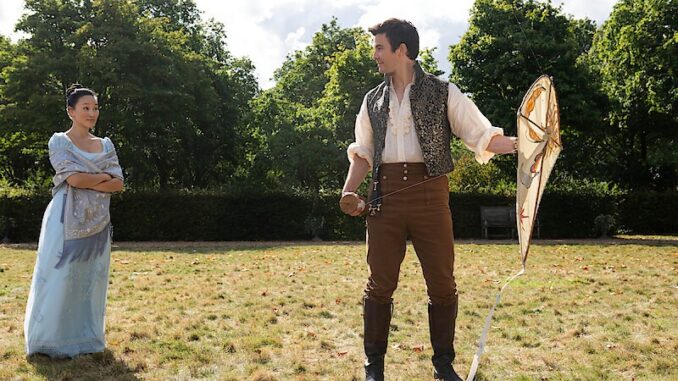
If “Bridgerton” Season 3’s big Part 1 cliffhanger was defined by the rush from that iconic carriage scene between Penelope (Nicola Coughlan) and Colin Bridgerton (Luke Newton), Season 4’s first half will be known for that whiplash of passion and rejection between Benedict (Luke Thompson) and Sophie (Yerin Ha) in the stairwell.
“First of all, that stairwell moment is something I had in my mind from the very beginning of the season,” “Bridgerton” showrunner Jess Brownwell tells Variety of the Part 1 finale scene that saw Benedict and Sophie passionately kissing and exploring each other’s bodies betwixt the kitchen and the family’s bedrooms at Bridgerton House. In a scene set to Caleb Chan’s instrumental version of Olivia Rodrigo’s “bad idea right?,” the two release all their inhibitions about their simmering upstairs/downstairs love, with Benedict going so far as to intimately touch Sophie under her dress, before he ruins it all by asking the young housemaid to be his mistress, rather than his wife.
“It felt like a really meaningful place for the two of them to have their first real encounter; in this liminal space between the upstairs and the downstairs,” Brownwell says. “I really love the way it came out. I think it is a really sexy moment — until, of course, that record scratch moment when Benedict asked Sophie to be his mistress. In part, we are trying to illustrate just how big the class divide was then. And I think truly, what Benedict asks would have been considered the only way for a man — a gentleman — and a housemaid to be together during that era. So it’s not that unusual for him to think that that’s romantic. However, in the larger context of this being the love of his life and us watching their love story, I think it’s absolutely the right reaction to be outraged and to be mad at him. So I think that reaction is correct and his lack of understanding about how it will come out is something we’re going to bring him up on in the back half.”
Elsewhere in Part 1 of the fourth season of the hit Shonda Rhimes romance: Penelope is trying to balance her personal life with Colin with her ongoing (and now public) job as Lady Whistledown, the Queen (Golda Rosheuvel) is refusing to let Lady Danbury (Adjoa Andoh) leave her longheld position as the top lady in waiting, Eloise (Claudia Jessie) is facing the reality of one day becoming a spinster as Hyacinth (Florence Hunt) is bursting with joy to join society, Anthony (Jonathan Bailey) and Kate (Simone Ashley) are still away in India with their newborn baby, Violet (Ruth Gemmell) is reviving her sex life, and newlyweds Francesca (Hannah Dodd) and John (Victor Alli) are having trouble communicating in the bedroom.
See below for more from Variety‘s interview with “Bridgerton” showrunner Brownell, including hints at what’s coming in Part 2 on Feb. 26, where things are headed for the upcoming fifth season of “Bridgerton,” which will be the first installment since Season 1 to focus on a Bridgerton daughter — and what’s planned for the remaining seasons of Julia Quinn’s eight-book “Bridgerton” series.
First thing’s first: Pen and Colin’s baby boy is named Elliot. This is clearly in honor of Eloise, yes?
Because we changed the gender of their baby so that they could win the Featherington Heir Race last season, we felt like we had an opening where we could be inventive about the name. And I think it just felt like a poetic way to close out a chapter of the Eloise-Penelope storyline by honoring Eloise with the name.
Moving to the Cinderella-esque storyline here for Season 4, how did you go about embracing the upstairs/ downstairs storyline from Julia Quinn’s book, “An Offer From a Gentleman”?
We wanted right away to signal to viewers that this is a different type of season and that you’re going to be let into places in this world that you’ve never been. So we dip in right away downstairs. I do think that “An Offer From a Gentleman” adapts himself really easily to television, because there are a lot of plot-driven visual set pieces in that book. So plot wise, it felt like we were able to follow it pretty closely. I feel like the Cinderella story, Julia Quinn is already invoking the trope and then turning it on its head a little bit, because the Sophie character, she’s not a maid waiting to be saved by a prince. She’s got pluck, she’s got moxie, she’s got all those words that you would use to suggest a woman who’s making her own way in the world. And our version definitely honors that character. And so we’re telling a story of not just a maid who wants to be with a gentleman, but also a gentleman who has to learn to grow to become worthy of the maid.

Part 1 includes the iconic masquerade ball, time spent at “My Cottage” — all of these callouts to the book that fans were looking for. Can you tease specific beats from the book that will be coming up in Part 2?
I don’t know how many spoilers we should give — but there are a couple key set pieces from the book in the back half. I will tease that there’s one light-hearted, sexy moment in the back half that is an homage to the book. And then there’s one darker set piece that we also invoke.
Luke Thompson has been with “Bridgerton” from the beginning. What conversations did you have with him as to how Benedict would look or act differently as a lead, or were there changes you didn’t want to make?
I think Benedict, at the very start of this season, he really hasn’t changed. It’s not until he meets Sophie, actually — or the masked woman, in this case — that he is inspired to change. So I think going into the season, there wasn’t a big glow up in the way that there have been for other characters. Frankly, Benedict has always been a really handsome, romantic character who presents in a glowed-up way from day one. But with each installment of this season, Luke was given the script to see how the character was going to change, and he really rose to the challenge of taking the character to a much more vulnerable place.
Benedict’s bisexuality was greatly explored in Season 3. You don’t shy away from that in Season 4, it’s definitely very much acknowledged in the first episode, but I want to know how you chose to navigate that, because ultimately he will end up with a woman character.
It’s really important that just because someone might end up in a heterosexual-presenting relationship, that does not negate their queerness. I think Benedict’s queerness will always be a piece of his identity. And when we were talking about representation, I don’t think there’s a lot of representation that I’ve seen of bisexual men. There is a really harmful and untrue stereotype that bisexual men are actually just gay men. More often, we see bisexual men ending up in media in homosexual-presenting relationships. And it felt fresh and important to see a bisexual man ending up in a heterosexual-presenting relationship and still owning the fact that he is still queer.
For the ball, masquerades are always complicated scenes because you have to wonder, how did you not know that was that person later, and figure that out? So how did you design what you wanted Sophie’s mask to look like, and toe the line between believability that later on, Benedict still would not be able to put it together he had met her and she was the one he’s been looking for?
I think there’s got to be a certain amount of willing suspension of disbelief. We definitely talked about putting Sophie in a full face mask, a wig, etc, and at the end of the day, the meeting between the masked woman and Benedict is so important that she needed to be able to emote, and that wasn’t going to happen in a full face mask. But I think what we’re really relying on is the fact that class was such a major divide in that time period that even for someone like Benedict, who is fairly progressive, he just would never expect that the lady that he’s been looking for who he met at a ball would be a housemaid. The staff were essentially invisible during that period, and his inability to recognize her is something we’re going to interrogate in the back half.
How did you decide how far you wanted Benedict and Sophie to go in that stairwell scene at the end of Part 1? We’ve seen examples in the show of not doing anything sexual until marriage, and we’ve seen carriage scenes. How do you decide what’s the right tone for the couple?
We let the characters lead how far the intimacy should go. And I think in this case, because Sophie’s origin story and her great trauma is about being an illegitimate child and being recognized, she is not a character who is going to, quote, unquote, go all the way unless she’s married. So that boundary that was baked into her character core really set the tone for us in terms of how far we could go with them, intimacy-wise.
Because we are waiting for that moment still for Benedict and Sophie, is that why you chose to focus on more intimate scenes with Penelope and Colin, Violet and Lord Anderson, and others in the first half, so that there was still that steaminess?
I don’t know that it was as calculated as, we’re not going to get there yet with Benedict and Sophie, so we’re going to do with other people, but more organically wanting to explore different kinds of intimacy from different characters. The Francesca story specifically I’m really excited about because I think on the show, obviously, people are always having magical simultaneous orgasms, and that fantasy is really fun, but also it doesn’t represent accurately most women’s experience. And so I think there’s actually something really empowering, hopefully, about the relatability of Francesca’s story.