Upstairs-downstairs is a tried-and-true trope of storytelling because it dependably illustrates character differences through the prism of class. This is evident in such shows as the eponymous 1970s British series Upstairs, Downstairs, Downton Abbey, and even Shondaland’s own The Residence, which portrayed the tensions between the staff at the White House and the political administration with a healthy dose of murder.
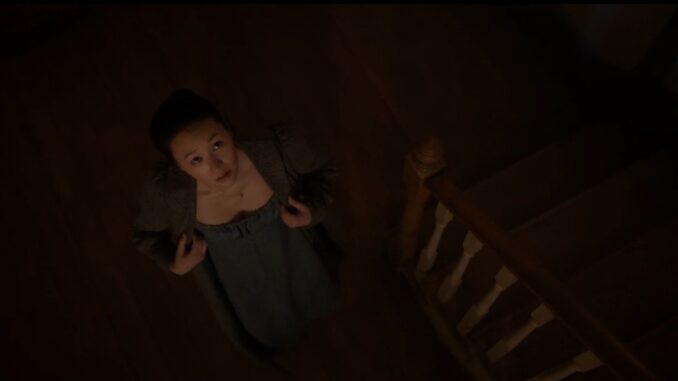
Season four of Bridgerton takes that motif and runs with it, both literally and metaphorically. We see it in the central love story between Benedict Bridgerton (Luke Thompson) and Sophie Baek (Yerin Ha), as well as in the complementary arc known as the “maid wars.” Here, we break down three key scenes from this season that take place in the liminal space between the upper-class world and the workers who serve them: on the staircase.
Benedict and Sophie, episode four
Who could forget the infamous “Be my mistress” cliff-hanger scene that ends part one of the fourth season? Benedict has slowly been falling in love with maid Sophie while still pining for the masked woman he met at his mother’s ball earlier in the season. All the while, the sweet (but slightly clueless) Benedict has not realized that Sophie is his Cinderella from the ball.
Even though Benedict can be unaware at times, he does acknowledge that Sophie’s lineage means they can never truly be together in the way they want. At a party, he sees a friend, Hiscox (Cai Brigden), with the lower-class Virginia (Francesca Lara Gordon), an actress whom Hiscox identifies as his mistress. A light goes off in Benedict’s brain, and he proudly asks Sophie to be his mistress after stealing her away from a night out with the friends she’s made among the Bridgerton downstairs crew. There was a collective scream heard across the globe after he uttered those three words.
This was historically accurate because a man of Benedict’s class could never really be with a maid in polite society. Hannah Greig, Bridgerton’s on-set historian, makes it undoubtedly clear that the Cinderella fantasy in the series was not possible in reality. “It’s never gonna happen,” she says. “Never gonna happen. A servant is never going to move up the ranks to become a lady.” So, the offer was perhaps the best that Benedict could do. However, the symbol of the staircase not only represents the meeting of Benedict’s upstairs world and Sophie’s downstairs one, but the fact that it is the servant’s staircase in the back of Bridgerton House, not the primary staircase in the main parlor, also adds a layer of subterfuge to their clandestine dalliance.
Benedict and Violet, episode five
Contrast this with the scene in episode five that takes place between Benedict and his mother, Lady Violet Bridgerton (Ruth Gemmell), when Violet chastises Benedict for pursuing Sophie, and he retorts by bringing up Violet’s similarly secret relationship with Lord Marcus Anderson (Daniel Francis).
“You’re bedding a man who is not your husband with your children sleeping down the hallway,” he says. “That is none of my business, but nor is mine yours.”
Their conversation is scandalous and has the potential to damage Violet’s reputation, which is perhaps why it occurs on a side staircase that leads to the bedrooms, hinting at its covert subject matter.
It does still take place on one of the main staircases just off from yet another Bridgerton ball, which alludes to the protection the Bridgertons’ social standing affords them, which is clear through Benedict’s pursuit of Sophie (figuratively and literally, as he continues up the staircase after Sophie in this scene) despite his potential ruin.
As Lady Whistledown notes at the beginning of part two, “Be my mistress” are the three most popular words a man can utter to a woman in Mayfair.

Portia and Varley, episode eight
Benedict and Sophie’s star-crossed union is mirrored by the “maid wars” as the ladies of Mayfair vie for the services of the maids. As Sophie realizes she’s worth far more than her standing as a maid and illegitimate daughter who can never hope to be more than a shunned secret, so too do the other maids, namely Mrs. Varley (Lorraine Ashbourne), who says she has had enough of Lady Portia Featherington (Polly Walker) “treating me like family and then working me like a dog and paying me worse than that” in the form of last season’s dresses.
This culminates in a scene in the finale in which Varley has been dismissed from her new job at Sophie’s former familial — we’re using this term loosely — home. Before she leaves for the country for another position, Varley confronts Portia to get an apology.
“You will not be getting an apology from me,” Portia counters from on high on the staircase landing, looking down at Varley in the foyer.
However, Portia ultimately concedes — reigniting their bond over the power of gossip — and descends the staircase to meet Varley at her level, both physically and regarding her employment terms moving forward.
Bonus: Penelope, various episodes and seasons
Perhaps the most furtive character on Bridgerton — at least up until the big reveal of her as the ton’s premier gossipmonger, Lady Whistledown, last season — is Penelope Bridgerton, née Featherington (Nicola Coughlan). She spends her time sequestered away in her lofty room penning the newsletter about her friends and family, which she distributes under the cover of night from another liminal space, a print shop, accessed via a dark alleyway. Her furtiveness is also demonstrated in the way she sneaks into Bridgerton House to see Eloise (Claudia Jessie) in season one.
It’s fitting then that many of Penelope’s most significant moments happen on stairs. Take, for instance, Penelope’s third season out in the marriage mart. Sick of being designated the wallflower, Penelope stuns the ton with an elevated look, lingering at the top of the stairs before she wades through the deluge of newly smitten suitors.
Similarly, when Colin Bridgerton (Luke Newton) not only finds out that Penelope has been hiding her secret identity as Lady Whistledown from him, but that Eloise also knows, their showdown takes place on the stairs of their home. Though Eloise is exalted in this scene, Colin brings her down to his level by insulting her: “I think you should consider yourself uncommonly lucky you have never been in love.” Ouch.
The stairs have always been a place rife with intrigue and gossip as we watch our main characters convene. But they also hold deep significance and capture some of the show’s most impactful moments.