In an exclusive interview with SCREEN, Bridgerton showrunner Jess Brownell spills some beans on the next instalment, reacts to criticism towards Season 3, reveals why she cast Indian actor Banita Sandhu and what she’s learnt from visionary creator Shonda Rhimes.
Jess Brownell has been working at Shondaland for 18 years now. She served as the showrunner of Bridgerton Season 3 and the upcoming Season 4, and even relocated from the US to London for that. In an exclusive interview with SCREEN, she spills some beans on the next instalment, reacts to criticism towards Season 3, and reveals what she’s learnt from visionary creator Shonda Rhimes.
Bridgerton Season 4 is going into the Downton Abbey zone by exploring the dynamics between the elite living upstairs and the working class in the basement. How do you think that’ll shake things up?
It shakes things up in a major way. We’ve always had a presence of the downstairs staff, but haven’t explored their stories in depth. So, this season broadens their world, and adds a level of depth and texture. And class also provides a major obstacle and stakes to the main romance between Benedict (Luke Thompson) and Sophie (Yerin Ha) this season.
Speaking of romance, there was a bit of criticism towards Season 3 that it wasn’t romantic enough. Do you agree with that criticism?
I don’t agree with the criticism. Everyone has a different connection with each season. There are people who really see themselves in the relationship in Season 1, in Anthony (Jonathan Bailey) and Kate (Simone Ashley). And there are people who see themselves in the wish fulfilment of the guy you’ve always had a crush on but has friend-zoned you, finally see you in a romantic way. This season has a different kind of love connection. It’s about forbidden romance. I’m excited for even more people to find alignment with what they consider romantic.
Bridgerton has been known widely for colourblind casting. But as a white woman, you’ve also brought your queer identity to the show in the form of Francesca (Hannah Dodd). How important was that for you?
For me, it has more to do with this being a show where more and more people can see themselves represented. Bridgerton is known, in many ways, for its inclusivity. It felt like queerness was one area where people weren’t given enough opportunity to see themselves represented, especially in leading characters. The fact that I’m queer is a plus, like a sprinkle on top, in the way that I do understand how to write those stories. But it’s not the main driving reason for that choice.

You’ve worked all you career at Shondaland. What have you picked up from creator Shonda Rhimes’ vision that you’ve incorporate into your own?
Shonda has a knack for telling unexpected stories. My training in writing has been rooted in structure in a big way, following the beats of a story. But Shonda challenges me to think out of the box. She pushed me to think about what I’d want to see as a viewer rather than just writing what it feels like should happen. That creates many more talk-worthy moments that surprise people and make them swoon.
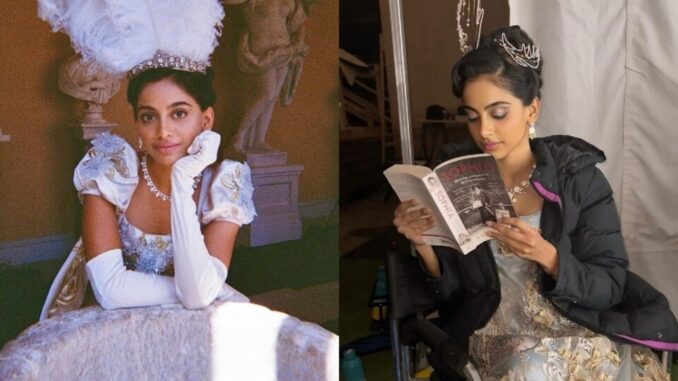
It was a pleasant surprise to see our very own Banita Sandhu as Sita Malhotra in season 3. How did you cast her?
I remember seeing Banita’s tape and her effervescence and glow came off the screen immediately. We were looking for fresh faces for our debutantes and she was someone that captured the screen. She is a wonderful addition to our group of debutantes, and we’re so lucky to have her on the show.
You relocated to London to work on the past two seasons of Bridgerton. Has that helped you to know the fragrance and history of the land that Bridgerton belongs to?
I’ve been in London for four years now. It’s funny because Bridgerton is such a fantasy of London. Our version of London is basically sunny 365 days a year, which is so inaccurate (laughs). And because it’s the 1800s, what’s really inspired the show is going to museums and the countryside, and taking in the architecture from the National Trust sites. But actually living in London would be a whole another show, but probably doesn’t translate to Bridgerton, to be honest.
How do you strike the balance between being loyal to source material and finding something new for the audience to watch?
We try to identify the moments from the book that are the most resonant and would be fan favourites, and then find a way to subtly adapt them to the screen. Because we have an ensemble cast, we have to do a little tweaking to the story to make sure everyone is served. But this season, more than ever, the book really lent itself to adaptation. And fans will recognize a lot of the book on screen this season.
Finally, can you tell us cryptically some fan-favourite moments we can look forward to in Season 4?
Cryptically (laughs)! Well, there are a couple of bodies of water from the book this season. One is played out somewhat faithfully, and we’ve adapted and changed the other one a little bit. I’m excited for people to see those.
Bridgerton Season 4 part 1 will premiere on Netflix on January 29.